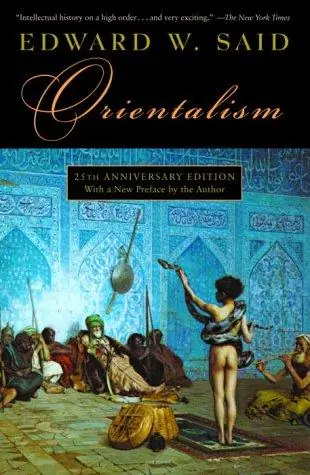
Orientalism
by Edward W. Said · first published 1978
33% recommend62% neutral5% critical
Orientalism is a 1978 book by Edward W. Said, in which the author discusses Orientalism, defined as the West's patronizing representations of "The East"—the societies and peoples who inhabit the places of Asia, North Africa, and the Middle East. According to Said, orientalism (the Western scholarship about the Eastern World) is inextricably tied to the imperialist societies who produced it, which makes much Orientalist work inherently political and servile to power. According to Said, in the Middle East, the social, economic, and cultural practices of the ruling Arab elites indicate they
Affiliate links. As an Amazon Associate I earn from qualifying purchases.
Mentions per year
What Hacker News says
Related books
 2011–2025
Imagined communities
Benedict Anderson
Recommended by 12 · mentioned by 1912 recommend · 19 mention12 recommend · 1912 recommend
 2015–2026
Superforecasting
Philip E. Tetlock, Dan Gardner, Santiago Foz (argentino)
Recommended by 44 · mentioned by 7144 recommend · 71 mention44 recommend · 7144 recommend
 2007–2026
On Writing
Stephen King
Recommended by 94 · mentioned by 13594 recommend · 135 mention94 recommend · 13594 recommend
 2008–2026
Elements
Euclid
Recommended by 60 · mentioned by 22560 recommend · 225 mention60 recommend · 22560 recommend
 2007–2026
The Structure of Scientific Revolutions
Thomas S. Kuhn, Dennis Holland
Recommended by 96 · mentioned by 21596 recommend · 215 mention96 recommend · 21596 recommend
…off. I could reply by pointing out similar behaviour in countries all over the world, it is a common human trait, not something that is somehow peculiar to China. Out of interest, have you ever read "Orientalism" by Edward Said? As this discussion could almost be an example from it.
on “Riot breaks out at Foxconn's Taiyuan plant” ↗As far as a historical look at cultural stereotyping goes, Edward Said's book 'Orientalism' is not a bad starting point. From reading it I became far more aware that the way that a culture is described is usually far more to do with the culture that is doing the describing. edit - A good example…
on “When Those Who Know Won’t Share” ↗It should be noted as well that the concept of the "Eastern" is also Western in origin. A good read about this is Orientalism by Edward Said.
on “Pythagorean Theorem proof in a 2100 year old Chinese book” ↗Short answer: Yes. What is more, your line of thinking is a good one. Edward Said constructed basically this same argument - persuasively, I think - in Orientalism, his book on the history of western writing about the east (https://en.wikipedia.org/wiki/Orientalism_(book)). If you can get a copy, I recommend it strongly: as you can no doubt see, the consequences…
That sounds interesting, I'll add that to my order list. What came to mind for me around this topic, was Edward Said's 'Orientalism'. Is an amazing critique.
on “The history of humans trying to reduce one another to a personality profile” ↗Edward Said's "Orientalism" snapped the toughest parts of Foucault's structuralism into focus for me.
on “Ask HN: Do you recall any book or course that made a topic finally click?” ↗…like to go back and read the rest. It's pretty heavy going though, from memory (translation from French doesn't help.) His ideas are really interesting and influential (at least the ones I can follow.) Orientalism, by Edward Said. This is, from memory, another really dense book but it also has some really illuminating and rewarding sections in it. The best "real" history book that I've read since uni is probably…
on “Google employees on Reddit answers questions.” ↗> Ukrainians now strongly identify with “Europe” and “the West”. Unfortunately, these concepts are haunted by the memories of colonialism and racial segregation. Orientalism, as Edward Said put it memorably, “is never far from… the idea of Europe, a collective notion identifying ‘us’ Europeans against all ‘those’ non-Europeans”. It's farcical to use the Orient as some kind…
on “UN’s Ukraine vote shows the racial subtext of global politics” ↗yeah yeah I've read Edward Said as well. Sure, its Orientalism and Imperialism crystalized into a language idiom. That's how language and culture works. We can find it distasteful all day but there's not much good to come from arguing semantics on the internet.
on “How the Arab World Came Apart” ↗I think he points it out in the article how it is mainly foreigners that are both leading the work, and are interested in Egyptology. I don't know if you have read Edward Said work, Orientalism, but this explains the article. What interests the readers of HN, and the Guardian is the romanticized past rather than the reality of now. But Peter Hessler in a way brings this up. Is Orientalism…
on “A trip to Amarna, the desert city of Akhenaten” ↗I think you’re talking past each other. Parent is referencing Edward Said, but mixing in an Americanism about “taming the frontier” that doesn’t really apply. Said’s talking more about colonialism. > Orientalism is an artistic current from the 18th to the early 20th focused on taking inspiration from the faraway, exotic, attractive Eastern cultures. You’re not wrong, but Said’s work really changed the way that…
on “Demolishing Soviet Modernism” ↗…may argue that the position of minorities under the Ottomans was lenient compared to minority treatment elsewhere in the world, such as in certain parts of Europe. According to Edward Said, abuses of “Orientalism,” which he described as a Western way of “dominating” or “restructuring” the history of the Middle East because of prejudice against Arab-Islamic peoples, has caused a misconstruction of the historical…
on “A librarian and a food historian rediscovered the recipes of Moorish Spain” ↗In the field of Middle Eastern Studies, Edward Said's Orientalism is seminal. It's the bedrock of how the field is taught in undergraduate classes, and as you observed, it's cited in a lot of papers. What you're doing here is like me jumping into a C++ conversation…
on “Content Bias Analysis of the New York Times” ↗I took "orientalist" to be a pejorative in line with Edward Said's Orientalism -- i.e., accusing its target of attitudes shaped by Western imperialism. It's not really correct to use it this way, since "Orientalist" already has the meaning you describe, but I've seen it a handful…
on “Labels used to suppress ideas” ↗…Chinese work can be interpreted as a slice of "what China is like". There's no such thing as immutable "Chinese-ness" that would be inevitably expressed by Chinese authors. To think otherwise is basically Orientalism in the Edward Said meaning [1]. [1] https://en.wikipedia.org/wiki/Orientalism_(book)
on “Liu Cixin, China’s hottest science-fiction writer” ↗