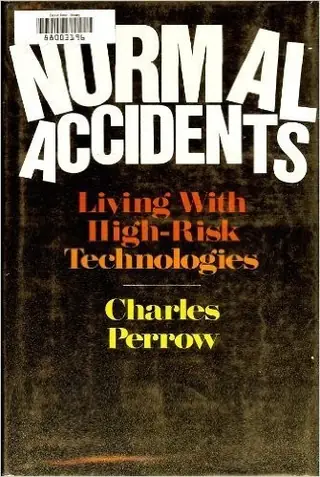
Normal Accidents
Living with High-Risk Technologies
by Charles Perrow · first published 1984
81% recommend17% neutral2% critical
Why HN recommends it
Explains how accidents in tightly coupled, complex systems like nuclear plants, chemical plants, dams and ships rarely have a single cause, using many case studies; suits engineers and anyone studying system safety.
Summarised by Claude from recommending comments
"Normal" accidents, or system accidents, are so-called by Perrow because such accidents are inevitable in extremely complex systems. Given the characteristic of the system involved, multiple failures which interact with each other will occur, despite efforts to avoid them. Perrow said that operator error is a very common problem, many failures relate to organizations rather than technology, and big accidents almost always have very small beginnings. Such events appear trivial to begin with before unpredictably cascading through the system to create a large event with severe consequences. Pe
Affiliate links. As an Amazon Associate I earn from qualifying purchases.
Mentions per year
What Hacker News says
Related books
 2009–2025
The logic of failure
Dietrich Dörner
Recommended by 15 · mentioned by 1715 recommend · 17 mention15 recommend · 1715 recommend
Engineering a safer world
Nancy Leveson
Recommended by 14 · mentioned by 2014 recommend · 20 mention14 recommend · 2014 recommend
 2016–2023
Organizing America
Charles Perrow
Recommended by 1 · mentioned by 21 recommend · 2 mention1 recommend · 21 recommend
 2012–2026
Inviting Disaster
James R. Chiles
Recommended by 4 · mentioned by 44 recommend · 4 mention4 recommend · 44 recommend
 2014–2025
SafeWare
Nancy Leveson
Recommended by 6 · mentioned by 96 recommend · 9 mention6 recommend · 96 recommend
 2009–2026
Sources of Power
Gary Klein
Recommended by 14 · mentioned by 1714 recommend · 17 mention14 recommend · 1714 recommend
 2008–2026
Systemantics
John Gall
Recommended by 45 · mentioned by 7545 recommend · 75 mention45 recommend · 7545 recommend
…shipping culture that most of us never experience. It is described in detail, with laugh-out-loud illustrations of boat paths, in an entire chapter devoted to these kind of accidents, in the excellent book _Normal Accidents_ by Charles Perrow.[1] In short, very, very large ships are captained by egomaniacal captains who play chicken with one another - each of whom is certain that they have the right of way (due to ship…
on “Why Did a U.S. Destroyer Fail to Dodge a Cargo Ship?” ↗For anyone interested in stories like these, I highly recommend "Normal Accidents" by Charles Perrow - there's an entire chapter on maritime accidents.
on “The Worst U.S. Maritime Disaster in Decades” ↗Not root cause analysis. Complex systems fail in complex ways. If you want to read more about how this is done, try Normal Accidents (Perrow), Human Error (Reason)... but you're going to land on Engineering a Safer World (Leveson) eventually. You can get a free copy from the author's web site: http://sunnyday.mit.edu/safer-world/index.html…
on “Amazon cargo plane crashes in Texas” ↗…Further, if our switch dies we can immediately replace it with any other dumb switch that just happens to be lying around. If you read failure studies - like those in the excellent Charles Perrow book _Normal Accidents_[1] - you see that in many cases there is a very special component that fails and everything goes to hell when they can't find a replacement for it. So, while I can't encourage everyone to use dumb,…
on “Interview with CEO of rsync.net: “no firewalls and no routers”” ↗…and dam bursts, the Union Carbide Bhopal, India, disaster. You cannot engineer out human nature. This isn't a root cause for which there are technical solutions. I hugely recommend Charles Perrow's Normal Accidents and The Next Catastrophe. As well as other writings. Note that Rickover also wished we'd never gone to the nuclear option. He defended his choice for lack of options, but would have preferred to see…
on “The Fukushima accident was preventable” ↗…it will be more expensive.[1][2] The standard closure to a comment like this is to refer to Talebs Black Swan and Antifragile books ... which you certainly should read ... but even more important is "Normal Accidents" by Charles Perrow[3] which I hope will convince you to stop looking for complex things that never fail, and instead look for simple things that fail gracefully. [1] ... but we have a HN-Readers discount…
on “Fuck the Cloud (2009)” ↗…expanded on pretty extensively on my own) but the characteristics of human, and not just computer, systems that lead people to do the wrong thing. It also introduced me to the book Customers who viewed Normal Accidents: Living with High-Risk Technologies by Charles Perrow, which is so critical that I think it's the closest thing to necessary reading that anyone working in any technical field should be required to read.…
on “Lack of ethics education for computer programmers shocks expert” ↗If you are interested in this topic, worth reading Charles Perrow's classic work, "Normal Accidents". The book is an analysis of industrial accidents (eg Three Mile Island) and their root causes. His observations suggest that correctly mapping the left side of a bowtie is virtually impossible in tightly…
on “Risk BowTie Method” ↗It's time to dispel the myth that the problems of nuclear are technical in nature and have technical solutions. The book to read in this context is Charles Perrow's Normal Accidents. http://www.ohio.edu/people/piccard/entropy/perrow.html Humans have had roughly 50 years' commercial generating experience with nuclear power. It took 25 years from first criticality to come up with…
on “It's time to dispel the myths about nuclear power” ↗If you liked "How Complex Systems Fail", you may be interested in "Normal Accidents" [1]. It's basically the long-form complete version of the paper you mentioned and packed with interesting examples. [1] http://www.amazon.com/Normal-Accidents-Living-High-Risk-Tech...
on “Thorium nuclear reactor trial begins in Norway” ↗…theoretical data and arguments. The 4:500 rate is what we've achieved, and, belabouring the point, all accidents have had massive sociological elements. I very strongly recommend reading Charles Perrow (Normal Accidents, but also other works). Yes, something's got to control human breeding. Either humans or something other than human. Most likely viral or bacteriological, in my book.
on “Bill Gates Expected to Create Billion-Dollar Fund for Clean Energy (2015)” ↗…drone strikes by aircraft will have negligible returns, that common sense "don't fly near airport runways" is sufficient, and that there is lower hanging fruit that makes more sense to concentrate on. Normal Accidents by Charles Perrow is an excellent book if you are interested in this topic: https://en.wikipedia.org/wiki/Normal_Accidents
on “Drone hits British Airways plane approaching Heathrow Airport” ↗You might find Normal Accidents by Perrow interesting. He describes accidents caused by systems (e.g. nuclear power plants) becoming so complex that they are incomprehensible to humans. "I used to believe that solid components strung…
on “The 'internet of things' is sending us back to the Middle Ages” ↗…many types of accidents where the driver will be killed no matter what car they're driving. Perhaps they'll still have all the body parts attached in the Honda though ;) One of my favorite books is "Normal accidents" by Perrow, where atomic plants are the perfect example of high-risk systems which invite system accidents. Their dedicated chapter is comically horrific. e.g.: "In 1978 a worker changing a light bulb…
on “Prevented mortality from historical and projected nuclear power (2013)” ↗Actually I see issue 1, 2, 4 as more relevant issues on the practicality of nuclear power. But as you want more about human issues, a classic work is Normal Accidents: Living with High-Risk Technologies by Charles Perrow. The book shows that any complex system is likely to fail due to its inherent complexity, and due to the external social organization. Worth reading.…
on “Hinkley Point C nuclear plant to run £2.9bn over budget” ↗