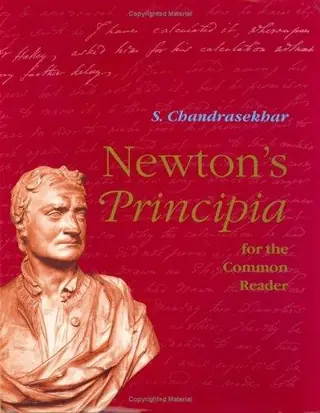
Newton's Principia for the common reader
by Subrahmanyan Chandrasekhar · first published 1995
67% recommend33% neutral
"Representing a decade's work from a distinguished physicist, this is the first comprehensive analysis of Newton's Principia without recourse to secondary sources. Professor Chandrasekhar analyses some 150 propositions which form a direct chain leading to Newton's formulation of his universal law of gravitation. In each case, Newton's proofs are arranged in a linear sequence of equations and arguments, avoiding the need to unravel the necessarily convoluted style of Newton's connected prose. In almost every case, a modern version of the proofs is given to bring into sharp focus the beauty, cla
Affiliate links. As an Amazon Associate I earn from qualifying purchases.
Mentions per year
What Hacker News says
Related books
 2014–2024
A source book in mathematics
David Eugene Smith
Recommended by 2 · mentioned by 32 recommend · 3 mention2 recommend · 32 recommend
 2009–2026
The Annotated Turing
Charles Petzold
Recommended by 56 · mentioned by 7056 recommend · 70 mention56 recommend · 7056 recommend
 2007–2026
Principia mathematica
Alfred North Whitehead, Bertrand Russell
Recommended by 9 · mentioned by 1619 recommend · 161 mention9 recommend · 1619 recommend
 2007–2026
I Am a Strange Loop
Douglas R. Hofstadter
Recommended by 101 · mentioned by 204101 recommend · 204 mention101 recommend · 204101 recommend
 2008–2026
Elements
Euclid
Recommended by 60 · mentioned by 22560 recommend · 225 mention60 recommend · 22560 recommend
 2007–2026
Zen and the Art of Motorcycle Maintenance
Robert M. Pirsig
Recommended by 302 · mentioned by 508302 recommend · 508 mention302 recommend · 508302 recommend
 2007–2026
Gödel, Escher, Bach
Douglas R. Hofstadter
Recommended by 505 · mentioned by 1,055505 recommend · 1,055 mention505 recommend · 1,055505 recommend
…explain the main ideas to the Student. So what Books can HN folks recommend that fall into this category? A few examples from my collection; 1) A Source Book in Mathematics by David Eugene Smith. 2) Newton's Principia for the Common Reader by S. Chandrasekhar. 3) The Annotated Turing: A Guided Tour Through Alan Turing's Historic Paper On Computability And The Turing Machine by Charles Petzold. 4) Maxwell on the Electromagnetic Field:…
on “Ask HN: Books on Maths/Physics/etc. explaining the Original Discoveries?” ↗People interested in studying the Principia might find the following useful: Newton's Principia for the Common Reader by S. Chandrashekhar (nobel prize winning astrophysicist)
on “Ian Stewart's top popular mathematics books (2012)” ↗…: The Black Swan by Nicholas Nassim Taleb The Drunkards Walk by Leonard Mlodinow Math/science history : Euclid's Window by Leonard Mlodinow A Short History of Nearly Everything by Bill Bryson Physics: Newton's Principia for the Common Reader by S. Chandrasekhar Lit: The Brothers Karamazov by Fyodor Dostoevsky House of Leaves by Mark Z. Danielewski East of Eden by John Steinbeck Philosophy: Zen Mind, Beginner's Mind by Shunryu Suzuki Any…
on “What Gödel Discovered” ↗…explanations so that i can learn from them. Some interesting ones are; 1) A Source Book in Mathematics by David Eugene Smith (Dover Publications) - https://archive.org/details/sourcebookinmath00smit 2) Newton's Principia for the Common Reader by Nobel-prize winning Physicist S.Chandrasekhar - https://archive.org/details/newtonsprincipia0000chan 3) Maxwell on the Electromagnetic Field: A Guided Study (Masterworks of Discovery series) by Thomas…
on “Abel, the Mozart of Mathematics” ↗…guides you through the original paper/book. It is still difficult to understand if you do not have the necessary background but at least you have a good starting point. Some books in my collection; 1) Newton's Principia for the Common Reader by S.Chandrasekhar 2) Maxwell on the Electromagnetic Field: A Guided Study (Masterworks of Discovery) by Thomas Simpson 3) Einstein's Miraculous Year by John Stachel. 4) The Annotated Turing by Charles…
on “Principia Mathematica is modern and insightful” ↗…reading/studying it. Actual conceptual mathematics/science is intrinsically hard even ignoring the archaic language/notations. As a good example; the Nobel-prize winning physicist S.Chandrasekhar wrote Newton's Principia for the Common Reader where he explains a subset of the principia (only dealing with gravitation) using modern notation and language. He himself found it quite hard and thus the "common reader" in the title is somebody who…
on “Principia Mathematica is modern and insightful” ↗Chandrasekhar's "Newton's Principia for the common reader" is a reading of Newton's book in modern mathematical notation and with commentary on the methods Newton was using.
on “Ask HN: Older textbooks/papers you consider classics still worth studying today?” ↗