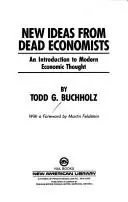
New ideas from dead economists
an introduction to modern economic thought
by Todd G. Buchholz · first published 1989
88% recommend13% neutral
Why HN recommends it
Offers a broad, accessible overview of major economic thinkers and their ideas, pitched at general readers and newcomers to the field, without getting too deep in the weeds.
Summarised by Claude from recommending comments
The classic introduction to economic thought, now updated in time for the publication of New Ideas from Dead CEOsThis entertaining and accessible introduction to the great economic thinkers throughout history Adam Smith, John Stuart Mill, Karl Marx, John Maynard Keynes, and moreshows how their ideas still apply to our modern world. In this revised edition, renowned economist Todd Buchholz offers an insightful and informed perspective on key economic issues in the new millennium: increasing demand for energy, the rise of China, international trade, aging populations, health care, and the effect
Affiliate links. As an Amazon Associate I earn from qualifying purchases.
Mentions per year
What Hacker News says
Related books
 2010–2022
Applied Economics
Thomas Sowell
Recommended by 5 · mentioned by 65 recommend · 6 mention5 recommend · 65 recommend
 2009–2023
Naked Economics
Charles J. Wheelan
Recommended by 15 · mentioned by 1715 recommend · 17 mention15 recommend · 1715 recommend
 2010–2020
How an economy grows and why it crashes
Peter D. Schiff
Recommended by 8 · mentioned by 128 recommend · 12 mention8 recommend · 128 recommend
 2010–2024
The new industrial state
John Kenneth Galbraith
Recommended by 6 · mentioned by 116 recommend · 11 mention6 recommend · 116 recommend
The use of knowledge in society
Friedrich A. von Hayek
Recommended by 16 · mentioned by 3116 recommend · 31 mention16 recommend · 3116 recommend
 2008–2024
Economics
Samuelson
Recommended by 4 · mentioned by 174 recommend · 17 mention4 recommend · 174 recommend
 2008–2024
The worldly philosophers
Robert L. Heilbroner
Recommended by 17 · mentioned by 1817 recommend · 18 mention17 recommend · 1817 recommend
 2008–2025
Hidden Order
David D. Friedman
Recommended by 7 · mentioned by 137 recommend · 13 mention7 recommend · 137 recommend
…and illuminating micro is. Admittedly micro suffers from not having a good theory of oligopoly, but I venture to suggest that that's a bit like the 3-body problem. For philosophical types, I recommend 'New Ideas from Dead Economists' by Todd Buckholz. If you just want to get going with the math, I like the Barrons Business Review book on Economics by Peter Eisen. You should be able to find either of these used for a few bucks.
on “Just how bad are hard drive prices going to get?” ↗Economist here. I disagree that if someone wants a broad introduction that by picking up Samuelson or MWG will be able to figure out the field from first (mathematical) principles. New Ideas from Dead Economists is a fantastic, broad introduction into the philosophy of economics that you appears interested in. Works by Keynes, Smith, Marx, Robinson, Hayek, and Ricardo do a fantastic job laying the groundwork…
on “Ask HN: What are the must-read books about economics/finance?” ↗Bookwise, some places to start for general overviews of economics are: "New Ideas from Dead Economists" by Todd Buchholtz "Naked Economics" by Charles Wheelan Blogwise: http://www.marginalrevolution.com/ is entertaining and filled with good insights from a libertarian point of view. http://economistsview.typepad.com/…
on “Ask HN: Best book(s) to learn about the basics of economics?” ↗The rise and plateau of the Japanese economy is one of the most interesting case studies on macroeconomics I've come across. There's a great review of it in "New Ideas from Dead Economists" [1]. It's fascinating to look into why the "inevitable," didn't come to pass. Likewise with many of the doomsday predictions we see here, the pivots that prevented many from occurring (arguably, fall…
on “1987 Time Capsule Predictions by Sci-Fi Writers About 2012 ” ↗That's correct. Alfred Marshall's theories of utility are the basis of modern economic analysis. Todd Buchholz' New Ideas from Dead Economists has a great introduction to these ideas while being more accessible than the typical econ textbook. http://www.amazon.com/New-Ideas-Dead-Economists-Introduction...
on “The Crisis of the Middle Class and American Power” ↗…digressionary chapter on the price of silver, which is an important contribution to the history of monetary theory but otherwise doesn't really go anywhere. If you want something shorter and punchier, try New Ideas from dead economists by Todd Buckholz, which is a somewhat shallow but still quite engaging tour through the history of economic theory and a good introduction to the basic concepts.
on “Ask PG and HN: What is your recommended reading list for economic history?” ↗For readable bios of the major economic thinkers, I like: New Ideas from Dead Economists: An Introduction to Modern Economic Thought, by Bucholz and Feldstein The Worldly Philosophers: The Lives, Times And Ideas Of The Great Economic Thinkers, by Heilbroner And for a readable sample of…
on “Ask HN: What are the must-read books about economics/finance?” ↗Try New Ideas from Dead Economists by Todd Buckholz, a gentle and non-ideological introduction to a wide variety of theoretical concepts in economics. For personal money management, ignore macroeconomics but develop some capability at…
on “Ask HN: Reliable/Reputable sources on personal financial literacy and economics” ↗…know the number but they have to be in the hundreds. To get a bit of background here's a book that's fun to read. It doesn't get too deep in the weeds. It gives you just enough info to be dangerous. "New Ideas from Dead Economists by Todd G. Buchholz" Also, "The Ascent of Money - Financial History of the World by Niall Ferguson" is a great read as away to get some historical background on how our financial system came to be.…
on “Ask HN: Recommendations for an in-depth book/video series about economics” ↗I read the book "New Ideas from Dead Economists" when I was in college. It's a great read. One of the recurring themes is how economists seem to always predict gloom and doom.
on “America's Jobless Future?” ↗…which to assess a complex problem. An excellent introduction to the field that has the merit of being intellectually neutral and exploring ideas from both left and right perspectives is Todd Buckholz's New Ideas From Dead Economists. IIRC it has a pretty good bibliography too, if not it'll still give you a decent overview of the field.
on “Trump’s F.C.C. Pick Quickly Targets Net Neutrality Rules” ↗"New Ideas from Dead Economists" by Todf Buckholz is an accessible but informative overview of the field, and free of ideology.
on “Ask HN: Best Books on Economics” ↗…though? For sure. If demand outstrips supply, some competitors will have to exit the market. A good micro textbook will go through all of this, or if you prefer a conceptual approach try Todd Buckholz' New ideas from dead economists.
on “Entrepreneurship for the 99%” ↗Grab an economics book and get familiar with the concept of marginal utility. A gentle introduction might be Todd Buckholz' 'New Ideas from Dead Economists.'
on “Novelist warns against utilitarian trends in higher education” ↗…remember reading in a PJ O'Rourke book about Comparative Advantage - I've found the section, as the 'non-trivial and non-obvious' sleight stuck with me, even decades later: > Todd G. Buchholz, in his book New Ideas from Dead Economists, says, “An insolent natural scientist once asked a famous economist to name one economic rule that isn’t either obvious or unimportant.” The reply was “Ricardo’s Law of Comparative Advantage.” >…
on “Mercantilism” ↗