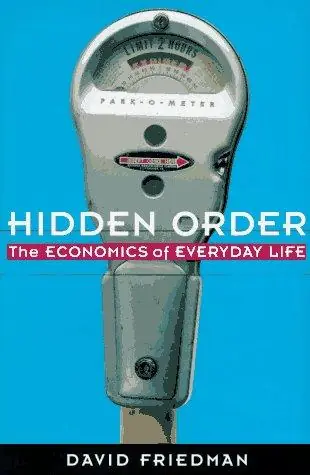
Hidden Order
by David D. Friedman · first published 1996
54% recommend38% neutral8% critical
Why HN recommends it
Readable introduction to price theory and economic reasoning in everyday life, drawn from the author's textbook; praised for clear, idiosyncratic explanations and concrete free-trade arguments, suiting non-economists.
Summarised by Claude from recommending comments
Friedman covers "everything you need to know about economics to get through life without being eaten alive."
Affiliate links. As an Amazon Associate I earn from qualifying purchases.
Mentions per year
What Hacker News says
Related books
 2010–2016
On the Wealth of Nations
P. J. O'Rourke
Recommended by 2 · mentioned by 82 recommend · 8 mention2 recommend · 82 recommend
 2016–2026
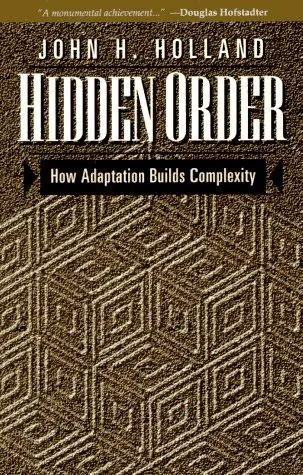
Hidden Order
John H. Holland
Recommended by 2 · mentioned by 22 recommend · 2 mention2 recommend · 22 recommend
 2008–2022
Thinking Strategically
Avinash K. Dixit, Barry J. Nalebuff
Recommended by 9 · mentioned by 119 recommend · 11 mention9 recommend · 119 recommend
 2009–2025
Man, economy, and state
Murray N. Rothbard
Recommended by 8 · mentioned by 138 recommend · 13 mention8 recommend · 138 recommend
 2010–2025
New ideas from dead economists
Todd G. Buchholz
Recommended by 7 · mentioned by 87 recommend · 8 mention7 recommend · 87 recommend
 2008–2024
The worldly philosophers
Robert L. Heilbroner
Recommended by 17 · mentioned by 1817 recommend · 18 mention17 recommend · 1817 recommend
 2008–2024
Economics
Samuelson
Recommended by 4 · mentioned by 174 recommend · 17 mention4 recommend · 174 recommend
 2008–2026
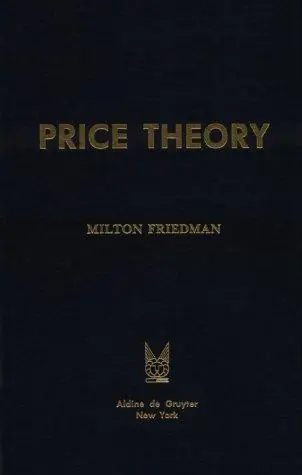
Price theory
Milton Friedman
Recommended by 6 · mentioned by 86 recommend · 8 mention6 recommend · 86 recommend
…firmer ground, in large part because they have more data and it's easier to accumulate it. If you want a very readable introduction to price theory, which is a large part of microeconomics check out "Hidden Order" by David D. Friedman. It's based on his Price Theory textbook but rewritten for interest and readability. If you want something a bit more mathematically sophisticated, (basic calculus) look at Intermediate…
on “Professors Make More Than a Thousand Dollars an Hour Peddling Mega-Mergers” ↗"Basic Economics" by Thomas Sowell is the easiest to read, accurate introduction I have read. "Hidden Order: The Economics of Everyday Life" by David Friedman requires a little more work. Several previous commentors have recommended Hayek's "Road to Freedom", but I think his last book, "The Fatal Conceit"…
on “Ask HN: Getting a grip on economics” ↗Sowell's Basic Economics is the easiest to read one I have seen, and for the math phobic it has no equations. Another really good, if idiosyncratic, book is David Friedman's Hidden Order: The Economics of Everyday Life. Also Thomas Sowell's Knowledge and Decisions covers roughly the same ground as Hayek's Use of Knowledge in Society, but is newer and more readable.
on “Ask HN: Best book(s) to learn about the basics of economics?” ↗For a readable introduction, I don't know of any better than Thomas Sowell's Basic Economics or David Friedman's Hidden Order: The Economics of Everyday Life (David Friedman's textbook Price Theory: An Intermediate Text is almost as readable and is here: http://www.daviddfriedman.com/Academic/Price_Theory/PThy_ToC... )
on “Just how bad are hard drive prices going to get?” ↗…attest they are all excellent (although with varying degree of readability). This is the exact sort of list if you want to see multiple perspectives and challenge yourself. I also want to shout out to Hidden Order, which I was really surprised to see here, but is really quite the gem. More than any other econ book, I have pulled off the shelf and gone through the much dog-eared pages. It does an amazing job of…
on “Books to Understand Economics” ↗…background in economics" Interesting. I recently came to the same conclusion (for myself anyways) - my thinking became a lot bigger after reading (addmittedly pop-)economics books like Freakonomics, Hidden Order (the better of the two IMHO), etc. It's not perfect, but I have yet to see a better explanation than the utility-maximizing principle (I made up that name but you get the idea). The key is to remember…
on “Marvin Minsky: What makes Mathematics hard to learn?” ↗…Algorithms, John Holland. Read about him here: http://en.wikipedia.org/wiki/John_Henry_Holland In my opinion, this is his most accessible book (for the topic that is) about GA's: http://www.amazon.com/Hidden-Order-Adaptation-Builds-Complex... Professor Holland is sharp as hell, insistent about expanding interdisciplinary studies, and a very nice guy.
on “Genetic Algorithm building a little car” ↗John Holland, "Hidden Order". Really. What is money? A message bus in a complex adaptive system. Lots of other stuff out there on complexity but this has a unique perspective. If you really want to go crazy find "Signs of Life,…
on “Ask HN: Book Recommendations?” ↗And an economics book that actually made sense to me: Hidden Order. I liked his way of defending free trade. „In America there are two ways to make cars. We build them and we grow them. The people in Detroit use steel and build them. And the people in Iowa put corn…
on “Legal Systems Very Different from Ours” ↗The way I think about this comes from reading John Holland's "Hidden Order". If you read that book not as a book but as a way to build a Complex Adaptive System, then it comes down to a few essentials. An environment, a bunch of entities, a read/write messaging bus so the entities…
on “The baffling intelligence of a single cell: The story of E. coli chemotaxis” ↗…anarcho-capitalist, so of course markets are the solution. For marriage, fire brigades, national defence, everything. But don‘t write him off so hastily. He has genuinely interesting articles [1], and his text book „Hidden Order: The Economics of Everyday Life“ is a more rigourous version of Freakonomics, the Landsburg books etc. This book explained to me the little economic theory I know. [1] http://www.daviddfriedman.com/Academic/Course_Pages/legal_sy...
on “The Marriage Market” ↗https://www.amazon.com/Hidden-Order-Economics-Everyday-Life/... I agree that the book upthread presents weak arguments. I didn't like it even though I sympathize with much "libertarian nonsense".
on “Ask HN: What's one book that changed your life?” ↗It turns out that Hidden Order is hard to google because of a spy thriller by the same name, so here's an Amazon link to the econ book: https://www.amazon.com/Hidden-Order-Economics-Everyday-Life/...
on “Books to Understand Economics” ↗…it more formally: Economics is that way of understanding behavior that starts from the assumption that individuals have objectives and tend to choose the correct way to achieve them." Excerpt from Hidden Order, a book which explains economic concepts to non-economists.
on “Nobody Really Knows How the Economy Works. A Fed Paper Is the Latest Sign” ↗…The Machinery of Freedom, he has authored several other books and articles, including Price Theory: An Intermediate Text (1986), Law's Order: What Economics Has to Do with Law and Why It Matters (2000), Hidden Order: The Economics of Everyday Life (1996), and Future Imperfect (2008).[3] Trump's ambassador to Israel https://en.wikipedia.org/wiki/David_M._Friedman David Melech Friedman is an American bankruptcy…
on “The Economics of Status (2006)” ↗