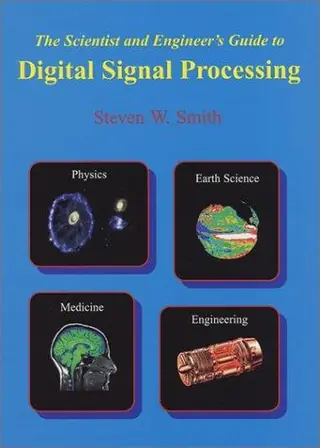
The scientist and engineer's guide to digital signal processing
by Steven W. Smith · first published 1997
94% recommend4% neutral2% critical
Why HN recommends it
Free online DSP text with clear, readable explanations that don't demand heavy math; useful for beginners, hobbyists (including music applications), and engineers wanting intuition for transforms, filters, and the FFT.
Summarised by Claude from recommending comments
Affiliate links. As an Amazon Associate I earn from qualifying purchases.
Mentions per year
What Hacker News says
Related books
 2013–2022
Digital signal processing
Steven W. Smith
Recommended by 2 · mentioned by 22 recommend · 2 mention2 recommend · 22 recommend
 2012–2025
Understanding digital signal processing
Richard G. Lyons
Recommended by 11 · mentioned by 1411 recommend · 14 mention11 recommend · 1411 recommend
The audio programming book
Richard Charles Boulanger
Recommended by 4 · mentioned by 94 recommend · 9 mention4 recommend · 94 recommend
Think DSP
Allen B. Downey
Recommended by 5 · mentioned by 95 recommend · 9 mention5 recommend · 95 recommend
 2008–2022
Musimathics
Gareth Loy
Recommended by 14 · mentioned by 1514 recommend · 15 mention14 recommend · 1514 recommend
 2010–2025
Who is Fourier?
Transnational College of Lex
Recommended by 15 · mentioned by 1615 recommend · 16 mention15 recommend · 1615 recommend
 2009–2026
Practical Electronics for Inventors
Paul Scherz
Recommended by 51 · mentioned by 6451 recommend · 64 mention51 recommend · 6451 recommend
 2009–2026
Unix Network Programming
W. Richard Stevens, Bill Fenner, Andrew M. Rudoff, Richard W. Stevens
Recommended by 54 · mentioned by 6954 recommend · 69 mention54 recommend · 6954 recommend
+1 for the recommendation for "The Scientist and Engineer's Guide to Digital Signal Processing" by Steven W. Smith. I spoke to Steven many years ago about his putting all of the book PDFs online for free and since then have recommended at least 5 university libraries to buy it because the students…
on “Sound” ↗I think this task is lot more about DSP, and very little ML, just Bayes classification (I will write on it later). Best book I know on DSP: The Scientist and Engineer's Guide to Digital Signal Processing By Steven W. Smith, Ph.D.
on “Ask HN: Best method to classify short audio events in real time?” ↗Halliday and Resnick, 60’s version. Feynman’s Lectures. Thomas’s Calculus books. The Scientist and Engineer's Guide to Digital Signal Processing Steven W. Smith, Ph.D. (Has always been available free. So good, I bought a hardcover one.)
on “Ask HN: What, in your opinion, are the greatest and most useful textbooks?” ↗As someone who is pure CS who hated EE, I now work in an EE shop as the only programmer performing most of the PC based DSP work, and the only thing I would recommend is this, http://www.dspguide.com/pdfbook.htm.
on “Signal Processing for Everyone (2000) [pdf]” ↗This was a reasonable explanation of the Fourier Transform, but sadly, not the Fast Fourier Transform. To me the easy part has always been understanding that many sines(and cosines) of different frequencies can make up pretty much any periodic signal and that time and frequency domains map back and forth without losing information. What I still do not fully understand is how exactly FFT algorith
on “Mastering The Fourier Transform in One Day” ↗There's also "Scientist and Engineer's Guide to Digital Signal Processing" which free too and is pretty #swag as well http://www.dspguide.com
on “Introduction to Signal Processing” ↗I haven’t finished this yet (only at the start of chapter 6) but The Scientist and Engineer’s Guide to Digital Signal Processing [0] has been excellent so far. DSP is one of the subjects I’ve wanted to learn for years but could never get my head around, mostly (I think) due to bad instructors and very math-heavy explanations. This book is finally demystifying it for me, with explanations that go f
on “Ask HN: What's the best book you read in 2021?” ↗I’ve wanted to learn more about DSP for a while and recently started working through The Scientist and Engineer’s Guide to DSP [0] and it’s been fantastic. It’s much heavier on explanations and lighter on math equations than other books or courses I’d seen previously. It’s helping me build some real intuition around this stuff. That book plus this article’s excellent explanations really helped th
on “How Audio Fingerprinting Works” ↗The book is amazing: http://www.dspguide.com/ (link for the lazy)
on “Sound” ↗Quite an interesting read. Another resource I used when I tried to delve into transforms and DSP was "The Scientist and Engineer's Guide to Digital Signal Processing" (the whole book is available for free at http://www.dspguide.com/). This was quite helpful, even for me with a linguistics background.
on “Mastering The Fourier Transform in One Day” ↗I can't say about programming DSP processors but for learning DSP concepts, I wholeheartedly recommend this: http://www.dspguide.com/
on “FPGA Programming: Where to Begin? (2012)” ↗I'm just a hobbyist, but here's some resources that have helped me. My interests are specifically for musical applications, so that might affect some things. "The Scientist and Engineer's Guide to Digital Signal Processing" is free online. This has been my most used text so far. [0] Introduction To Digital Filters [1]. Another book free online. I haven't dug very deep into this one yet, but sele
on “Faust – A language for audio applications and plugins” ↗The Scientist and Engineer's Guide to Digital Signal Processing By Steven W. Smith, Ph.D. http://www.dspguide.com/ http://www.dspguide.com/pdfbook.htm
on “Ask HN: What single book is the best intro to your field for laypeople?” ↗If anyone's interested in learning more, the clearest explanation I have ever seen of convolutions is here: http://www.dspguide.com/ch6.htm Pedagogically speaking, that book is one of the best technical books I have ever read.
on “Understanding Convolutions (2014)” ↗The best DSP intro I've found, especially for the non-math whiz is Steven W. Smith's DSP Guide: http://www.dspguide.com/pdfbook.htm
on “Signal processing is key to embedded machine learning” ↗