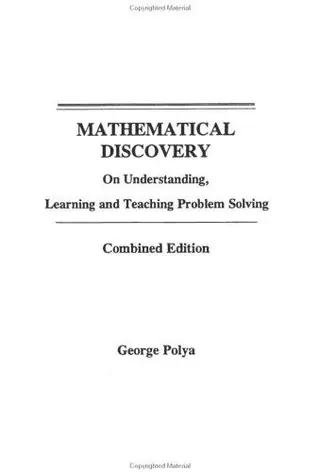
Mathematical discovery
by George Pólya · first published 1962
50% recommend50% neutral
Affiliate links. As an Amazon Associate I earn from qualifying purchases.
Mentions per year
What Hacker News says
Related books
 2008–2024
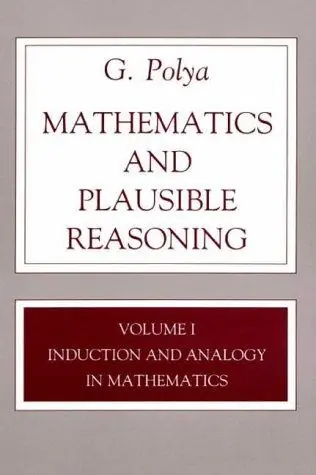
Mathematics and plausible reasoning
George Pólya
Recommended by 10 · mentioned by 1310 recommend · 13 mention10 recommend · 1310 recommend
 2013–2026
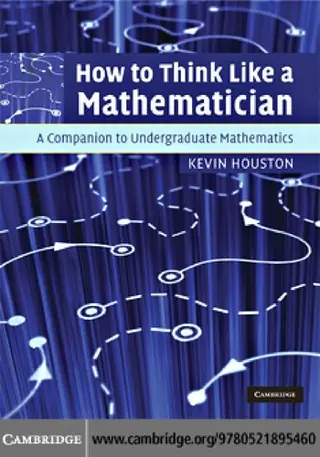
How to think like a mathematician
Kevin Houston
Recommended by 8 · mentioned by 108 recommend · 10 mention8 recommend · 108 recommend
Burn math class
Jason Wilkes
Recommended by 9 · mentioned by 139 recommend · 13 mention9 recommend · 139 recommend
 2008–2026
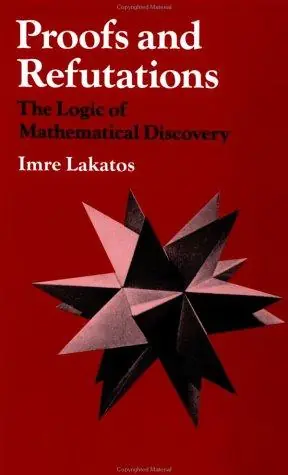
Proofs and refutations
Imre Lakatos, John Worrall, Elie Zahar
Recommended by 34 · mentioned by 4534 recommend · 45 mention34 recommend · 4534 recommend
 2012–2026
The Joy of X
Steven H. Strogatz
Recommended by 15 · mentioned by 2015 recommend · 20 mention15 recommend · 2015 recommend
 2012–2025
Measurement
Paul Lockhart
Recommended by 23 · mentioned by 3023 recommend · 30 mention23 recommend · 3023 recommend
 2007–2026
How to prove it
Daniel J. Velleman
Recommended by 78 · mentioned by 10478 recommend · 104 mention78 recommend · 10478 recommend
 2009–2026
Conceptual Mathematics
F. William Lawvere, Stephen Hoel Schanuel
Recommended by 36 · mentioned by 4436 recommend · 44 mention36 recommend · 4436 recommend
…their existing methods. Even advanced undergraduate math students who read it aren’t going to fully understand the book IMO; I would recommend Pólya’s other books (Mathematics and Plausible Reasoning, Mathematical Discovery), or maybe start with a gentler book like Mason, Burton, & Stacey, Mathematical Thinking.
on “Book: Mathematics for Machine Learning” ↗…a first step in my opinion is to think about problem solving per se. E.g. see: Mason, Burton, & Stacey, Thinking Mathematically Pólya, How to Solve It; Mathematics and Plausible Reasoning (2 vols); Mathematical Discovery (2 vols) Schoenfeld, Mathematical Problem Solving Larson, Problem-Solving Through Problems
on “How to Study Mathematics (2017)” ↗…dictionary–style with short sections on particular named problem solving topics, and is somewhat hard to interpret for novices without guidance, let me recommend Polya’s other two books (each 2 volumes), Mathematical Discovery and Mathematics and Plausible Reasoning.
on “Ask HN: Recommend a maths book for a teenager?” ↗Read 'Proofs and Refutations, The Logic of Mathematical Discovery' by Imre Lakatos. That may provide a good answer to your question.
on “The Man Who Knew Infinity: A Life of the Genius Ramanujan [pdf]” ↗…introduction with Pascal's triangle and some of Polya' legendary problem solving insights (paraphrased from my memory: "you are on to something once you find a pattern") are definitely highlights in this book. Mathematical Discovery: On Understanding, Learning and Teaching Problem Solving by George Polya. Based on the previous book and my fond memories of reading "How to Solve it", I got this one from the library. Again I can't attest…
on “Ask HN: Best books you read in 2012” ↗…student group in the lead-up to the 1956 Hungarian Revolution. > ... He received a PhD in philosophy in 1961 from the University of Cambridge; his doctoral thesis was entitled Essays in the Logic of Mathematical Discovery, and his doctoral advisor was R. B. Braithwaite. The book Proofs and Refutations: The Logic of Mathematical Discovery, published after his death, is based on this work.
on “How to think in writing” ↗