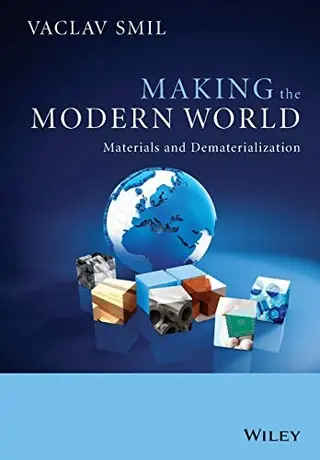
Making the Modern World
by Vaclav Smil · first published 2013
15mentions
2recommended by
4HN commenters
2015–2024first – last mentioned
50% recommend50% neutral
Affiliate links. As an Amazon Associate I earn from qualifying purchases.
Mentions per year
What Hacker News says
Related books
 2017–2026
Energy and Civilization
Vaclav Smil
Recommended by 23 · mentioned by 3223 recommend · 32 mention23 recommend · 3223 recommend
 2010–2026
The collapse of complex societies
Joseph A. Tainter
Recommended by 34 · mentioned by 6134 recommend · 61 mention34 recommend · 6134 recommend
 2012–2026
Why Nations Fail
Daron Acemoglu, James A. Robinson
Recommended by 74 · mentioned by 11774 recommend · 117 mention74 recommend · 11774 recommend
…unprecedented since the introduction of Bessemer process furnaces in the 1860s. Vaclav Smil writes on many energy and resource topics, and covers steel from both perspectives in his Energy and Civilization and Making the Modern World books. I'd strongly recommend both. What I'm finding odd with the article is that Bloomberg appear to be principally citing themselves as sources. I'm reviewing literature and there appears to be scientific…
on “Hydrogen Could Replace Coke in Steel Production” ↗I'd very much recommend the writings of Vaclav Smil who's been exploring numerous parameters of this issue for years. His Energy Realities, Energy Myths, and Making the Modern World all answer your question in large part. But briefly: 1. Vast amounts of coal, oil, and gas. We're using in one year the legacy of about 5 million years of accumulation of fossil fuels. We've managed…
on “The Real Population Problem (2013)” ↗…to handle heavily loaded coal cars without splitting, also dependant on coked coal fuel), in the 1880s. For further references, see Vaclav Smil (Energy in World History, Energy and Civilization, also Making the modern world : materials and dematerialization, on material use), Manfred Weissenbacher (Sources of Power), and Gregory Clark (A Farewell to Alms). Regards copper ores: as of the 18th century, English copper mines…
on “Studying the demise of historic civilisations” ↗…polymers were invented (polystyrene, polyester, PVC, Nylon, etc.). Earlier, ~1840s-1890s rayon and celluloid (from plant fibres) and bakelite (coal tar). Vaclav Smil has an excellent book on materials, Making the Modern World, which looks at sourcing and usage (https://www.worldcat.org/title/making-the-modern-world/oclc/...). Strongly recommended. You can look at what materials were used before plastics were available.…
on “Reycling Plastic from the Inside Out” ↗…of terrestrial (vs. marine) zones, and activities at one point on a river will have major impacts downstream and even offshore.[2] Another excellent reference on physical resource use is Vaclav Smil's Making the Modern World https://www.worldcat.org/title/making-the-modern-world/oclc/... ________________________________ Notes: 1. Which suggests strongly that frictions may be the most effective antimonopoly measures, and…
on “Time is running out for sand” ↗Quite honestly, this is as good as any. I'd read the earlier version (Energy and History) previously. His materials book, Making the Modern World, is also an eye-opener. He covers energy transitions, fertilisers, China, and much else. Oh, and apparently just published: https://www.worldcat.org/title/growth-from-microorganisms-to...
on “Kardashev Scale” ↗…virtually fully electrically-based, and steel recycling (which doesn't require coal) can and does run in electric arc furnaces. Vaclav Smil's books on energy, Energy and Civilisation, and materials, Making the Modern World, are very strongly recommended.
on “Civilizational Collapse, Part 4” ↗…Current iron ore extraction is on the order of about 2.5 billion tons/year. That's roughly 1/3 ton per person on Earth. https://www.visualcapitalist.com/all-the-worlds-metals-and-m... Vaclav Smil's Making the Modern World goes into depth on material use in contemporary civilisation: https://www.worldcat.org/title/making-the-modern-world-mater... (After water and oil, sand and gravel are our most-used material, then concrete…
on “Does Oil Come from Dinosaurs?” ↗Smil's books (no final 'e' BTW) are excellent. His Energy and Civilization (and the earlier (Energy in World History), demonstrate the phenomenal role of energy in bringing about modernity. Making the modern world : materials and dematerialization looks at the material side. https://www.worldcat.org/search?q=au%3Asmil%2C+vaclav
on “People are realizing that degrowth is bad” ↗…It really is difficult to convey the volumes of resources humans use on an annual basis. Vaclav Smil's books on the topics of energy and material resource uilisation are highly recommended, especially Making the Modern World: https://www.worldcat.org/title/making-the-modern-world-mater...
on “We need to take CO2 out of the sky” ↗In this vein I would also recommend: "Making the Modern World: Materials and Dematerialization" (2014) by Vackav Smil. In this work, Smil explores how these materials have shaped industrial civilization and examines trends in material use, efficiency, and potential…
on “Ask HN: What is the best thing you read in 2024?” ↗…down). There's a wonderful paper exploring this, Jeffrey S. Dukes, "Burning Buried Sunshine" (2003), availble at stanford.edu, highly recommended. Vaclav Smil also gets into this dynamic, I in his book Making the Modern World, in which he excludes from consideration food and fuel as materials of the modern world (along with air and water): Exclusion of food and fuel is justified not only because these two large consumption…
on “The Great Productivity Puzzle” ↗…electricity halves, will you start using twice as much electricity? Possibly since not all my cars are electric yet. You can also see this happening for other resources https://www.gatesnotes.com/Books/Making-the-Modern-World
on “Truckers Working Alongside Coders Trying to Make Driverless Trucks” ↗…change, over fishing, or water shortages. Moreover, if you've read one of Bill Gates' more recent blog posts; gaining efficiencies doesn't lessen demand for resources. http://www.gatesnotes.com/Books/Making-the-Modern-World > Also, at what point will you be satisfied? Ideally, with humanity extinct, Please re-read the post that I replied to. I was just merely giving an answer to a question: "Why is a smaller population…
on “Japan records lowest number of births on record as population shrinks” ↗I have yet to read Making the Modern World: Materials and Dematerialization however I paired his "How the world really works" with Material World. That was an excellent read in itself.
on “Ask HN: What is the best thing you read in 2024?” ↗