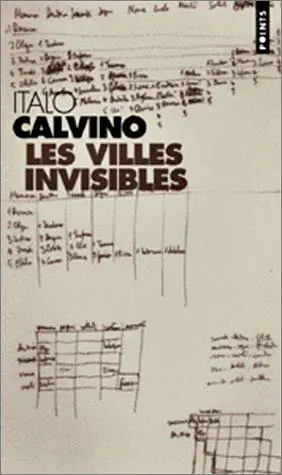
Le città invisibili
by Italo Calvino, William Weaver 1923 · first published 1972
100% recommend
"Kublai Khan does not necessarily believe everything Marco Polo says when he describes the cities visited on his expeditions, but the emperor of the Tartars does continue listening to the young Venetian with greater attention and curiosity than he shows any other messenger or explorer of his." So begins Italo Calvino's compilation of fragmentary urban images. As Marco tells the khan about Armilla, which "has nothing that makes it seem a city, except the water pipes that rise vertically where the houses should be and spread out horizontally where the floors should be," the spider-web city of Oc
Affiliate links. As an Amazon Associate I earn from qualifying purchases.
Mentions per year
What Hacker News says
Related books
Invisible Cities
Italo Calvino
Recommended by 33 · mentioned by 5733 recommend · 57 mention33 recommend · 5733 recommend
 2007–2026
The Man Who Mistook His Wife for a Hat
Oliver Sacks
Recommended by 61 · mentioned by 7761 recommend · 77 mention61 recommend · 7761 recommend
 2008–2026
Finite and infinite games
James P. Carse, James Carse
Recommended by 58 · mentioned by 7858 recommend · 78 mention58 recommend · 7858 recommend
 2007–2026
Fooled by randomness
Nassim Nicholas Taleb
Recommended by 195 · mentioned by 307195 recommend · 307 mention195 recommend · 307195 recommend
 2007–2026
Don't Make Me Think
Steve Krug
Recommended by 237 · mentioned by 339237 recommend · 339 mention237 recommend · 339237 recommend
 2007–2026
Influence
Robert B. Cialdini
Recommended by 214 · mentioned by 303214 recommend · 303 mention214 recommend · 303214 recommend
 2007–2026
The Selfish Gene
Richard Dawkins
Recommended by 220 · mentioned by 431220 recommend · 431 mention220 recommend · 431220 recommend
 2007–2026
The Black Swan
Nassim Nicholas Taleb, David Chandler
Recommended by 263 · mentioned by 666263 recommend · 666 mention263 recommend · 666263 recommend
Since someone’s done Hofstadter — Italo Calvino Le Città Invisibili or Invisible Cities. It’s a novel about complexity and civilisation and the difficulty and intangibility of memories, history and storytelling. It’s told in a series of 55 miniatures, each about a city that reveals some aspect of human experience. It’s like nothing else and utterly brilliant.
on “Ask HN: What is one book you would recommend everyone to read?” ↗Gödel, Escher, Bach is an artistic appetizer over the stimulating world of structures, - not a manual. They young mind is opened by being shown relations it did not yet see. Read the extreme in that direction: Italo Calvino - Le città invisibili (which not only masterfully connects ideas, but most of the realm of existence and experience) - you should be able to see that principle at its apex.
on “Ask HN: Which book can attract anyone towards your field of study?” ↗I submit this article as this public may be interested in the proposed «brainteaser[s]», and as of course Italo Calvino's Le città invisibili (in the list) we consider pretty much mandated for proper intellectual development - but I got intrigued, especially relevant to this public, by the summary of Elizabeth Tan's Rubik: > One night, Elena Rubik ... gets hit by a car and dies. Even in death,
on “Six Books That Feel Like Puzzles” ↗Very great initiative. I would add the year of composition in the list: 'Oct 10, Tacciono i boschi e i fiumi (1591), by Torquato Tasso' The voice is quite good. How will we submit requests? Today (15 Oct 2023) is the centenary of the birth of Italo Calvino. You could have added "Le città e la memoria 1. [Diomira]", the proper opening, from "Le città invisibili". > Partendosi di là e andando t