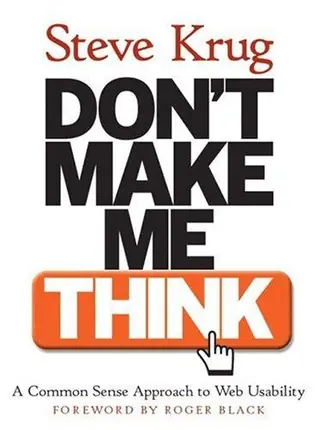
Don't Make Me Think
by Steve Krug · first published 2000
70% recommend26% neutral5% critical
Why HN recommends it
Short, digestible introduction to web usability and how people actually scan interfaces, with a focus on user testing. Suits developers, founders and non-designers who want a practical foundation in UX.
Summarised by Claude from recommending comments
Yesterday's Web looked far different from today's Web, and tomorrow's Web will look more different still. Amidst all of this change, however, one aspect of Web use remains the same: The sites that offer the best, easiest, most intuitive experience are the ones people visit again and again. To ensure that your sites provide that experience, this guide from usability guru Krug distills his years of on-the-job experience into a practical primer on the do's and don'ts of good Web design. The second edition of this classic adds three new chapters that explain why people really leave Web sites, how
Affiliate links. As an Amazon Associate I earn from qualifying purchases.
Mentions per year
What Hacker News says
Related books
 2007–2026
Dont Make Me Think
Steve Krug
Recommended by 38 · mentioned by 4338 recommend · 43 mention38 recommend · 4338 recommend
 2007–2023
The Non-Designer's Design Book
Robin Williams
Recommended by 75 · mentioned by 8375 recommend · 83 mention75 recommend · 8375 recommend
 2007–2023
Defensive Design for the Web
Jason Fried
Recommended by 4 · mentioned by 44 recommend · 4 mention4 recommend · 44 recommend
 2009–2026
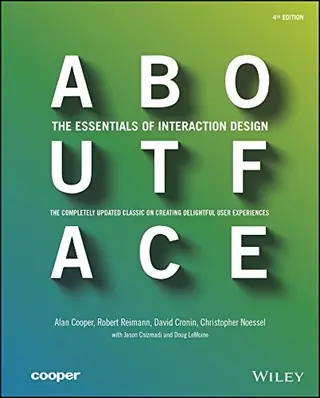
About Face
Alan Cooper, Robert Reimann, David Cronin, Christopher Noessel
Recommended by 23 · mentioned by 3323 recommend · 33 mention23 recommend · 3323 recommend
 2007–2024
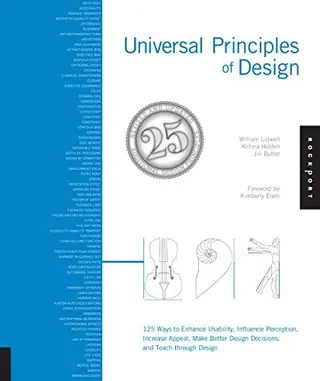
Universal principles of design
William Lidwell
Recommended by 24 · mentioned by 3624 recommend · 36 mention24 recommend · 3624 recommend
 2007–2023
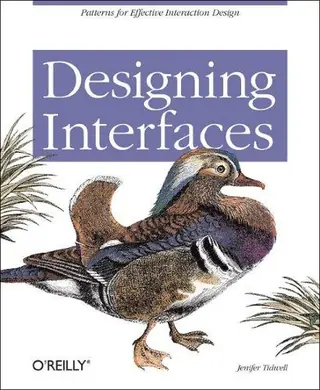
Designing interfaces
Jenifer Tidwell
Recommended by 9 · mentioned by 129 recommend · 12 mention9 recommend · 129 recommend
 2007–2026
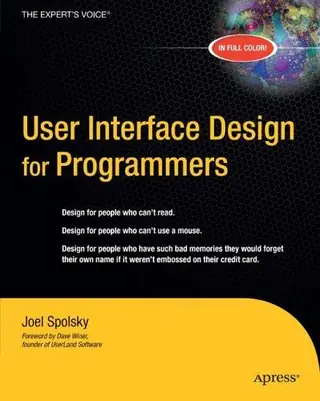
User Interface Design for Programmers
Joel Spolsky
Recommended by 18 · mentioned by 2318 recommend · 23 mention18 recommend · 2318 recommend
Refactoring UI
Adam Wathan, Steve Schoger
Recommended by 129 · mentioned by 143129 recommend · 143 mention129 recommend · 143129 recommend
…it depends on if you want to understand users or do implementation. But generally, I'd highly recommend Don Norman's The Design of Everyday Things to improve how you look at the world, and Steve Krug's Don't Make Me Think for simple and practical design tips. For tools, the best is paper prototyping, where you have your team just draw it out on paper and simulate the UI. It's simple, fast, and cheap, and from a cognitive…
on “Ask HN: What's the best book on modern UI/UX?” ↗Don't Make Me Think http://www.amazon.com/Dont-Make-Me-Think-Usability/dp/032134...
on “Ask HC: Which books on user interface design do you wish your CEO/Cofounders would read?” ↗…can make 90% of your designs look good. It also explains briefly on what colors and typography to use. When you've firm grasp of the fundamentals, it would make sense to arm yourself with more theory. Don't make me Think by Steve Krug. It teaches you to simplify and focus on the end-user.
on “Design Books Every Hacker Should Read” ↗"Don't Make Me Think" by Steve Krug, Second Edition The book changed the course of my life. It allowed me to build a sustainable business, that at some point became my full-time job. The magic of that book comes from the…
on “Ask HN: Which books do you wish you'd read earlier in life?” ↗It may be a nice satirical tagline, but it's by no means a good tagline according to Steven Krug (http://www.sensible.com/). I'm by no means a Steven Krug fanboy, but if you've read "Don't Make Me Think" you'll kringe at "Humanity's Only Hope." It doesn't tell you anything about what the site is or does.
on “Ask YC: Your favorite startups” ↗Particularly memorable books I read (or re-read) this year: - Don't Make Me Think by Krug: http://www.amazon.com/Dont-Make-Me-Think-Usability/dp/032134... - Apartment Therapy by Gillingham-Ryan http://www.amazon.com/Apartment-Therapy-Eight-Step-Home-Cure... - Presentation Zen by…
on “Ask HN: Best book you read in 2011” ↗…Programmers" is concise, educational, entertaining... and free (even an easy-to-read all-in-one HTML page): http://www.joelonsoftware.com/uibook/fog0000000249.html Also highly recommend Steve Krug's "Don't Make Me Think" (as others have already commented): http://www.sensible.com/dmmt.html
on “Ask HN: Good books or articles on UI design?” ↗…can just pick it up and start using it pretty easily. Good design principles are ultimately tool-agnostic though. - The Design of Everyday Things by Don Norman is the classic for learning design. - Don't Make Me Think by Steve Krug is another classic, and very digestible. - Refactoring UI is a good book for those coming from a developer perspective: https://refactoringui.com/book/ - Mismatch by Kat Holmes talks about…
on “Ask HN: Best UI/UX book relevant to 2021 and the rise of Figma?” ↗I guess it would depend on the category, like if you are doing any sort of front-end dev then one book I'd recommend over any other is Don't make me think which is still relevant today. For the smb/indie-hacking I think E-myth revisited really changes your whole perspective about running a small business, especially when you read yourself on the pages.…
on “Ask HN: What is one book you would recommend everyone to read?” ↗…frustrating to use because everything is an abstract monochrome glyph. The extreme of fashion over function we're suffering right now is mind-boggling. In the early 2000's we had books like Steve Krug's "Don't Make Me Think"; but now, for some reason, decades of design and engineering knowledge are being totally ignored, to society's great detriment.
on “Using hamburger menus? Try sausage links (2019)” ↗…improve. Credentials: been doing UX work for 25 years and I run https://www.TrialToPaid.com where I'm well paid to improve UX to grow trial conversion revenue. Here are three steps you can take: 1. Read Don't Make Me Think by Steve Krug, User Interface Design for Programmers by Joel Spolsky, Refactoring UI, and (optionally) The Design of Everyday Things (this will get you paying attention to UX and UI in the real world).…
on “Ask HN: How did you increase your UX skills?” ↗Don't Make Me Think - Steve Krug Information Dashboard Design - Stephen Few
on “Ask HN: Good books or articles on UI design?” ↗http://www.alistapart.com/topics/design/ http://www.baekdal.com/articles/ The book "Don't Make Me Think" by Steve Krug is a classic.
on “Ask news YC: Your best sources to learn about design & usability” ↗Along the same lines, "Don't make me think" by Steve Krug provides an awesome Usability foundation. (Better than Nielson, IMO.) http://www.amazon.com/Dont-Make-Me-Think-Usability/dp/078972...
on “Ask YC: Best way to learn CSS/UI design?” ↗…have been countless studies on this that say people aren't going to read more than a paragraph or so before giving up on a site. My advice to dejan: Most important thing, buy a copy of a book called "Don't make me think" by Steve Krug (http://www.amazon.com/Dont-Make-Me-Think-Usability/dp/032134...). Have it shipped next day. I can't go in to all the reasons you need the book without essentially rewriting the book…
on “Ask HN: Review my startup” ↗