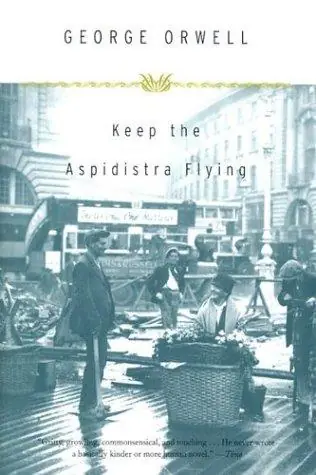
Keep the Aspidistra Flying
by George Orwell · first published 1936
37% recommend58% neutral5% critical
Why HN recommends it
A sharp, funny satire of money and middle-class respectability, seen through a struggling poet. It offers a fresh view of capitalism and commercial life, and suits fans of social realism and Orwell.
Summarised by Claude from recommending comments
Gordon Comstock loathes dull, middle-class respectability and worship of money. He gives up a 'good job' in advertising to work part-time in a bookshop, giving him more time to write. But he slides instead into a self-induced poverty that destroys his creativity and his spirit. Only Rosemary, ever-faithful Rosemary, has the strength to challenge his commitment to his chosen way of life. Through the character of Gordon Comstock, Orwell reveals his own disaffection with the society he once himself renounced.
Affiliate links. As an Amazon Associate I earn from qualifying purchases.
Mentions per year
What Hacker News says
Related books
 2020–2026
Coming Up for Air
George Orwell
Recommended by 6 · mentioned by 96 recommend · 9 mention6 recommend · 96 recommend
 2018–2026
The Lion and the Unicorn
George Orwell
Recommended by 3 · mentioned by 93 recommend · 9 mention3 recommend · 93 recommend
 2009–2026
Down and Out in Paris and London
George Orwell
Recommended by 50 · mentioned by 8650 recommend · 86 mention50 recommend · 8650 recommend
 2011–2026
Burmese Days
George Orwell
Recommended by 8 · mentioned by 238 recommend · 23 mention8 recommend · 238 recommend
 2009–2026
Homage to Catalonia
George Orwell
Recommended by 74 · mentioned by 12274 recommend · 122 mention74 recommend · 12274 recommend
 2007–2026
Animal Farm
George Orwell
Recommended by 105 · mentioned by 407105 recommend · 407 mention105 recommend · 407105 recommend
 2010–2026
The Road to Wigan Pier
George Orwell
Recommended by 27 · mentioned by 5927 recommend · 59 mention27 recommend · 5927 recommend
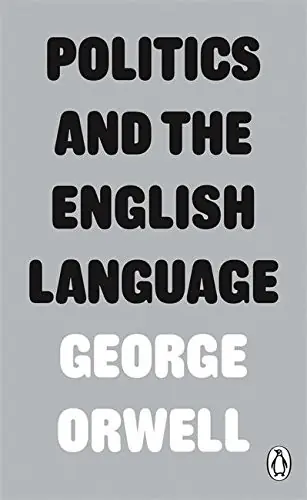 2008–2026
Politics and the English language
George Orwell
Recommended by 112 · mentioned by 210112 recommend · 210 mention112 recommend · 210112 recommend
The content looks quite interesting for a mathematician too—so I'm sorry that the advertising needs to be antagonising. But even Keep the Aspidistra Flying was basically mutilated by circumstance [1] and it's still a great book. So, I'll take the insults towards mathematicians with humour and actually read some of it—I often switch between grumpy rigour…
on “Street-Fighting Mathematics” ↗http://en.wikipedia.org/wiki/Keep_the_Aspidistra_Flying was a book disowned by Orwell in later years (mostly because of editorial changes he was forced to make). Still, it is a good book to read on trappings of wealth and poverty.
on “The Gentle Art of Poverty” ↗Absolutely amazing, changed the way I look at the society, will re-read: - George Orwell, Keep the Aspidistra Flying Loved: - Alastair Reynolds, House of Suns - Andy Weir, The Martian - Neal Stephenson, Seveneves - Greg Egan, Teranesia Liked: - Arthur C. Clarke, 3001: The Final Odyssey - Arthur C. Clarke, 2061:…
on “Ask HN: Books you read in 2015?” ↗Some recents: Surely You're Joking Mr Feynmann is a good read. As is Vonnegut's Cat's Cradle As is Hugh Laurie's The Gun Seller And I'm just getting into Orwell's Keep The Aspidistra Flying which is quite good too.
on “Ask HN: Summer Reading Recommendations?” ↗Was going to mention that myself. I just finished both Down and Out in Paris and London and Keep the Aspidistra Flying. Orwell's commentary on money is definitely worth checking out. A very different glimpse of capitalism than that often seen on HN.
on “Homeless Experiment” ↗Keep The Aspidistra Flying is my favorite Orwell book atleast his among his fiction. I have read it atleast thrice. Among the Non Fictions I loved Down and Out in Paris and London and Homage to Catalonia which is perhaps my favorite.
on “The lesser-known Orwell: are his novels deserving of reappraisal?” ↗"Keep the Aspidistra Flying" is very funny. It's been made into a movie twice. The 1965 one is closer to the original. It used to be available on line, but with the copyright crackdown, films only of historical interest, with near…
on “The lesser-known Orwell: are his novels deserving of reappraisal?” ↗…auxlangs, than that he would be pretending to any originality. It's not newspeak that causes crimestop. It's that "quiet desperation is the english way", it's the middle class attitudes of the title of "Keep the Aspidistra Flying", etc. that cause crimestop. Orwell was aware of crimestop from his own experiences, and he was aware that he lived in a world with, admittedly, bureaucratese, but without newspeak.
on “George Orwell’s 1984 through a neuroscience lens” ↗"Advertising is the rattling of a stick inside a swill bucket." Gordon Comstock - George Orwell's protagonist in Keep the Aspidistra Flying
on “Facebook adds 5 divs, 9 spans and 30 CSS classes to every post in the timeline” ↗Demoting Orwell's masterpieces (1984 and Animal Farm) to "juvenile science fiction stuff" while holding up Keep the Aspidistra Flying—a mid-tier social realism novel about a middle-class poet struggling with commercialism—is top-tier British condescension (extra points for misspelling Aspidistra while doing so).
on “London Underground begins scanning passengers' faces” ↗George Orwell in "Keep the Aspidistra Flying" suggested that friendly personal offline relationships are all but impossible between people with widely disparate incomes. Exceptions as always, prove the rule.
on “A Basic Income Should Be the Next Big Thing” ↗…daily street fighting style problem solving. The way they state it, however, it sounds like they are saying that rigorous math is not necessary. My reference to George Orwell is simply that when he wrote Keep the Aspidistra Flying his publishers made him write a lot of things he didn't want to write, and they even specified the amount of words the books needed to have (which is is somewhat understandable, but limiting still). [1]…
on “Street-Fighting Mathematics” ↗…an essay on his experience working in a book shop: https://www.orwellfoundation.com/the-orwell-foundation/orwel... He worked there 1934+ and wrote the essay in 1936[1]. The main character of his novel Keep The Aspidistra Flying worked in a book store - with some scathing character vignettes of the customers! Despressing book and Eric Blair himself disliked it “Orwell refused to allow either Keep the Aspidistra Flying or his…
on “Lessons from Owning a Bookstore” ↗…what my preference order would be, but I can admit that whatever literary criticism has to say on the matter, and I suspect it disagrees with me, I found "A clergyman's daughter" more fun to read than "Keep the aspidistra flying". You can read all nine of Eric Blair's books here: https://gutenberg.net.au/plusfifty-n-z.html#orwell Sadly, those texts are not perfect. I noticed a number of OCR errors. Also, in "Down and out in…
on “George Orwell and me: Richard Blair on life with his extraordinary father” ↗…perspective, these are the approximate word counts of the books currently listed at "George Orwell bibliography" under "Novels": • Burmese Days (1934): 97000 • A Clergyman’s Daughter (1935): 94000 • Keep the Aspidistra Flying (1936): 87000 • Coming Up for Air (1939): 83000 (?) • Animal Farm (1945): 30000 (just over 30k) • Nineteen Eighty-Four (1949): 103000 (or 99000 without the “The Principles of Newspeak” appendix).
on “Why I Write (1946)” ↗