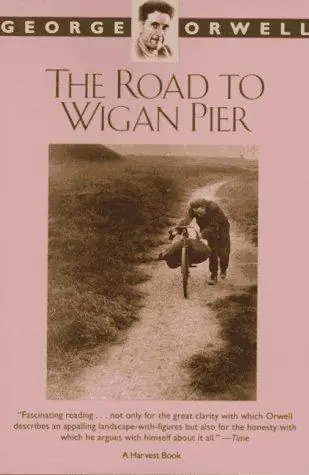
The Road to Wigan Pier
by George Orwell · first published 1724
46% recommend53% neutral2% critical
Why HN recommends it
Orwell's firsthand report on 1930s northern English coal miners and the poor, plus a second part arguing for socialism and why workers resisted it. Suits readers who know only 1984 and Animal Farm.
Summarised by Claude from recommending comments
A searing account of George Orwell's observations of working-class life in the bleak industrial heartlands of Yorkshire and Lancashire in the 1930s, The Road to Wigan Pier is a brilliant and bitter polemic that has lost none of its political impact over time. His graphically unforgettable descriptions of social injustice, cramped slum housing, dangerous mining conditions, squalor, hunger and growing unemployment are written with unblinking honesty, fury and great humanity. It crystallized the ideas that would be found in Orwell's later works and novels, and remains a powerful portrait of pover
Affiliate links. As an Amazon Associate I earn from qualifying purchases.
Mentions per year
What Hacker News says
Related books
 2020–2026
Coming Up for Air
George Orwell
Recommended by 6 · mentioned by 96 recommend · 9 mention6 recommend · 96 recommend
 2009–2026
Down and Out in Paris and London
George Orwell
Recommended by 50 · mentioned by 8650 recommend · 86 mention50 recommend · 8650 recommend
 2011–2026
Burmese Days
George Orwell
Recommended by 8 · mentioned by 238 recommend · 23 mention8 recommend · 238 recommend
 2009–2026
Homage to Catalonia
George Orwell
Recommended by 74 · mentioned by 12274 recommend · 122 mention74 recommend · 12274 recommend
Shooting an Elephant
George Orwell
Recommended by 6 · mentioned by 126 recommend · 12 mention6 recommend · 126 recommend
 2010–2022
Why Orwell Matters
Christopher Hitchens
Recommended by 4 · mentioned by 74 recommend · 7 mention4 recommend · 74 recommend
 2007–2026
Animal Farm
George Orwell
Recommended by 105 · mentioned by 407105 recommend · 407 mention105 recommend · 407105 recommend
 2018–2026
The Lion and the Unicorn
George Orwell
Recommended by 3 · mentioned by 93 recommend · 9 mention3 recommend · 93 recommend
The Road to Wigan Pier should be in this. Orwell lived with coal miners' families in Northern Britain for months. I particularly was struck by his descriptions of the way social-welfare policies were used to weaken family structures…
on “I say, damn it, where are the beds? New books on Orwell” ↗…books you find your self going back to repeatedly (or want to)? My list: - Domain Driven Design - Ray Bradbury's short stories and Farenheit 451 - George Orwell's Down and Out in Paris and London, The Road to Wigan Pier - Descent into Hell - LotR, the Hobbit, and Narnia - Hitchhiker's Guide to the Galaxy - Psalms, Job, James - The Rare Jewel of Christian Contentment - Wendell Berry's Essays - Winnie the Pooh -…
on “Read Fewer Books” ↗For a detailed look at Orwell's views on socialism, read his non-fiction work "The Road to Wigan Pier". It's split into two parts: first an investigation into the living conditions of poor English people; second an examination of socialism, both arguing for its necessity and acknowledging the practical…
on “George Orwell in Spain” ↗…workforce" (agricultural workers) was made redundant and moved off the land into the cities. This extended well into the early twentieth century - you might want to check out the first part of Orwell's The Road to Wigan Pier for ordinary life in the late stages of an economic transition. Those were different times: before organised state welfare and health provision, and with very different economic structures. But as others…
on “How Computers Are Creating a Second Economy Without Workers” ↗…(known to some as George Orwell) wrote two of the most biting descriptions of the grind of poverty: Down and out in Paris and London http://www.george-orwell.org/Down_and_Out_in_Paris_and_Londo... The Road to Wigan Pier http://www.george-orwell.org/The_Road_to_Wigan_Pier/
on “How Poverty Taxes the Brain” ↗Read "Road to Wigan pier" by Orwell. He became seriously disillusioned with socialist ideals later on in his life. And famously said "Socialists don't care about the poor, they just hate the rich"
on “Decline of Global Extreme Poverty Continues but Has Slowed” ↗I adore Orwell. The second chapter of The Road to Wigan Pier (separately published in the excellent essay collection 'Inside The Whale'), which describes the working conditions of coal miners in the North of England, is one of the greatest pieces of journalistic…
on “The lesser-known Orwell: are his novels deserving of reappraisal?” ↗George Orwell’s ‘The Road to Wigan Pier’ is an argument for socialism in the social context of the time, and presents an intensely classist society, published 36 years after Victoria died. It’s a very interesting book: a snapshot of how people…
on “How did the Victorians become a reference point for joyless prudery?” ↗You're most likely familiar with Orwell's "Down and Out in Paris and London" and "The Road to Wigan Pier", two of the finest books ever written. The first is his "vivid and moving account of life below poverty line", first in Paris, when he, after resigning being a servant of the Empire as a police officer…
on “The Benefits of Being Cold” ↗…as self-evidently as the psychological point does, but I suspect that it does carry over somewhat. I do encourage anyone who hasn't already to read the whole chapter http://www.george-orwell.org/The_Road_to_Wigan_Pier/5.html : it's not really very long though I felt that the relevant parts were a bit too long, all together, to fit in a comment.
on “Poor in Tech” ↗I also recommend Orwell's The Road To Wigan Pier for a report on workers in northern England in the 1930s and their living conditions (and the second part on why Socialism isn't being embraced in the UK, but that's a different topic). I'm pretty sure…
on “The Next Button” ↗The Road to Wigan Pier - Orwell Antifragile - Taleb What is Life? - Schrodinger Structure and Interpretations of Computer Programs - Abelson
on “Ask HN: Which non-fiction books had the biggest impact on you?” ↗'The Road to Wigan Pier' and 'Down and Out in Paris and London' (also by Orwell) are the starkest accounts of poverty and what it does to you I have ever read.
on “You Don't Batch Cook When You're Suicidal” ↗If you haven't read it Road to Wigan pier is a great work by Orwell on the status of the British poor post war.
on “Of mice and men and Magdalen: C. S. Lewis’s Oxford” ↗…was a relentless moralist and didn't know how to have fun. Sorta the opposite of P.G.Wodehouse. Which ... I'm OK with. I've read most of his work too. Of course 1984 and Animal Farm are the best but Road to Wigan Pier and Down and Out in Paris and London are good too. (I also love Wodehouse)
on “Why I Write (1946)” ↗