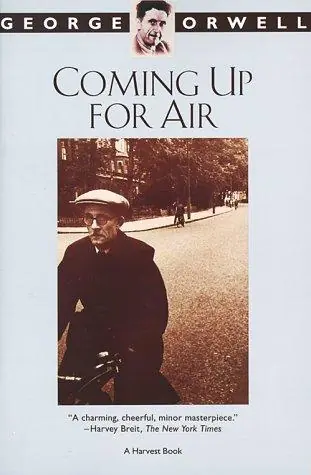
Coming Up for Air
by George Orwell · first published 1939
67% recommend33% neutral
Why HN recommends it
Orwell's 1939 novel follows a middle-aged insurance salesman longing for his childhood countryside. It offers a sharp, funny take on suburban life and explores modern themes of commercialism and money worries.
Summarised by Claude from recommending comments
Years in insurance and marriage to the joyless Hilda have been no more than death in life to George Bowling. This and fear of another war take his mind back to the peace of his childhood in a small country town. But his return journey to Lower Binfield brings complete disillusionment.
Affiliate links. As an Amazon Associate I earn from qualifying purchases.
Mentions per year
What Hacker News says
Related books
 2018–2026
The Lion and the Unicorn
George Orwell
Recommended by 3 · mentioned by 93 recommend · 9 mention3 recommend · 93 recommend
Shooting an Elephant
George Orwell
Recommended by 6 · mentioned by 126 recommend · 12 mention6 recommend · 126 recommend
 2010–2026
The Road to Wigan Pier
George Orwell
Recommended by 27 · mentioned by 5927 recommend · 59 mention27 recommend · 5927 recommend
 2010–2026
Keep the Aspidistra Flying
George Orwell
Recommended by 7 · mentioned by 197 recommend · 19 mention7 recommend · 197 recommend
 2014–2026
Such, Such Were the Joys
George Orwell, Sean Michael Wilson, Jaime Huxtable
Recommended by 4 · mentioned by 104 recommend · 10 mention4 recommend · 104 recommend
 2009–2026
Homage to Catalonia
George Orwell
Recommended by 74 · mentioned by 12274 recommend · 122 mention74 recommend · 12274 recommend
 2009–2026
Down and Out in Paris and London
George Orwell
Recommended by 50 · mentioned by 8650 recommend · 86 mention50 recommend · 8650 recommend
 2007–2026
Animal Farm
George Orwell
Recommended by 105 · mentioned by 407105 recommend · 407 mention105 recommend · 407105 recommend
It's been progressively so throughout the entire 20th century. George Orwell wrote about the suburbanisation of rural life in his "Coming Up for Air" [1] back in the 1930s. Highly recommended. [1] https://www.goodreads.com/book/show/509080.Coming_Up_for_Air
on “Animal Populations Fell by 68% in 50 Years and It’s Getting Worse” ↗"Coming Up for Air" is another of his lesser known works, which is worth a read.
on “George Orwell's 6 rules for writing (2018; originally published in 1946)” ↗…come next. I think Homage to Catalonia is not a great book, but valuable for the autobiographical insight about Orwell, and how it informed him to write those other, better works. I would also add that Coming Up For Air is delightful and underrated. Try the audio book. Any middle-aged man can appreciate the quiet understated honesty.
on “The impact of Orwell's "Homage to Catalonia" on Noam Chomsky's path to anarchism” ↗I was surprised at how modern many of the themes in both Keep The Aspidistra Flying and Coming Up For Air are, from (in Keep The Aspidistra Flying) the negative effects of commercialisation and mass advertising, obsession with (because of a dependence on) money, difficulties making ends meet when trying to…
on “The lesser-known Orwell: are his novels deserving of reappraisal?” ↗I enjoyed Coming Up For Air. I didn't find the description in the article matched the book. The nostalgia in the book is that of the character not of the author. There is a reasonable ironic distance between the two. The narrator…
on “The lesser-known Orwell: are his novels deserving of reappraisal?” ↗Coming Up for Air is practically my childhood in a nutshell
on “Currying” ↗It’s years since I’ve read Orwell, but I believe I have read almost all of his books (Coming up for Air nor Clegryman’s Daughter I have not read, or I don’t remember a single thing about them). He’s Non-fiction books (Down and Out in Paris and London, The Road to Wigan Pier, and especially Homage to Catalonia)…
on “Why I Write (1946)” ↗…democratic socialism".[3][89] Nineteen Eighty-Four is a cautionary tale about revolution betrayed by totalitarian defenders previously proposed in Homage to Catalonia (1938) and Animal Farm (1945), while Coming Up for Air (1939) celebrates the personal and political freedoms lost in Nineteen Eighty-Four (1949). > In one 1948 letter, Orwell claims to have "first thought of [the book] in 1943", while in another he says…
on “An illustrated guide to post-Orwellian censorship (2021)” ↗…know with some clarity what kind of book I want to write. This was written in 1946. According to https://en.wikipedia.org/wiki/George_Orwell_bibliography#Nov... consecutive books he published were: * Coming Up for Air (1939) * Animal Farm (1945) Given the "seven years", it appears considered "Coming Up for Air" his previous novel, and "Animal Farm" not a novel. I wonder why? In any case, the novel that he next wrote…
on “Why I Write (1946)” ↗…counts of the books currently listed at "George Orwell bibliography" under "Novels": • Burmese Days (1934): 97000 • A Clergyman’s Daughter (1935): 94000 • Keep the Aspidistra Flying (1936): 87000 • Coming Up for Air (1939): 83000 (?) • Animal Farm (1945): 30000 (just over 30k) • Nineteen Eighty-Four (1949): 103000 (or 99000 without the “The Principles of Newspeak” appendix).
on “Why I Write (1946)” ↗