Book of Proof
by Richard Hammack · first published 2009
82% recommend18% neutral
Why HN recommends it
Free, gentle introduction to proofs and mathematical formalism for people new to proof-based math, such as self-learners and programmers. Exercise solutions are included, and some say it made college math finally click.
Summarised by Claude from recommending comments
This book is an introduction to the language and standard proof methods of mathematics. It is a bridge from the computational courses (such as calculus or differential equations) that students typically encounter in their first year of college to a more abstract outlook. It lays a foundation for more theoretical courses such as topology, analysis and abstract algebra.
Affiliate links. As an Amazon Associate I earn from qualifying purchases.
Mentions per year
What Hacker News says
Related books
 2013–2024
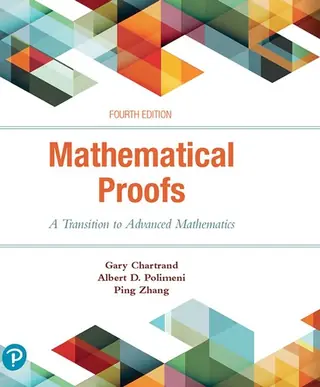
Mathematical proofs
Gary Chartrand, Albert D. Polimeni, Zhang, Ping, Ping Zhang
Recommended by 17 · mentioned by 2017 recommend · 20 mention17 recommend · 2017 recommend
 2007–2026
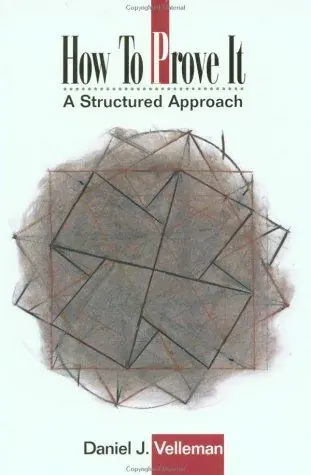
How to prove it
Daniel J. Velleman
Recommended by 78 · mentioned by 10478 recommend · 104 mention78 recommend · 10478 recommend
Linear Algebra
Kuldeep Singh
Recommended by 9 · mentioned by 119 recommend · 11 mention9 recommend · 119 recommend
 2010–2023
A transition to advanced mathematics
Smith, Douglas
Recommended by 15 · mentioned by 1715 recommend · 17 mention15 recommend · 1715 recommend
 2015–2026
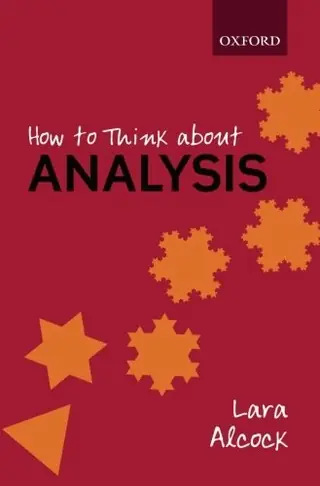
How to Think About Analysis
Lara Alcock
Recommended by 15 · mentioned by 1615 recommend · 16 mention15 recommend · 1615 recommend
 2019
Pure Mathematics for Beginners
Steve Warner
Recommended by 2 · mentioned by 32 recommend · 3 mention2 recommend · 32 recommend
A Book of Abstract Algebra
Charles C. Pinter
Recommended by 25 · mentioned by 2725 recommend · 27 mention25 recommend · 2725 recommend
 2016–2026
A Programmer's Introduction to Mathematics
Jeremy Kun
Recommended by 24 · mentioned by 3124 recommend · 31 mention24 recommend · 3124 recommend
…Preparation for Collegel-level maths: 3a. General prep for high level maths: How to Study as a Mathematics Major - Alcock 3b. Proof writing: How to Prove It - A Structured Approach - Velleman OR Book of Proof (2nd ed) - Hammack (it's free!) 4. Mathematical Analysis: 4a. Good prep for Analysis: How to Think About Analysis - Alcock 4b. Understanding Analysis (2nd ed) - Abbott OR Yet Another Introduction…
on “Ask HN: How to self-learn math?” ↗…chapter, work through the solutions, and ask around if you still can't figure it out. Persistance and routine are key here. As for books, I like Stewart's Calculus, Lay's Linear Algebra, and Hammack's Book of Proof. For physics, I don't know what your background is. Giancoli is a popular undergrad freshman year book, where as griffith's electrodynamics is a bit more advanced.
on “Ask HN: How do I learn math/physics in my thirties?” ↗…brings a smile to my face. I just happen to be relearning math right now as I dive deeper into data science and this is perfect timing. Going to watch this series once I get through my math proofs book ("Book of Proof" by Richard Hammack which I recommend to people getting into math https://www.amazon.com/Book-Proof-Richard-Hammack/dp/0989472...).
on “Calculus Made Easy (1914) [pdf]” ↗…on algorithms and data structures), and learn lower level details by working your way through Bryant and O'Halloron's Computer Systems: A Programmer's Perspective. You can learn proofs from Hammack's Book of Proof, freely available online. From there, you can learn algorithms and data structures from Stanford and/or Princeton's courses on Coursera. The above would be the equivalent of a strong CS minor. From…
on “Ask HN: How can I become a self-taught software engineer?” ↗…me their definition, it'd be trivial to check if they form a semigroup under a certain operation: we'll just check it for associativity. To get a hang of this stuff I recommend the following books: Book of Proof by Richard Hammack (tools of the trade) Linear Algebra by Kuldeep Singh (rigorous tutorial: combines the rigor of a textbook and the ease of use of tutorial) Abstract Algebra by the Dos Reis (rigorous…
on “Robert Langlands: The Greatest Mathematician You’ve Never Heard Of?” ↗What initially turned me into a curious person were Surely You Are Joking Mr Feynman & Godel, Escher, Bach. Then Book of Proof & Forallx: an introduction to formal logic helped me develop an interest in mathematics. But what was really a kind of aesthetic crack was The UNIX Programming Environment and The TeXbook.
on “Ask HN: The book that did it for you in math and/or CS?” ↗Consciousness and the Brain: Deciphering How the Brain Codes Our Thoughts [Stanislas Dehaene], interesting book about up to date neuroscience. Book of Proof [Richard Heath Hammack], great books on maths. gives a head start on proofs. Mastery [Robert Greene], best self help book I've read. https://www.goodreads.com/user/year_in_books/2017/5980292
on “Ask HN: What is the best book you read on 2017?” ↗In order: 1. Book of Proof 1a. How to Prove It: A Structured Approach 2. Elements of Set Theory - Enderton 2a. Naive Set Theory - Halmos 3. Foundations of Analysis - Landau 4. Basic Mathematics - Lang 5. Principles of Mathematics…
on “Ask HN: Serious mathematics books that can replace a good teacher?” ↗Mathematik für Ingenieure und Wissenschaftler I, II and III from Lothar Papula (in German). The solutions are detailed, making it perfect for self-studying. Book of Proof by Richard Hammack. A great introduction to proofs in mathematics. The book is available free online [0], but also I bought the physical version because I really enjoyed it. [0]https://jdhsmith.math.iastate.edu/class/BookOfProof.pdf
on “Ask HN: Math books that made you significantly better at math?” ↗I just started reading Book of Proof by Richard Hammack and I agree it's an amazing book
on “Ask HN: Math books that made you significantly better at math?” ↗There is a whole "grammar of proofs and basic intro to higher mathematics" style course nowadays. Book of Proof has a free PDF version. It covers the basic styles of proof (necessary to learn but still not super advanced). Other texts of this sort include Jay Cummings long form texts (I myself haven't worked through…
on “Ask HN: What is the best way to learn proof based math without a teacher?” ↗For math, the first step is to know how to prove math statements. Usually, it's learned together with the subject at hand(analysis, algebra), but you can come prepared. Book Of Proof by Hammack(might've misspelled that) is a good one. It's free online. Very similar to working out at the gym when you engage in a sports discipline whether thats boxing or gymnastics.
on “How Do I Learn?” ↗Book of Proof by Hammack
on “Ask HN: Have you been able to teach yourself advanced mathematics as an adult?” ↗…continuity, for example. One such book that comes to mind is "Mathematical Proofs: A Transition to Advanced Mathematics" by Chartrand, Polimeni, Zhang. I think the best book in this introductory genre is "Book Of Proof" by Richard Hammack. It's freely available. I see the latest edition added a few techniques for proving convergence and continuity on the real line: epsilon-delta and epsilon-N stuff. I call the books…
on “Ask HN: The book that did it for you in math and/or CS?” ↗…claim to be "introductory" are actually truly introductory. This isn't a slight against the linked work, I absolutely love when profs make resources such as this freely available. "How to Prove It" and "Book of Proof" are also great intros to formal math, if less immediately practical.
on “Math Basics for Computer Science and Machine Learning [pdf]” ↗