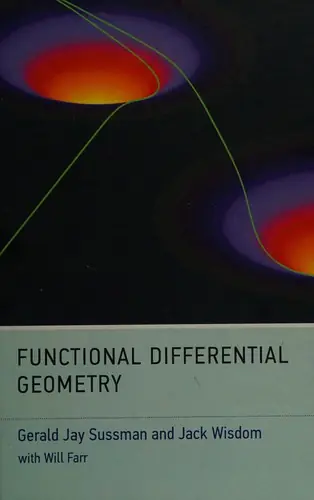
Functional Differential Geometry
by Gerald Jay Sussman · first published 2013
42% recommend58% neutral
Why HN recommends it
Teaches differential geometry by turning formulas into programs, building the theory through symbolic computation in Scheme; suits readers who already like the SICM style and want the math expressed as code.
Summarised by Claude from recommending comments
An explanation of the mathematics needed as a foundation for a deep understanding of general relativity or quantum field theory.Physics is naturally expressed in mathematical language. Students new to the subject must simultaneously learn an idiomatic mathematical language and the content that is expressed in that language. It is as if they were asked to read Les Misérables while struggling with French grammar. This book offers an innovative way to learn the differential geometry needed as a foundation for a deep understanding of general relativity or quantum field theory as taught at the coll
Affiliate links. As an Amazon Associate I earn from qualifying purchases.
Mentions per year
What Hacker News says
Related books
 2008–2025
Structure and Interpretation of Classical Mechanics
Gerald Jay Sussman, Jack Widsom
Recommended by 42 · mentioned by 9242 recommend · 92 mention42 recommend · 9242 recommend
 2011–2025
General relativity
Robert M. Wald
Recommended by 8 · mentioned by 108 recommend · 10 mention8 recommend · 108 recommend
 2008–2025
Gravitation
Charles W. Misner
Recommended by 16 · mentioned by 2916 recommend · 29 mention16 recommend · 2916 recommend
 2020–2026
Software Design for Flexibility
Chris Hanson, Gerald Jay Sussman
Recommended by 8 · mentioned by 278 recommend · 27 mention8 recommend · 278 recommend
 2009–2026
Finite-dimensional vector spaces
Paul R. Halmos
Recommended by 24 · mentioned by 3824 recommend · 38 mention24 recommend · 3824 recommend
 2007–2026
Calculus on manifolds
Michael Spivak
Recommended by 22 · mentioned by 4822 recommend · 48 mention22 recommend · 4822 recommend
 2008–2026
Calculus
Michael Spivak
Recommended by 88 · mentioned by 13088 recommend · 130 mention88 recommend · 13088 recommend
…interested to learn the topic from different angle: Gerald Jay Sussman (among others, co-author of Structure and Interpretation of Computer Programs) has co-written a book on differential geometry called Functional Differential Geometry. It builds up the theory of differential geometry using Scheme, just like SICP and SICM, and is a fantastic read for programmers wanting to grasp the topic in a more familiar language. It is available…
on “Differential Forms and Integration (2008) [pdf]” ↗Additionally by Sussman is Functional Differential Geometry. This builds on work from SICM and delves into ideas of Relativity.
on “Learn Physics by Programming in Haskell [pdf]” ↗List was last updated in 1999 so missing good books like Sussman's Functional Differential Geometry where you convert formulas into programs.
on “Chicago undergraduate mathematics bibliography” ↗You can try Functional Differential Geometry by Sussman and Wisdom (which exists both as a printed book and as a freely downloadable PDF file). It is an interesting experiment in teaching mathematics by heavily relying on the computer for doing…
on “Ask HN: Programming to learn math?” ↗Or, if you want to learn the core ideas and math involved, but in terms of computer programming, see: Functional Differential Geometry by Gerald Sussman, same author behind Structure and Interpretation of Computer Programs https://archive.org/details/FunctionalDifferentialGeometry/
on “Albert Einstein's theory of relativity in words of four letters or less (1999)” ↗I haven't read them myself yet, but I've heard good things about Structure and Interpretation of Classical Mechanics and Functional Differential Geometry. I hear there is a reasonable alternative to classical notation in these books, and with Prof. Sussman's insistence on good names for things, I'm sure single-letter variables do not happen that often.…
on “Fluid Simulation (with WebGL demo)” ↗…but I'll just leave two book recommendations for those who might enjoy programming advanced mathematics. Structure and Interpretation of Classical Mechanics : https://mitpress.mit.edu/classical_mech Functional Differential Geometry : https://mitpress.mit.edu/books/functional-differential-geome...
on “How to Learn Advanced Mathematics Without Heading to University – Part 3” ↗If you are more mathematically inclined, there's also "Functional Differential Geometry" by the same authors, and in the same spirit, but much shorter. The goal of the book is essentially to write the Euler-Lagrange equations in lisp, which is a breathtakingly beautiful thing.
on “Structure and Interpretation of Classical Mechanics” ↗I'm a huge fan of that book, but am very glad you called it out as more people should know about it. there's also a great companion book "Functional Differential Geometry". My one caveat with that approach is it requires a very specific implementation of their library in MIT Scheme. There probably is a racket implementation by now, but it still looks like it's most small…
on “Ask HN: How to do self-study on Physics” ↗If you liked the "functional" style of calculus in SICM, or want a calculus only book in this vein I recommend Baby Spivak: https://en.wikipedia.org/wiki/Calculus_on_Manifolds_(book) (And obviously Functional Differential Geometry by the authors of SICM)
on “Derivatives don't always act like fractions (2021)” ↗I’ve been wanting to ask this a differential geometer - what do you think of Sussman and Wisdom’s book as a DE intro for an CS/applied math person? Thanks! https://www.amazon.com/Functional-Differential-Geometry-MIT-...
on “Ask HN: What are you learning?” ↗…since I always assumed Landau was one of the targets of Sussman and Wisdom's comment, "It is surprisingly easy to get the right answer with unclear and informal symbol manipulation." (See their paper, Functional differential geometry.) Sussman/Wisdom's book is, from a brief look, not 'rigorous' either, but the 'symbol manipulations' in Landau/Lifschitz's series are sometimes borderline insane!
on “Modern Physics From Scratch” ↗Where to begin depends on what your goal is, mine was to be able to complete Sussman's SICM book (and later, his Functional Differential Geometry book). The book I used to do this was Advanced Calculus by Loomis & Sternberg because it covers classical mechanics, potential theory, differentiable (Banach) manifolds, differential equations, (multi)linear…
on “Mathematicians are chronically lost and confused (2014)” ↗This reminds me of the effort by Sussman to teach physics by programming : Functional differential geometry [1] was discussed on hacker news before [2]. [1] https://mitpress.mit.edu/books/functional-differential-geome... [2] https://news.ycombinator.com/item?id=7884551
on “Making math more Lego-like” ↗…of Sussman and his coworkers[7, 8]. ''' [7] Gerald Jay Sussman & Jack Wisdom (2001): Structure and Interpretation of Classical Mechanics. The MIT Press. [8] Gerald Jay Sussman & Jack Wisdom (2013): Functional Differential Geometry. The MIT Press
on “Learn Physics by Programming in Haskell” ↗