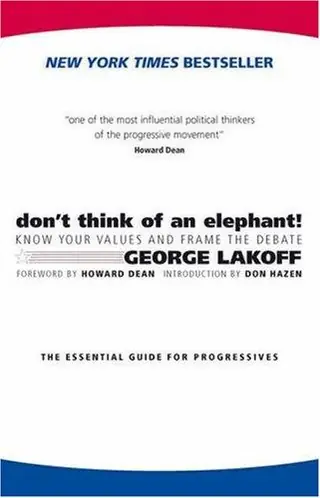
Don't Think of an Elephant!
Know Your Values and Frame the Debate--The Essential Guide for Progressives
by George Lakoff · first published 2004
58% recommend32% neutral11% critical
Why HN recommends it
A short, readable introduction to political framing and rhetoric. It explains how politicians use values and language to shape debate, and it is useful regardless of political affiliation.
Common criticism: Critics say its framing ideas failed when applied in practice and find its analysis overreaching.
Summarised by Claude from recommending comments
"Don't Think of an Elephant! is the antidote to the last forty years of conservative strategizing and the right wing's stranglehold on political dialogue in the United States." "Author George Lakoff explains how conservatives think, and how to counter their arguments. He outlines in detail the traditional American values that progressives hold, but are often unable to articulate. Lakoff also breaks down the ways conservatives have framed the issues, and provides examples of how progressives can reframe the debate." "Lakoff's years of research and work with environmental and political leaders h
Affiliate links. As an Amazon Associate I earn from qualifying purchases.
Mentions per year
What Hacker News says
Related books
48 Rules of Power
Renu KARKI
Recommended by 3 · mentioned by 43 recommend · 4 mention3 recommend · 43 recommend
 2013–2025
Excellent Sheep
William Deresiewicz
Recommended by 4 · mentioned by 144 recommend · 14 mention4 recommend · 144 recommend
 2009–2026
Metaphors We Live By
George Lakoff, Mark Johnson, Lakoff
Recommended by 56 · mentioned by 8156 recommend · 81 mention56 recommend · 8156 recommend
 2016–2026
Prisoners of geography
Tim Marshall
Recommended by 21 · mentioned by 3221 recommend · 32 mention21 recommend · 3221 recommend
 2009–2026
Ishmael
Daniel Quinn
Recommended by 48 · mentioned by 6548 recommend · 65 mention48 recommend · 6548 recommend
 2016–2026
The Body Keeps the Score
Bessel van der Kolk
Recommended by 90 · mentioned by 14290 recommend · 142 mention90 recommend · 14290 recommend
 2012–2026
Why Nations Fail
Daron Acemoglu, James A. Robinson
Recommended by 74 · mentioned by 11774 recommend · 117 mention74 recommend · 11774 recommend
 2013–2026
The dictator's handbook
Bruce Bueno de Mesquita, Alastair Smith
Recommended by 63 · mentioned by 9463 recommend · 94 mention63 recommend · 9463 recommend
…command I gave you. Very good, you almost grasped my point. In fact you even managed to produce spontaneously one of the most famous examples of this principle by the great philosopher George Lakoff (read "Don't Think of an Elephant!", which was used for Clinton's campaign) > we interpret speech more or less automatically This is more or less my point. Speech is interpreted automatically: it is not a choice to interpret it, or…
on “The dangers of illiberal liberalism” ↗There are some great reads by the cited examples. George Lakoff's (left) Don't Think of an Elephant!: Know Your Values and Frame the Debate - is a fascinating read regardless of your political beliefs. http://www.amazon.com/Dont-Think-Elephant-Debate-Progressive... The Frank Luntz (right) example of…
on “Apple changes words in order to change the debate ” ↗…for is an ability to communicate with their target base." Yes- they are so good at this, its a great lesson in conveying with power.. George Lakoff beautifully explains how they do this in his book- "Don't Think of an Elephant!: Know Your Values and Frame the Debate".. You also mention they get the other political parties to use "their" terminology as well, George Lakoff goes through this in the book as well. I found a ton…
on “I was on BloombergTV talking SOPA today - how'd I do?” ↗The wording "liberated" is a nice frame. See "George Lakoff: Don't Think of an Elephant"
on “Can Programming Be Liberated from the von Neumann Style? (1978) [pdf]” ↗I recommend also Lakoff's book "Don't think of an elephant" I thought it is a good story how rethoric and framing is used nowadays in politics.
on “Reasons not to use (i.e., be used by) Facebook” ↗I took a course in rhetoric and encountered the book Don’t Think of an Elephant by George Lakoff https://www.amazon.com/Dont-Think-Elephant-Democrats-Progres... Short book, yet enlightening on rhetoric. Can recommend, regardless of political affiliation.
on “Ask HN: What skills to acquire in 2019?” ↗…ring true to the audience being targeted according to their past experience. For example, evangelicals love a good redemption and hard work story. Each group has their own highest morals. I'd recommend "Don't Think of An Elephant" by George Lakoff, which explains how politicians hack the human mind by crafting an entire language that plays into their hopes and fears. I'd love to have every test in life be genuine and unhackable.…
on “The Lesson to Unlearn” ↗There is some great theory around moderation which goes far beyond this piece. David Lakoff's book "Don't Think of an Elephant" is a classic. Moderation is rarely a choice. There's an old expression, "The only thing in the middle of the road is roadkill." It's not saying that moderates are extinct or undesirable. Rather, left…
on “The Two Kinds of Moderate” ↗Thumbs up for Snyder. His talks are incredible. https://framelab.substack.com/ - A newsletter about politics, language and your brain. Written by Dr. George Lakoff and Gil Duran. george Lakoff wrote Don’t Think of an elephant and The Political Mind. Both seminal works on how our brains get hijacked by political ideas and manipulation.
on “Ask HN: What are your favorite Substacks?” ↗Don't Think of an Elephant will completely change how you view politics and what anyone in politics says and how to interpret it. Aristotle's Ethics helped me reconcile my desire to constantly strive to do more and what to make…
on “Ask HN: Any interesting books you have read lately?” ↗yes some of the provocative imagery is non-productive in public spheres outside private circles. As a remedy, I recommend everyone on the left read George Lakoff's book "Don't Think of an Elephant." It's a guide for how to communicate effectively, especially to people who have a vastly different worldview from themselves. He's been consulting to organizations for a long time and these books are…
on “The war against 'woke' could end US science as we know it” ↗…will of the 17M". Remainers didn't counter-frame this with "50M didn't vote for Brexit". Therefor all the marches, petitions etc. are always/can be ignored in the context of "but the will of the 17M". "Don't Think of an Elephant!" is now such an old book, and still a lot of people haven't read it. Brexiteers have read it it seems.
on “UK Parliament petitions site crashes under traffic for petition to cancel Brexit” ↗Seems odd to me that the authors don't reference George Lakoff's Don't Think Of An Elephant[0] which seems to describe much of their findings under the term "framing". Then again, this is written in part by Lera Boroditsky, a psychologist who seems to think that doing linguistics require little…
on “Metaphors can change our opinions in ways we don’t even realize” ↗On the nose. Reads like he picked up a copy of Lakoff's "Don't think of an elephant!"and is attempting to apply framing theory. Great job sans the lack of details–though that in itself is probably intentional. It's useful to try out different metaphors and see what sticks.
on “American Equity” ↗Lakoff's "Don't Think of an Elephant" says something similar: don't let the other side provide the frame for your narrative.
on “David Shor’s Unified Theory of American Politics” ↗