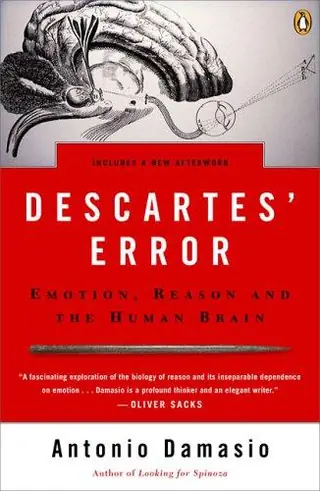
Descartes' Error
by Antonio Damasio · first published 1995
74% recommend26% neutral
Why HN recommends it
Neuroscientist's readable case, built on patient studies, that emotion underlies reasoning and decision-making and that impaired emotion leads to poor choices; suits readers curious about the somatic marker idea.
Summarised by Claude from recommending comments
Affiliate links. As an Amazon Associate I earn from qualifying purchases.
Mentions per year
What Hacker News says
Related books
 2017–2026
Supernormal stimuli
Deirdre Barrett
Recommended by 3 · mentioned by 63 recommend · 6 mention3 recommend · 63 recommend
 2015–2026
Moral tribes
Joshua David Greene
Recommended by 8 · mentioned by 108 recommend · 10 mention8 recommend · 108 recommend
 2009–2026
Sources of Power
Gary Klein
Recommended by 14 · mentioned by 1714 recommend · 17 mention14 recommend · 1714 recommend
 2012–2026
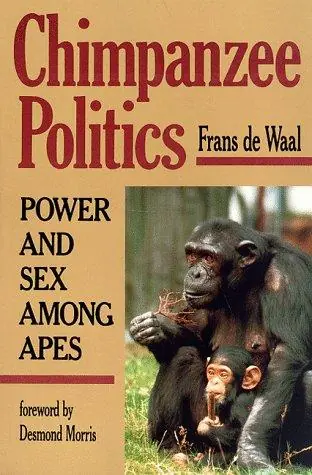
Chimpanzee Politics
Frans de Waal
Recommended by 6 · mentioned by 156 recommend · 15 mention6 recommend · 156 recommend
 2007–2026
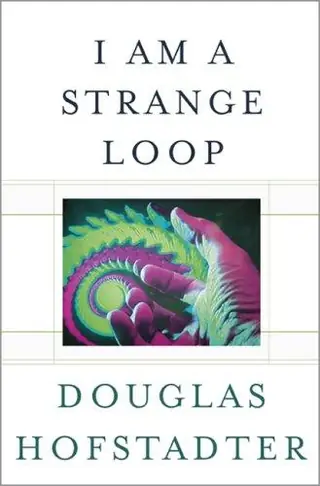
I Am a Strange Loop
Douglas R. Hofstadter
Recommended by 101 · mentioned by 204101 recommend · 204 mention101 recommend · 204101 recommend
 2007–2026
The evolution of cooperation
Robert M. Axelrod
Recommended by 21 · mentioned by 3521 recommend · 35 mention21 recommend · 3521 recommend
 2007–2026
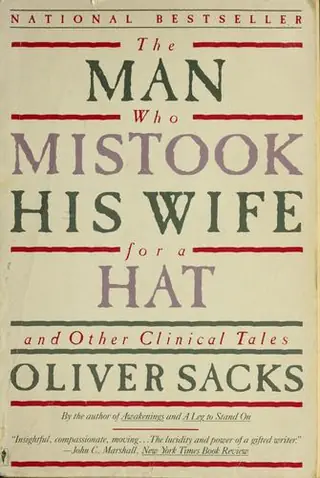
The Man Who Mistook His Wife for a Hat
Oliver Sacks
Recommended by 61 · mentioned by 7761 recommend · 77 mention61 recommend · 7761 recommend
…* * * More broadly, if you're interested in psychology, primate behaviour, neuroscience, philosophy, game theory, and linguistics, here are a selection of books that I've found helpful: • Descartes' Error by Antonio Damasio • Neuroscience: Exploring the brain by Bear, Connors, and Paradiso (this is a fantastic illustrated text book with great explanations; fully worth the 72 euros I paid for it) • Behave…
on “Revisiting “The 4-Hour Workweek”” ↗…that I could see a data-bus and an address-bus. I know what they feel, and smell like. I got good at patching dataflow DSP because 20 years earlier I spent hours in the studio patching analogue synths. Descartes Error is a book by Antonio Damasio [1] that talks about the weakness of purely rationalist epistemology. The foundation is laid long before we are even aware of knowing and learning. That book had an influence…
on “Knowledge is like a house of cards” ↗Have you read "Descartes' Error", by António Damásio (USC Neurology professor)? I must have recommended this a thousand times. Found it amazing. https://en.wikipedia.org/wiki/Descartes%27_Error
on “Mental fatigue impairs physical performance in humans (2009)” ↗That may not be possible. A good case can be made that emotions are vital to human cognition. E.g.: http://www.amazon.com/Descartes-Error-Emotion-Reason-Human/d... What you could instead be doing is not noticing your subtler emotions. Until I took up meditation, I thought I was very rational. But after years of paying attention to the…
on “Don’t Jump to Conclusions About the Killer” ↗…known phenomenon! Emotions are key to the decision-making process, and when they are impaired for whatever reason then you are more likely to make suboptimal decisions. I recommend Antonio Damasio's book Descartes' Error for a good picture of how this works.
on “Why I Quit Being a Therapist [video]” ↗…vast interest in consciousness, no-one had claimed to have identified regions. If you haven't come across it before, I'd recommend The Man Who Mistook his Wife for a Hat by Oliver Sacks. Following that, Descartes Error by Antonio Damasio might also be interesting (if you're interested in emotion and reason). [1] http://en.m.wikipedia.org/wiki/Memory
on “What Happens When a Neurosurgeon Removes Your Hippocampus ” ↗António Damásio (portuguese, but based in USC) is also worth checking out. Descartes' Error is a must read.
on “What Happens When a Neurosurgeon Removes Your Hippocampus ” ↗If you are liking "Thinking, fast and slow", you should check "Descartes' Error" by António Damásio (USC neurologist).
on “Ask HN: What books are you reading?” ↗Gladwell's works Blink and Outliers both paraphrase important scientific works, in the simplified style the references are largely glossed over. In place of Blink, read Antonio Damasio's Descartes Error, the seminal book on emotional reasoning. Instead of Outliers read Anders Ericsson's The Road To Excellence. Both of these more formal books cite sources meticulously.
on “How Not to Explain Success” ↗…these can be worthwhile. I haven't read them all, but slow-juggling a few of 'em over several months. These range from neuroscience to game theory to primate behaviour to human culture and more: • Descartes' Error by Antonio Damasio • Moral Tribes by Joshua Greene • Chimpanzee Politics by Frans de Waal • Homo Ludens: A Study of the Play-Element in Culture by Johan Huizinga • The Evolution of Cooperation by…
on “Chomsky – The Machine, the Ghost and the Limits of Understanding (2012) [video]” ↗…a fundamental error, that the brain is the sole repository and processor of memory. Two books that will help clear-up this misunderstanding are: The Body Keeps the Score by Bessel van der Kolk [1] Descartes' Error by António Damásio [2] Our whole body, at the (neuro only?) cellular level, has mechanisms for "experiencing", processing and reminding us of physical and chemical experiences. No matter any ecstatic…
on “A pill that makes you sad and happy” ↗…leading neuroscientists such as Antonio Damasio and others. FWIW, here's some references[1][2][3], if you're not actively studying neuroscience. [0] https://news.ycombinator.com/item?id=31037882 [1] Descartes' Error, by Antonio Damasio [2] Behave, by Sapolsky [3] On Task, by David Badre
on “She was missing a chunk of her brain – it didn’t matter” ↗I don't know what ever became of the line of research, but there was a very interesting book I read decades ago called Descartes' Error by Antonio Damasio that examined case studies of patients who had their corpus collosum severed, resulting in a split brain. You could show their left and right eyes different images and ask them what…
on “The unbearable slowness of being: Why do we live at 10 bits/s?” ↗…Quite simply, we don't yet understand how consciousness arises. There are a lot of theories, but they are just that—theories. Related reading: Antonio Damasio wrote a book in 1994 with the spicy title, Descartes' Error[1] to rebut his famous quote that you cite. Also look up "Somatic Marker Hypothesis" by Damasio. [1] https://en.wikipedia.org/wiki/Descartes%27_Error
on “The New AI Consciousness Paper” ↗Yes, I was waiting for that sort of ending too. Not that it is inevitable -- just that is seems likely given what makes humans human has a lot more to do with emotions than intelligence (see the book "Descartes' Error" on how emotion underlies all thinking). If you create a creature without human emotions (including feelings for other humans), don't be surprised when it behaves in other-than-human ways. Of course,…
on “The Last Invention of Man” ↗