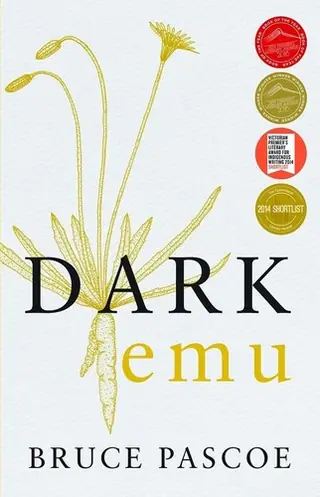
Dark emu
by Bruce Pascoe · first published 2014
53% recommend35% neutral12% critical
Why HN recommends it
Argues that Indigenous Australians practised farming, aquaculture and land management, citing early settler diaries and explorers' accounts. Readers find it a well-referenced, eye-opening look at colonial bias.
Common criticism: Critics say it misrepresents its primary sources and blurs evidence with argument.
Summarised by Claude from recommending comments
In this seminal book, Bruce Pascoe uncovers evidence that long before the arrival of white men, Aboriginal people across the continent were building dams and wells; planting, irrigating, and harvesting seeds, and then preserving the surplus and storing it in houses, sheds, or secure vessels; and creating elaborate cemeteries and manipulating the landscape. All of these behaviors were inconsistent with the hunter-gatherer tag, which turns out have been a convenient lie that worked to justify dispossession. --back cover
Affiliate links. As an Amazon Associate I earn from qualifying purchases.
Mentions per year
What Hacker News says
Related books
 2017–2020
The biggest estate on earth
Bill Gammage
Recommended by 2 · mentioned by 22 recommend · 2 mention2 recommend · 22 recommend
 2010–2026
At Home
Bill Bryson
Recommended by 12 · mentioned by 2212 recommend · 22 mention12 recommend · 2212 recommend
 2010–2026
Orthodoxy
Gilbert Keith Chesterton
Recommended by 22 · mentioned by 3522 recommend · 35 mention22 recommend · 3522 recommend
 2011–2024
Mastering the core teachings of the Buddha
Daniel M. Ingram
Recommended by 21 · mentioned by 2821 recommend · 28 mention21 recommend · 2821 recommend
 2007–2024
Effective Executive
Peter F. Drucker, Joseph A. Maciariello, Jim Collins, Tim Andres Pabon
Recommended by 48 · mentioned by 6048 recommend · 60 mention48 recommend · 6048 recommend
 2018–2026
Enlightenment now
Steven Pinker, Pablo Hermida Lazcano
Recommended by 51 · mentioned by 9751 recommend · 97 mention51 recommend · 9751 recommend
 2009–2026
The Dream Machine
M. Mitchell Waldrop
Recommended by 109 · mentioned by 131109 recommend · 131 mention109 recommend · 131109 recommend
 2011–2026
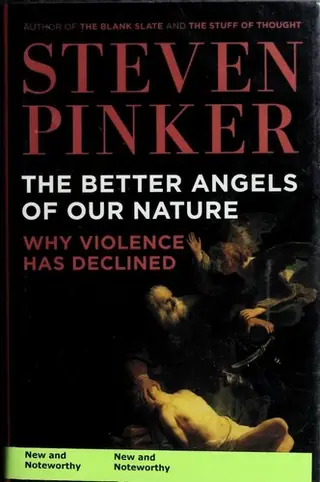
The better angels of our nature
Steven Pinker
Recommended by 72 · mentioned by 15272 recommend · 152 mention72 recommend · 15272 recommend
…governance models were put into practice, and how the history of progress that we are given is not the whole story. Useful for seeing that we are in a local minim, and can evolve into something better. Dark Emu by Bruce Pascoe. Goes through the diaries and historical evidence of the early interactions with Australia's Aboriginals. Shows how over time their agricultural practices, towns and living environments…
on “Ask HN: What book changed your life?” ↗…Indigenous Australians were not purely hunter-gatherers, running naked around a 'pristine' environment, but were active managers of an entire continent's biomass. The aforementioned Gammage and Bruce Pascoe's Dark Emu are the best popular accounts, both drawing on and carefully referencing primary sources. Reading either might dispel a few prejudices.
…you want to know more, there are two related books you can read: The Greatest Estate On Earth, Bill Gammage, on how Australian indigenous land management was much more extensive than commonly thought Dark Emu, Bruce Pascoe - this one cites the above substantially and is much more polemic, but it looks at more aspects of Australian indigenous life, hunting, trade etc.
on “Aboriginal Hunters’ Fires Help Restore an Australian Desert” ↗…in their country (and to keep them available throughout good & bad seasons). Popular accounts of the contemporary research can be found in Bill Gammage's The Biggest Estate on Earth and Bruce Pascoe's Dark Emu. It's a fast-changing research landscape, though, with much left to be discovered.
on “The Case Against Civilization” ↗Bruce Pascoe, "Dark Emu" This book really highlighted for me how we literally rewrite history to suit our own prejudices, and finally taught me what "history is written by the victor" actually means (including claiming victory).
on “Ask HN: What books changed the way you think about almost everything?” ↗…unintended consequences in any system - Anne Lammott's Bird by Bird - I have to write a lot for my work and this is the best primer on getting things out the door - For the Australians: Bruce Pascoe's Dark Emu, on how early white European settlers completely misunderstood indigenous agriculture, all the things that were lost when Europeans settled Australia, and what we can use today. Gives you a VERY different…
on “Ask HN: What books changed the way you think about almost everything?” ↗The aborigines of Australia were said to have been peaceful for some absurdly long time period, like 10k years minimum. If you'r interested, I would suggest reading Dark Emu by Bruce Pascoe.
on “Why Our Postwar “Long Peace” Is Fragile (2018)” ↗…my view, it's still nice to read. After 4 years I also finally finished Capital in the 21st Century. My opinion: worth reading by jumping around, not worth reading in linear fashion. Bruce Pascoe's Dark Emu is worth a read too. It's well researched, but the author does occasionally blur the line between opinion and facts. I attribute it to writing styles. Similar in nature to another book I quite liked in…
on “Ask HN: Favorite Nonfiction Books of 2019?” ↗…bunya nut etc. Except for kangaroo meat you can't get these in the supermarket here either, there's no industry growing them on a large scale due to cultural and sometimes religious reasons. Pascoe's Dark Emu or Gammage's Biggest Estate on Earth (less fought about) are good reads in that area.
on “An Archaeobotanist Searching Art for Lost Fruit” ↗I recently read “Dark Emu” by Bruce Pascoe. It’s a great read on Australian indigenous culture. He notes similar experiences documented by British colonists in Australia. They remarked on how the whole continent was kept like…
on “We Know How to Prevent Megafires” ↗You’ve read Bruce Pascoe? His reputation tarnished or otherwise, Dark Emu was a brilliant book for me.
For context there's a pseudo debate going on in Australia about whether the indigenous people had large-scale agri- and aquaculture. A book, highly recommended, called Dark Emu quotes primary sources from early settlers and white explorers clearly describing an agrarian economy that was rapidly wiped out by invading settlers and their livestock. If true, and it's a convincing…
on “Is an Aboriginal tale of an ancient volcano the oldest story ever told?” ↗It's worth giving Dark Emu a (critical) read. It gathers numerous primary sources from early explorers which describe practices of cooperative harvesting, cultivation, and land management between indigenous tribes in Australia.…
on “Stories told by Aboriginal Tasmanians could be oldest recorded in the world” ↗This is well-written article discussing Bruce Pascoe's book "Dark Emu", issues surrounding his Aboriginal heritage and how he's been criticised by certain right-wingers in Australia: https://www.themonthly.com.au/blog/russell-marks/2020/05/202... (Pascoe is the farmer…
on “Farm in SE Australia is growing native grains for flour and bread” ↗Thanks for this. I've recently been reading Bruce Pascoe's 'Dark Emu', which is on how Aboriginal Australians had agriculture too, even recorded in the journals of the original Euro explorers but now lost to public consciousness.
on “A 1,000-year-old road lost to time” ↗