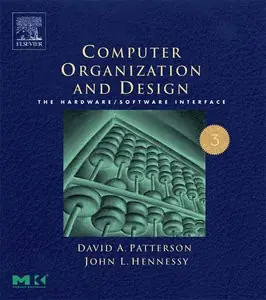
Computer organization and design
by David A. Patterson · first published 2004
60% recommend38% neutral2% critical
Why HN recommends it
Readable, approachable textbook on how hardware and software meet, from compiler down to CPU, using a simple MIPS design. Suits software engineers and beginners wanting to understand how modern computers work.
Summarised by Claude from recommending comments
In addition to thoroughly updating every aspect of the text to reflect the most current computing technology, the third edition uses standard 32-bit MIPS 32 as the primary teaching ISA; presents the assembler-to-HLL translations in both C and Java; highlights the latest developments in architecture in Real Stuff sections: Intel IA-32, Power PC 604, Googles PC cluster, Pentium P4, SPEC CPU2000 benchmark suite for processors, SPEC Web99 benchmark for web servers, EEMBC benchmark for embedded systems, AMD Opteron memory hierarchy, AMD vs. 1A-64.
Affiliate links. As an Amazon Associate I earn from qualifying purchases.
Mentions per year
What Hacker News says
Related books
 2008–2026
Computer architecture
John L. Hennessy, David A. Patterson
Recommended by 59 · mentioned by 9459 recommend · 94 mention59 recommend · 9459 recommend
 2022–2024
The Every Computer Performance Book
Bob Wescott
Recommended by 2 · mentioned by 22 recommend · 2 mention2 recommend · 22 recommend
 2010–2026
Digital Design and Computer Architecture
Sarah Harris, David Money Harris
Recommended by 26 · mentioned by 3626 recommend · 36 mention26 recommend · 3626 recommend
 2018–2026
Computer architecture
Caxton C. Foster
Recommended by 5 · mentioned by 75 recommend · 7 mention5 recommend · 75 recommend
 2010–2026
Inside the Machine
Jon Stokes
Recommended by 27 · mentioned by 3027 recommend · 30 mention27 recommend · 3027 recommend
 2008–2024
Structured Computer Organization
Andrew S. Tanenbaum
Recommended by 21 · mentioned by 2421 recommend · 24 mention21 recommend · 2421 recommend
 2011–2024
For the Love of Physics
Walter Lewin
Recommended by 3 · mentioned by 53 recommend · 5 mention3 recommend · 53 recommend
 2009–2026
Computer systems
Randal Bryant, Randal E. Bryant, David R. O'Hallaron
Recommended by 67 · mentioned by 8367 recommend · 83 mention67 recommend · 8367 recommend
I remember doing MIPS assembler in the computer hardware class in college. We used the book "Computer Organization and Design: The Hardware/Software Interface" (aka "Patterson and Hennessy") [1]. At the time it was an enlightening experience because until then I hadn't fully internalized how computers were implemented at the…
on “Programmed Introduction to MIPS Assembly Language” ↗…just a post about "how to learn" to code; however, I think there is a need to specify that some of these references are not entirely necessary for a decent subset of programmers. For example, you listed Computer Organization and Design by Patterson & Hennessy. I think it's a fantastic book, and had to go through 11 chapters of it for the sake of a Stanford architecture class. The first few chapters almost feel like a must read for…
on “A Crash Course in Computer Science: Reading List” ↗Check out this book, I started my MIPS CPU reading it: D. A. Patterson, Computer organization and design: the hardware/software interface, 4th ed. Burlington, MA: Morgan Kaufmann Publishers, 2009.
on “Introduction to MIPS assembly language (2007)” ↗…more fun since we could actually have crazy ideas and try to implement them. I don't know the current state of literature, but when I took the courses (12 years ago) the Patterson and Hennessy books (Computer Organization and Design, Computer Architecture) were terrific.
on “Designing a CPU in VHDL, Part 1: Rationale, Tools, Method” ↗…mention). What you want is just the smart ideas, I'd say. If you want to get an understanding of how modern computers work, and given your CS degree, I would recommend David Patterson/John Hennessy's Computer Organization and Design, any edition. A lot of universities use this book in a second-year architecture course. In terms of relating this information to the overall hierarchy of computer systems, I would also recommend Nisan…
on “Ask HN: Best way to learn about computing history?” ↗Fun fact: Stanford President Hennessy is the same Hennessy who with Patterson wrote that great computer architecture book: Computer Organization & Design: The Hardware/Software Interface. Oh, he also co-founded MIPS Although as my first job was doing MIPS related stuff I may be biased about usefulness of the book. Amusingly the first featured 5-star review on Amazon is from John Mashey whom older
on “Stanford Pulls Bid for New York Tech Campus” ↗For an intro read, Hennessy and Patterson's "Computer Organization and Design" is good. Their other book, "Computer Architecture: A Quantitative Approach" is the de facto bible, but it's slightly more advanced, and not a good first read. Another good intro book is "Computer Systems:…
on “Ask HN: What are your favorite books about computer hardware?” ↗For something covering the "lower half" of this material, I highly recommend Patterson and Hennessy's "Computer Organization and Design". I'm currently reading the 5th edition, and have gotten to the last chapter, which is on parallel processors.
on “Computer Science from the Bottom Up” ↗Without a doubt it is, for me, "Pat & Hen": "Computer Organization and Design" by Patterson and Hennessy. I was mesmerised by this book as an undergrad and spent night after night devouring every page. It is a true eye-opener, explaining why computers are the way they are from…
on “Ask HN: What's the best technical eBook you have read?” ↗…working multi-cycle and pipelined MIPS CPUs for the same FPGA. All of us came from software backgrounds, never having touched any hardware description language. To get started I'd recommend reading Computer organization and design by Patterson and Hennessy (http://www.amazon.com/Computer-Organization-Design-Fifth-Edi...). For the VHDL part, all we had available was this small basic VHDL compendium (not sure if I can redistribute…
on “FPGA Programming: Where to Begin? (2012)” ↗Massive upvote, the standard text book for Computer Organization is Patterson and Hennesy's "Computer Organization and Design: The Hardware/Software Interface" Its a lovely book, but its hard to get hold of MIPS processors these days. Hopefully this creates a new generation of devs which can tinker with real hardware and are…
on “Introduction to Computer Organization: ARM Assembly Language on the Raspberry Pi” ↗We used "Computer Organization and Design: the Hardware/Software Interface" (also Hennessy and Patterson) as our comp arch textbook. I'd recommend it (any moderately recent version) for simply learning as well. Learning the internals of everything…
on “More details about mitigations for the CPU Speculative Execution issue” ↗The course "Computer Systems Architecture" at Queen's University uses "Computer Organization and Design: The Hardware/Software Interface" by Patterson and Hennessy. It's a 400-level course in the computer and electrical engineering department. I can recommend it. Most chapters in it have a "Real Stuff"…
on “The new microcode from Intel and AMD adds three new features” ↗I read both Computer Architecture and Computer Organization and Design in college and I really enjoyed them. I would recommend COaD to any beginner who wants to learn some basic concepts of computer design (and if working with FPGAs why not build one). CA deals with more…
on “Hennessy and Patterson win Turing Award” ↗Pick up Discrete Mathematics by Knuth, Foundations of Mathematics by Sibley, Modern Operating Systems by Tanenbaum, and Computer Organization and Design by Patterson and Hennessy. You internalize those, combined with your experience, and you'll be better off than a lot of CS grads.
on “Consider applying for grad school” ↗