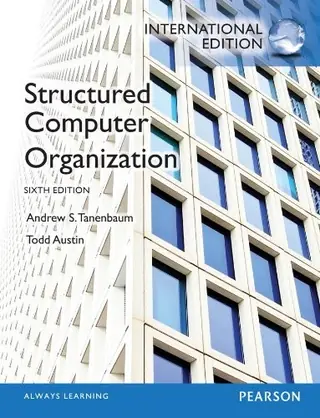
Structured Computer Organization
by Andrew S. Tanenbaum · first published 1975
88% recommend13% neutral
Why HN recommends it
Layered walk through a computer from transistors and digital logic up through microcode and assembly, in a friendly, readable style. Suits self-taught programmers and students wanting the fundamentals of architecture.
Summarised by Claude from recommending comments
Structured Computer Organization, specifically written for undergraduate students, is a best-selling guide that provides an accessible introduction to computer hardware and architecture. This text will also serve as a useful resource for all computer professionals and engineers who need an overview or introduction to computer architecture.
Affiliate links. As an Amazon Associate I earn from qualifying purchases.
Mentions per year
What Hacker News says
Related books
 2016–2026
Introduction to Computing Systems
Yale N. Patt, Sanjay J. Patel
Recommended by 4 · mentioned by 94 recommend · 9 mention4 recommend · 94 recommend
 2017–2025
A Common-Sense Guide to Data Structures and Algorithms
Jay Wengrow
Recommended by 9 · mentioned by 119 recommend · 11 mention9 recommend · 119 recommend
 2007–2026
Operating Systems
Andrew S. Tanenbaum, Albert S. Woodhull
Recommended by 63 · mentioned by 10363 recommend · 103 mention63 recommend · 10363 recommend
 2013–2022
Nine algorithms that changed the future
John MacCormick
Recommended by 4 · mentioned by 64 recommend · 6 mention4 recommend · 64 recommend
 2011–2026
Concepts of programming languages
Robert W. Sebesta
Recommended by 4 · mentioned by 74 recommend · 7 mention4 recommend · 74 recommend
Deep Learning for Coders with fastai and Pytorch
Jeremy Howard, Sylvain Gugger
Recommended by 4 · mentioned by 74 recommend · 7 mention4 recommend · 74 recommend
 2008–2026
Modern Operating Systems
Andrew S. Tanenbaum, Herbert Bos
Recommended by 52 · mentioned by 8552 recommend · 85 mention52 recommend · 8552 recommend
…M. Digital Design, 3rd ed. Prentice Hall, 2002 Mano, M and Kime, C Logic and Computer Design Fundamentals, 2nd ed Prentice Hall, 2001 Gajski, D Principles of Digital Design Prentice Hall, 1997 Tanenbaum, A Structured Computer Organization, 5th ed Prentice Hall, 2006 Patt, Y and Patel, S Introduction to Computing Systems: From Bits and Gates to C and Beyond, 2nd ed. McGraw Hill, 2004 Null, L and Lobur, J The Essentials of Computer Organization…
on “Ask HN: Learning to code, without a computer?” ↗This question has been asked 9 years ago and couldn't find anything else. I've read Structured Computer Organization by Andrew Tanenbaum and Todd Austin. While it was a good book I wonder what do you guys think are good books? I've noticed I need to look for a good book because my knowledge on caching is just a bit…
on “Ask HN: Good computer architecture books?” ↗I'm a hardware guy, so I've got a different approach. I'd say, drop the algorithms book. Start with a book called "Structured Computer Organization" by Andrew Tanenbaum. After you read that book, you'll feel like you actually KNOW a lot more. And after you read that book, you'll probably know a lot more than half the people here about how computers…
on “Ask HN: How should I go about learning CS?” ↗I can't really emphasize enough how well-written his books are. I picked up some of Tanenbaum's books early in high school (specifically: Structured Computer Organization, Modern Operating Systems, and Computer Networks). They were so well-written and engaging they I could hardly take my eyes off of 'em. They really cultivated an interest and love for Computer Science…
on “Retirement of Prof. Andy Tanenbaum” ↗It was 1995... so the Comp Org was Tanenbaum's Structured Computer Organization. I also used his Operating Systems book in the OS class. I thought they were excellent but I also had great profs. I'll try to find my theory of computation text so I can see who wrote that, but again…
on “The Elements of Computing Systems, Second Edition” ↗Tanenbaum's Structured Computer Organization, Computer Networks, and Operating Systems: Design and Implementation
on “Ask HN: The book that did it for you in math and/or CS?” ↗…Don't ignore older texts - the basics won't (don't, can't) change; the language of choice changes every year but the basics are still the same. Things I liked: * Tanenbaum on Computer Networks, and Structured Computer Organization (the examples are old but the fundamentals are very clear and very applicable) * Kernighan's original C book * Brooks Mythical Man-Month * Aho on Compilers (dragon book) * Abelson's Structure and…
on “Ask HN: Which RFCs do you think most developers should read?” ↗It's a bit dated but perhaps you should check out Structured Computer Organization by Andrew Tanenbaum.
on “Show HN: I'm 17 and wrote this guide on how CPUs run programs” ↗all of Tanenbaum's books, especially Structured Computer Organization
on “Ask HN: Which books do you consider real gems in your field of work/study?” ↗…Computation by Hopcroft, Ullman Programming Languages Theory -> Programming languages: design and implementation by Pratt et al Database Theory -> Database Design by Wiederhold Architecture -> Structured Computer Organization by Andrew S Tanenbaum
on “Must Read CS Books For Self Self-Taught Programmers” ↗«Structured Computer Organization » by Andrew S. Tanenbaum. I don't know the newer edition but the 3rd edition is the first computer book I have read and its layered approach is great (and I think, was new at that time)
on “Ask HN: recommend a book that explains how computers work down to the silicon” ↗…(the MINIX book), to anyone interested in OS dev. I read it when I was teenager (around 15), and I really really enjoyed it. Tanenbaums' books were one of the few truly addicting textbooks. As a side, "Structured Computer Organization" by Tanenbaum was also really great. It gives you a foundational understanding of how computers are architected that is indispensable if you're going to be doing OS dev.
on “Writing a simple operating system from scratch (2010) [pdf]” ↗…and Design: The Hardware/Software Interface (ARM edition)", https://www.amazon.com/Computer-Organization-Design-ARM-Arch... ...or Tannenbaum's "Stuctured Computer Organization" https://www.amazon.com/Structured-Computer-Organization-Andr...
on “Ask HN: Getting started with hardware development?” ↗…hardware multiplier might still have an assembly (and machine code) multiply instruction, and simply implement a shift-and-add multiplication algorithm in the microcode. I suggest Tanenbaum and Austin's "Structured Computer Organization" for a pretty good book about this (and other aspects of CPU design).
on “Intel CEO’s Stock Sales May Warrant SEC Examination” ↗For Practical aspects: Code Complete by Steve Mcconnell. For overall understanding of the Computer as a holistic system of abstractions: Structured Computer Organization by Andrew Tanenbaum. Any book on Algorithms/Data Structures; Robert Sedgewick's books are recommended. The above should give you a good foundation. You can then move onto in-depth study of each layer/abstraction…
on “Ask HN: What is a must read for a developer without a computer science degree?” ↗