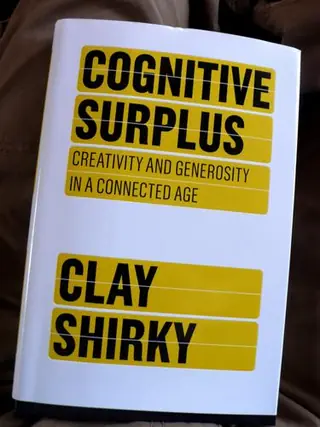
Cognitive Surplus
by Clay Shirky · first published 2010
14% recommend86% neutral
"Every single year for the second half of the 20th century, the amount of television watched by humanity increased. Collectively, we now watch more than one trillion hours of television every year – something not entirely unlike, as Clay Shirky sees it, tipping the free time of the world's educated citizenry (their "cognitive surplus") down an intellectual plughole. It's not that television is evil, or even bad. It's just that, as a medium, it's incredibly good at soaking up leisure and producing very few tangible results. It tells stories, it makes people feel less alone, it passes the time.
Affiliate links. As an Amazon Associate I earn from qualifying purchases.
Mentions per year
What Hacker News says
Related books
 2011–2026
Economic Facts and Fallacies
Thomas Sowell
Recommended by 8 · mentioned by 138 recommend · 13 mention8 recommend · 138 recommend
 2010–2026
The Shallows
Nicholas G. Carr
Recommended by 39 · mentioned by 6739 recommend · 67 mention39 recommend · 6739 recommend
 2010–2024
This time is different
Carmen M. Reinhart
Recommended by 13 · mentioned by 2013 recommend · 20 mention13 recommend · 2013 recommend
 2013–2026
Bullshit Jobs
David Graeber
Recommended by 159 · mentioned by 477159 recommend · 477 mention159 recommend · 477159 recommend
 2008–2026
Amusing Ourselves to Death
Neil Postman
Recommended by 174 · mentioned by 306174 recommend · 306 mention174 recommend · 306174 recommend
 2011–2026
Debt
David Graeber
Recommended by 182 · mentioned by 303182 recommend · 303 mention182 recommend · 303182 recommend
 2007–2026
Brave New World
Aldous Huxley
Recommended by 202 · mentioned by 708202 recommend · 708 mention202 recommend · 708202 recommend
 2007–2026
Snow Crash
Neal Stephenson
Recommended by 364 · mentioned by 977364 recommend · 977 mention364 recommend · 977364 recommend
People who think Quora is temporary or just for hipsters don't understand Clay Shirky's Cognitive Surplus. 1) Contributing is more rewarding than playing video games or watching TV. 2) People have more free time now than at any other point in history. They're going to contribute some kind of intellectual…
on “I finally understand Quora” ↗You'd probably enjoy Clay Shirky's book "Cognitive Surplus", which really put into perspective for me what this apparent glut of time I had on my hands meant. There's an excerpt at: http://mentalfloss.com/article/18670/gin-sitcoms-and-cogniti...
on “Why are Adults so busy?” ↗Clay Shirky told the same story in his excellent book `Cognitive Surplus: Creativity and Generosity in a Connected Age` https://witandwisdomofanengineer.blogspot.com/2010/07/engine... TLDR: McDonald's customers buy milkshakes. Marketing people ask customers how they can…
on “Asking your customers what they want doesn't work” ↗…classifieds; his (estimated) $100m business helped disrupt more than $13b in classified revenue. The funds are a dividend for the transactors so the value is not gone, but jobs are. Look, too, to Clay Shirky's cognitive surplus. In the comments on this post at Google+, Eric Reasons brought up entertainment as an example. They get a double whammy. The people formerly known as the audience (TM Jay Rosen) now have more ways to…
on “We’re not going to have a jobless recovery. We’re going to have a jobless future” ↗…for interesting middle ground, I think. A lot of the public debate currently is framed more or less between the "very optimistic" and "very pessimistic" poles represented, respectively, by Clay Shirky's Cognitive Surplus: Creativity and Generosity in a Connected Age, and Nicholas Carr's The Shallows: What the Internet Is Doing to Our Brains. They make for a nice pair of dueling books, but I'd rather read something with…
on “The lost world of physicality” ↗…easy to understand positions, of the "Go is great!" or "Go is crap!" variety. I think I first noticed that tendency in general, though there are doubtless lots of earlier examples, when Clay Shirky's Cognitive Surplus and Nicholas Carr's The Shallows were simultaneous best-sellers. On the question of how modern technology/networking impacts cognition, it seems the two positions that sell a lot are: "it's awesome for…
on “Why I like lots of languages, and Go is pretty neat too” ↗…“Where do people find the time?” That was her question. And I just kind of snapped. And I said, “No one who works in TV gets to ask that question. You know where the time comes from. It comes from the cognitive surplus you've been masking for 50 years.” — Gin, Television, and Social Surplus, Clay Shirky, May 2008 (http://www.worldchanging.com/archives/008009.html)
on “The 1,000-hour rule (2009)” ↗Have you read Clay Shirky's "Gin, Television, and Cognitive Surplus" [1]? He argues that technology does free us from more and more work, and we find ways to spend this time, by wasting it, or by fitting other things into it. E.g. the lazy Saturday when people can just…
on “Kropotkin's 'The Conquest of Bread'” ↗Agreed. Clay Shirky made a similar point in Here Comes Everybody. Or maybe it was Cognitive Surplus. (Crap, sorry, it's been a while.) His analogy, IIRC: teens treat social media as hanging out at the food court with friends, not as public speech. To them, adults eavesdropping are the creeps, not the…
on “Being Ridiculed for My Open Source Project (2013)” ↗The OP seems related to Clay Shirky's argument about "cognitive surpluses" See http://www.amazon.com/Cognitive-Surplus-Creativity-Generosit... His argument is roughly that strongly addictive behaviors arise to soak up spare time created by technological advances, e.g. gin…
on “The Acceleration of Addictiveness” ↗This reminds me of what Clay Shirky talks about in "Cognitive Surplus: Creativity and Generosity in a Connected Age". It's the difference between intrinsic motivations and extrinsic (generally financially related) motivations. These guys wanted it to work, and operated…
on “The Graphing Calculator Story - a developer who refused to leave” ↗…didn't take either of the two polarized views that it's really great, totally amazing or completely terrible, ruining civilization. But instead, we get dueling books, one from each extreme: Clay Shirky's Cognitive Surplus versus Nicholas Carr's The Shallows. Unfortunately, it works, both on and off the internet, so it seems pretty hard to change. Imagine trying to sell a hypothetical third book to a publisher, where you…
…will just resort to sockpuppets even more than normal. And limits to editing will also hurt a number of people who are doing a lot of good. Clay Shirky is more or less right that Wikipedia thrives on "cognitive surplus", so trying to limit the supply is just self-defeating. What we need, IMO, is some different kind of structure where being a wiki-insider with OCD isn't the absolute advantage that it is today. I don't…
on “Wikipedia's Notability Requirements And The Slash” ↗Indeed, and Clay Shirky actually wrote an entire book called Cognitive Surplus on how the shift away from TV will unlock oceans of time for people. I wrote about it some here: http://jseliger.com/2010/06/26/progress-extra-time-efficienc... .
on “Chucking TV Helped me Start my Company” ↗Clay Shirky also describes 'society's collective bender' in more optimistic terms: http://google.com/search?q=cognitive+surplus
on “Computers Will Entertain Us to Death” ↗