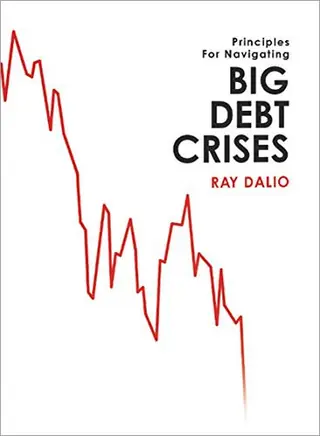
Big Debt Crises
by Ray Dalio · first published 2018
62% recommend38% neutral
Why HN recommends it
A clear, historically grounded explanation of how debt cycles and financial crises unfold, with in-depth case studies across economic eras. Useful as an introduction for newcomers and for practitioners.
Summarised by Claude from recommending comments
Affiliate links. As an Amazon Associate I earn from qualifying purchases.
Mentions per year
What Hacker News says
Related books
 2012–2026
The wealth and poverty of nations
David S. Landes
Recommended by 4 · mentioned by 94 recommend · 9 mention4 recommend · 94 recommend
 2015–2026
Incerto
Nassim Nicholas Taleb
Recommended by 32 · mentioned by 4132 recommend · 41 mention32 recommend · 4132 recommend
 2007–2026
The Wealth of Nations
Adam Smith
Recommended by 92 · mentioned by 40592 recommend · 405 mention92 recommend · 40592 recommend
 2007–2026
Economics in One Lesson
Henry Hazlitt
Recommended by 107 · mentioned by 147107 recommend · 147 mention107 recommend · 147107 recommend
 2011–2026
Debt
David Graeber
Recommended by 182 · mentioned by 303182 recommend · 303 mention182 recommend · 303182 recommend
 2010–2026
The big short
Michael Lewis, Francisco José Ramos Mena
Recommended by 99 · mentioned by 20299 recommend · 202 mention99 recommend · 20299 recommend
 2007–2026
The Intelligent Investor
Benjamin Graham
Recommended by 152 · mentioned by 244152 recommend · 244 mention152 recommend · 244152 recommend
 2007–2026
The Black Swan
Nassim Nicholas Taleb, David Chandler
Recommended by 263 · mentioned by 666263 recommend · 666 mention263 recommend · 666263 recommend
…EDIT: Here's a pretty good overview of debt cycles, and when debt helps/doesn't: https://www.youtube.com/watch?v=PHe0bXAIuk0 Or if you have more time to devote to the subject: https://www.amazon.com/Big-Debt-Crises-Ray-Dalio-ebook/dp/B0... EDIT 2: When I say "stored wealth", I don't mean the amounts in normal peoples' savings accounts, but the productive capital of the country - land, businesses, infrastructure.
on “U.S. Weighs Selling 50- and 100-Year Bonds After Yields Plummet” ↗From someone working in the hedge fund world, “Big Debt Crises” by Ray Dalio is the most useful book I have read on the topic. The language is quite accessible and it describes how various kinds of business cycles have played out through history. The highlight for…
on “Ask HN: Book recommendations for understanding financial systems?” ↗…USD), and a strengthening of the USD would have a huge impact in reducing confidence in the ZMB dollar. A similar thing happened in Venezuela and Post-WW1 Germany I think. For a better explanation see Big Debt Crises by Dalio.
on “Hyperinflation is already here [video]” ↗…profitability, so it's worth talking about. I think a deep depression is coming in the next credit/debt cycle bust or the one after, based on what I've been reading about how debt cycles work (I recommend Big Debt Crises by Ray Dalio), which should bring asset prices down. Of course, it'll also bring incomes down, spike unemployment, and a whole host of other shitty problems. I agree that saving more isn't a cure-all,…
on “Is everything an MLM” ↗I'm not sure, it just seems likely to me. I'm enjoying reading Ray Dalio's Big Debt Crises right now, which covers these cycles.
on “The Rate of Return on Everything, 1870–2015 [pdf]” ↗I started "Big Debt Crises" by Ray Dalio a while ago and so far it's proving to be a very good introduction on what you're looking for.
on “Ask HN: Book recommendations for understanding financial systems?” ↗1. How an Economy Grows and Why it Crashes (2010) by Peter Schiff and Andrew Schiff 2. A Template For Understanding Big Debt Crises (2018) by Ray Dalio 3. Capitalism: The Unknown Ideal by Ayn Rand 4. Basic Economics: A Citizen's Guide to the Economy by Thomas Sowell
on “Ask HN: What are you reading to make sense of the economy?” ↗…suppress a $1MM bitcoin. Some good references for how currencies (and contract denominated in the currency, like debt & assets) evolve in various crises throughout history: "Principals for Navigating Big Debt Crises" by Ray Dalio, "Debt: The First 5000 Years" by David Graeber, Perry Mehrling's course "Economics of Money and Banking."
on “Why the Yuppie Elite Dismiss Bitcoin” ↗…after 3:1 is where the smaller effects become noticeable. I'd suggest you educate yourself a bit more on this. I'd recommend Debt, the first 5,000 years by David Graeber as a starting point, and then Big Debt Crises by Bridgewater/Ray Dalio for case studies of how these things actually play out. If pricing becomes irrational, you run into economic calculation problem, breakdown, shortages ensue, then death (its…
on “Why America will soon see a wave of bank mergers” ↗…years; and then The Wealth of Nations & The Wealth and Poverty of Nations, for a more broad economic understanding (when things actually worked). Following those two, Bridgewater's Report (Ray Dalio) Big Debt Crises will give you sufficient background to understand what they are talking about and realize its just a narrow niche that ignores the forest for the trees. There are people that believe you can borrow from…
on “Risky bank debt makes customers safer” ↗Ray Dalio explains this history in his books "How Countries Go Broke" and "Big Debt Crises". His theory is that governments have a debt cycle, and printing money is just one point in that cycle.
on “Satan's 19th-Century Bank Note” ↗…and it trickles down through intermediates from there before showing up in governmental statistics as inflation. For more data oriented on this you may want to look at Ray Dalio/Bridgewater's report on Big Debt Crises series (Argentina,Zimbabwe). Its an excellent read. Now, incentives are only incentives as long as the value not only meets costs but provides net profit of at least cost inflation for the following…
on “Are You Ok?” ↗…centralize and concentrate, then you nationalize (though they won't call it that). Credibility is terribly important, and once its lost, its lost for good. As a final recommendation, I'd recommend the Big Debt Crises by Ray Dalio. It covers in-depth case studies of various economic cycles. (Cost Push vs Demand Pull Inflation, Hyperinflation, Depression, and Deflationary Spirals iirc). The media lies about this all…
on “Ask HN: Book Ideas for Math, Physics, AI, Economics” ↗…far outweighs any potential benefit. I'm all to aware what happens when hyper-inflation occurs. Ray Dalio wrote some nice case studies on those if you haven't already reviewed ("Bridegwater/Ray Dalio - Big Debt Crises"). In my opinion, most modern finance and economics training which I've seen is absolute garbage and encourages you to look at everything in isolation, or a very narrow context without providing fundamentals…
on “Risky bank debt makes customers safer” ↗…printing ever increasing amounts of money since 2010 to give the illusion our economy was doing well (under the name Quantitative Easing). This is all very very basic. Ray Dalio wrote a series called Big Debt Crises, I suggest you look at the case studies for hyper-inflation events. We are on-track except the Fed made a monetary policy f'up and didn't pull a Volcker while also creating new problems with Basel. Initially…
on “What If We’re Thinking About Inflation All Wrong?” ↗