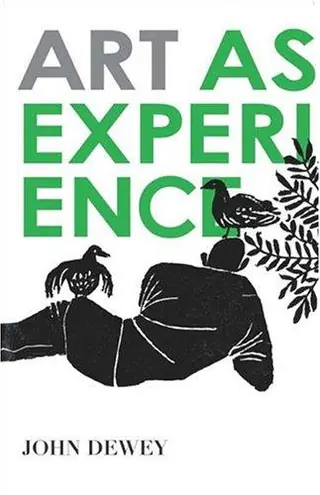
Art as Experience
by John Dewey · first published 1934
100% recommend
Why HN recommends it
Treats art as a heightened, refined experience and separates the art product from the process of creation. Useful for those thinking about creativity and aesthetics, but dense.
Summarised by Claude from recommending comments
Based on John Dewey’s lectures on esthetics, delivered as the first William James Lecturer at Harvard in 1932, Art as Experience has grown to be considered internationally as the most distinguished work ever written by an American on the formal structure and characteristic effects of all the arts: architecture, sculpture, painting, music, and literature.
Affiliate links. As an Amazon Associate I earn from qualifying purchases.
Mentions per year
What Hacker News says
Related books
 2009–2024
Philosophy in the flesh
George Lakoff
Recommended by 14 · mentioned by 2014 recommend · 20 mention14 recommend · 2014 recommend
 2008–2026
Finite and infinite games
James P. Carse, James Carse
Recommended by 58 · mentioned by 7858 recommend · 78 mention58 recommend · 7858 recommend
 2009–2025
Against Method
Paul K. Feyerabend
Recommended by 32 · mentioned by 7232 recommend · 72 mention32 recommend · 7232 recommend
 2008–2025
Your Money Or Your Life
Joe Dominguez, Vicki Robin
Recommended by 42 · mentioned by 4842 recommend · 48 mention42 recommend · 4842 recommend
 2009–2026
Discipline and Punish
Michel Foucault, Simon Prebble
Recommended by 36 · mentioned by 7036 recommend · 70 mention36 recommend · 7036 recommend
 2009–2026
Metaphors We Live By
George Lakoff, Mark Johnson, Lakoff
Recommended by 56 · mentioned by 8156 recommend · 81 mention56 recommend · 8156 recommend
…philosophy books I've read - and I read mostly philosophy for many years - it felt like having my eyes opened. And the book that helped me in understanding art and music far more than any other, Dewey's Art as Experience, I picked up because of good things they say about Dewey in the first pages of Philosophy in the Flesh! I'm a musician and artist, so I'm extremely grateful for that lead.
on “Ask HN: Which book can attract anyone towards your field of study?” ↗Metaphors We Live By - Lakoff/Johnson Philosophy in the Flesh - L/J Rationalism in Politics - Oakeshott Erving Goffman – Presentation of Self in Everyday Life Walter Lippmann – Public Opinion Art as Experience - John Dewey Plutarch's Lives G.K. Chesterton – Heretics (essay) William James - On A Certain Blindness in Human Beings (and its sequel) (essay) R.L. Stevenson - The Lantern-Bearers
on “Ask HN: Books on specific topics that have applied to many areas of your life?” ↗…take the more sensible side. Putnam is a very clear and stimulating writer—his Realism with a Human Face is perhaps his best and a good place to start, filled with remarkably good essays. p.s. Dewey's Art as Experience changed my life. I'm a musician/artist and philosophy student, and it solved all my problems concerning art, which each further book of analytic philosophy of art had only multiplied.
on “How Philosophers Think” ↗…Others, like Nietzsche, Wilde, Hilary Putnam, Dewey, I don't read so constantly but I've read some/most of their books over and over again. Wilde's Intentions, Putnam's Realism with a Human Face, Dewey's Art as Experience, for example, and almost everything of Nietzsche's, e.g. Human, All Too Human or Daybreak, I find endlessly rereadable. Chesterton, Nietzsche and Wilde are very funny too.
on “Ask HN: Books worth reading multiple times?” ↗I'm sure you'll do some thinking on the philosophy of art front. To name a few recommendations: Adorno's Aesthetic Theory (1970) and Dewey's Art as Experience (1934). > Art [as a creation] does not imitate nature, it imitates a creation [or nature, in a Spinozian meaning, which is but an eternal activity of creation], sometimes to propose an alternative world,…
on “I plan to leave tech to pursue art” ↗John Dewey - Art As Experience I'm a jazz musician & artist who also studied philosophy a lot for a long time. Aged about 30 I was reading a lot of philosophy books about art, and about philosophy of music, both the classics and the…
on “Ask HN: Which book/essay changed your life?” ↗If this kind of thing interests you, you might also like John Dewey's Art as Experience. It is among Paul Rand's favorite books, but be warned it is quite dense!
on “Why is it so hard to buy things that work well? (2022)” ↗…that belong to the common and public world. This problem cannot be solved once for all. It is met in every new work undertaken. Otherwise an artist repeats himself and becomes esthetically dead. – Dewey, Art as Experience
…carry the varied elements of the interview to a decisive issue. They enter into the settlement of every situation, whatever its dominant nature, in which there are uncertainty and suspense." - John Dewey, Art as Experience
on “What do the best interviewers have in common?” ↗