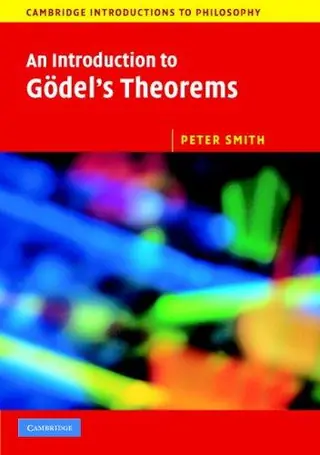
An Introduction to Gödel's Theorems
by Peter Smith · first published 2007
75% recommend25% neutral
Affiliate links. As an Amazon Associate I earn from qualifying purchases.
Mentions per year
What Hacker News says
Related books
 2010–2022
Godel's Theorem
Torkel Franzen
Recommended by 4 · mentioned by 54 recommend · 5 mention4 recommend · 54 recommend
 2011–2024
Incompleteness
Rebecca Goldstein
Recommended by 5 · mentioned by 55 recommend · 5 mention5 recommend · 55 recommend
 2011–2024
Infinity and the mind
Rudy Rucker
Recommended by 8 · mentioned by 138 recommend · 13 mention8 recommend · 138 recommend
 2008–2026
Gödel's proof
Ernest Nagel, James Roy Newman
Recommended by 30 · mentioned by 3930 recommend · 39 mention30 recommend · 3930 recommend
 2007–2026
Gödel, Escher, Bach
Douglas R. Hofstadter
Recommended by 505 · mentioned by 1,055505 recommend · 1,055 mention505 recommend · 1,055505 recommend
 2007–2026
I Am a Strange Loop
Douglas R. Hofstadter
Recommended by 101 · mentioned by 204101 recommend · 204 mention101 recommend · 204101 recommend
Do you have a decent understanding of first order logic? If not, sort that out first. Peter Smith has a good list of books to choose from: http://www.logicmatters.net/2012/05/teach-yourself-logic-1-f... Then get Smith's book An Introduction to Gödel's Theorems. It explains Gödel's results in great detail and doesn't assume too much background knowledge. A certain amount of perseverance will, of
on “Gödel and the limits of logic” ↗I'm not sure why you have it in quotes. But FWIW, most of my questions were cleared up by these two wonderful books: Peter Smith's An Introduction to Gödel's Theorems and Torkel Franzén's Gödel's Theorem: An Incomplete Guide to Its Use and Abuse
on “A Python implementation of formal systems from the book “Gödel, Escher, Bach”” ↗Gödel Without (Too Many) Tears, by Peter Smith. Also his An Introduction to Gödel’s Theorems. https://www.logicmatters.net/books/
on “The complete story of Gödel incompleteness” ↗Lots of reading are available to technical people who are willing. People elsewhere in this thread have mentioned Nagel and Newman, and also Smullyan. Here are two more: 1) Smith's Introduction to Godel's Theorems http://www.logicmatters.net/igt/ is a great book, with all the mathematics but willing to go into the philosophy. 2) Franzen's Gödel's Theorem: An Incomplete Guide to Its Use and Abuse http://www.ams.org/notices/200703/rev-raatikainen.pdf…
on “Memories of Kurt Gödel” ↗…consciousness as pattern and make the claim that a sufficiently powerful AI is as sentient and meaningful a consciousness as we are. I read Godel's Proof after though, and I agree that it is a far clearer introduction to Godel's theorems.
on “What Made Gödel’s Incompleteness Theorem Hard to Prove” ↗