A history of modern computing
by Paul E. Ceruzzi · first published 1998
80% recommend20% neutral
Why HN recommends it
Well-researched overview of computing history from ENIAC onward, strongest on the 1950s to 1970s and on companies like DEC; valued for its academic rigor and bibliography by working engineers and history readers.
Summarised by Claude from recommending comments
This engaging history covers modern computing from the development of the first electronic digital computer through the advent of the World Wide Web. The author concentrates on four key moments of transition: the transformation of the computer in the late 1940s from a specialized scientific instrument to a commercial product; the emergence of small systems in the late 1960s; the beginnings of personal computing in the 1970s; and the spread of networking after 1985.
Affiliate links. As an Amazon Associate I earn from qualifying purchases.
Mentions per year
What Hacker News says
Related books
 2012–2024
From Airline Reservations to Sonic the Hedgehog
Martin Campbell-Kelly
Recommended by 2 · mentioned by 52 recommend · 5 mention2 recommend · 52 recommend
 2014–2022
A history of computing technology
Michael R. Williams
Recommended by 2 · mentioned by 32 recommend · 3 mention2 recommend · 32 recommend
 2013–2024
Grace Hopper and the invention of the information age
Kurt W. Beyer
Recommended by 2 · mentioned by 52 recommend · 5 mention2 recommend · 52 recommend
 2014–2026
The thrilling adventures of Lovelace and Babbage
Sydney Padua
Recommended by 14 · mentioned by 1514 recommend · 15 mention14 recommend · 1514 recommend
 2009–2025
Computing in the Middle Ages
Severo M. Ornstein
Recommended by 8 · mentioned by 108 recommend · 10 mention8 recommend · 108 recommend
 2017–2026
Programmed inequality
Mar Hicks
Recommended by 7 · mentioned by 127 recommend · 12 mention7 recommend · 127 recommend
 2013–2026
Turings Cathedral Vintage
George Dyson
Recommended by 8 · mentioned by 108 recommend · 10 mention8 recommend · 108 recommend
 2015–2025
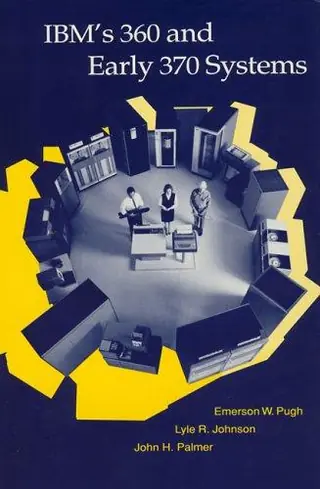
IBM's 360 and early 370 systems
Emerson W. Pugh
Recommended by 6 · mentioned by 96 recommend · 9 mention6 recommend · 96 recommend
Paul E. Ceruzzi's A History of Modern Computing does a good job of filling in the story, as Bricklin wishes here that someone would do. It is especially good on the 1950's, 60's, and 70's, and the origins and legacy of DEC (Digital) and other companies…
on “Thoughts on the culture that gave birth to the personal computer (2013)” ↗The most authoritative work is Ceruzzi's A History of Modern Computing (http://amzn.to/1TiHgqd). Because it's written by an academic, not a journalist, it also has a great bibliography and footnotes. Some of the works it cites that are very valuable in themselves, depending…
on “Ask HN: How to learn about the history of computing?” ↗The standard textbooks by historians are: A History of Modern Computing by Paul Ceruzzi Computer: A History of the Information Machine by Martin Campbell-Kelly and William Aspray There are good books by journalists and popular writers. Favorites on HN are: The Dream Machine:…
on “Ask HN: Where to learn about computer science and software engineering history?” ↗I loved A History of Modern Computing by Paul Ceruzzi https://www.amazon.com/History-Modern-Computing/dp/026253203...
on “Ask HN: Anything Like Carl Sagan's Cosmos for Computer Science?” ↗The Innovators by Walter Issacson A History of Modern Computing 2ed by Paul Ceruzzi The Innovator's Dilemma by Clayton Christensen Connections by James Burke (also a PBS series)
on “Ask HN: How do I learn about the history of innovation?” ↗…science." I highly recommend the following books that helped me out on that journey: - Continuous Delivery by Jez Humble and Dave Farley - The Pragmatic Programmer by Andy Hunt and Dave Thomas - A History of Modern Computing by Paul E. Ceruzzi - Version Control with Git by Prem Ponuthorai and Jon Loeliger - and SICP. Understanding it is like accessing a new dimension of power.
on “Books for Software Engineers in 2023” ↗Highly recommend A History of Modern Computing [1]. Starting with the ENIAC in the '40s through the successive generations of computing technology in the 20th century, it gives a fantastic overview of the field's history. Sadly, now that I look into…
on “Ask HN: Computer Science/History Books?” ↗I think the way to go about it is read some books gradually on history of computing & the various designs and rationale that evolved over time. Consider these sources: 1. The Annotated Turing. 2. A History of Modern Computing 3ed 3. The ACM Turing award lectures 4. Theory of computation - Dexter Kozen 5. Coders at Work 6. Hackers: Heroes of the computer revolution Additionally, you could subscribe to Communications of…
on “Ask HN: Best way to learn about computing history?” ↗A History of Modern Computing is great Would add: - How The Internet Happened (history of the internet) - To The Digital Age (transistor history)
on “Ask HN: Best way to learn about computing history?” ↗…famous; I gave a lecture on the HP-35 and other early pocket calculators). http://www.cs.sjsu.edu/~mak/CS185C/ There are a lot of links to papers and other videos. The textbook used in the class was "A History of Modern Computing, 2nd edition" by Paul E. Ceruzzi Visit the Computer History Museum in Mountain View, CA, Paul Allen's Living Computer Museum in Seattle, WA (computers that still run), and London's Science Museum.
on “Ask HN: How to learn about the history of computing?” ↗The "History of Computing" class I took in college used Ceruzzi's "A History of Modern Computing" and "From Airline Reservations to Sonic the Hedgehog" as our textbooks.
on “Ask HN: How to learn about the history of computing?” ↗I'm currently reading "Persepolis," the graphic novel by Marjane Satrapi, and MIT Press' "A History of Modern Computing." I recently acquired a copy of Steven Levy's "Hackers," which I'd like to at least start before the end of the summer.
on “What are you reading?” ↗