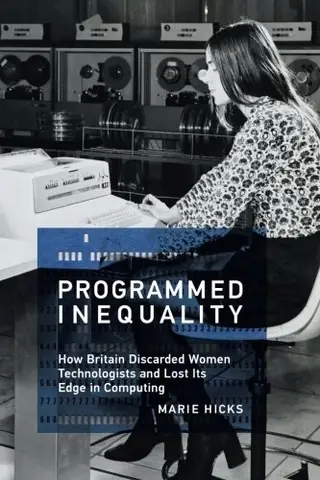
Programmed inequality
by Mar Hicks · first published 2017
58% recommend42% neutral
Why HN recommends it
Historical account of how Britain lost its mid-1940s computing lead after pushing women technologists out of the profession, with anecdotes from women who worked in the field. Suits readers of computing history.
Summarised by Claude from recommending comments
Affiliate links. As an Amazon Associate I earn from qualifying purchases.
Mentions per year
What Hacker News says
Related books
 2012–2024
From Airline Reservations to Sonic the Hedgehog
Martin Campbell-Kelly
Recommended by 2 · mentioned by 52 recommend · 5 mention2 recommend · 52 recommend
 2009–2023
A history of modern computing
Paul E. Ceruzzi
Recommended by 8 · mentioned by 108 recommend · 10 mention8 recommend · 108 recommend
 2018–2024
Hidden Figures
Margot Lee Shetterly
Recommended by 5 · mentioned by 105 recommend · 10 mention5 recommend · 105 recommend
How the Internet happened
Brian McCullough
Recommended by 7 · mentioned by 117 recommend · 11 mention7 recommend · 117 recommend
 2014–2026
The thrilling adventures of Lovelace and Babbage
Sydney Padua
Recommended by 14 · mentioned by 1514 recommend · 15 mention14 recommend · 1514 recommend
 2008–2023
Alan Turing
Andrew Hodges
Recommended by 17 · mentioned by 2417 recommend · 24 mention17 recommend · 2417 recommend
 2014–2026
The Innovators
Walter Isaacson, Francisco José Ramos Mena, Marcos Pérez Sánchez, Inga Pellisa Díaz
Recommended by 55 · mentioned by 7355 recommend · 73 mention55 recommend · 7355 recommend
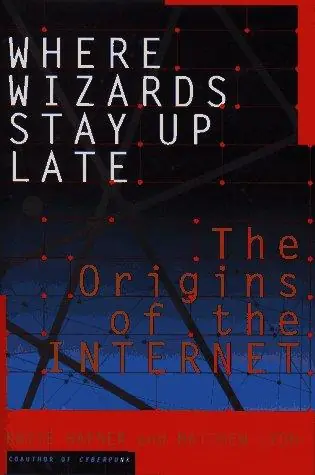 2008–2026
Where wizards stay up late
Katie Hafner, Katie Hefner, Matthew Lyon
Recommended by 86 · mentioned by 10986 recommend · 109 mention86 recommend · 10986 recommend
There are great essays on the topic, but basically - they were kicked out when the position started to earn money for the business. Programmed Inequality by Marie Hicks [0] is a great introduction to some of the history. As my mother was a software engineer in the 70s, it's so incredibly upsetting to hear folks describe how it's just an inherently male…
on “1969 and 1970 at Bell Labs” ↗In addition to the great books listed here, a few more that might be of interest: - Turing’s Cathedral, by George Dyson - Black Software, by Charlton McIlwain - Programmed Inequality, by Mar Hicks The Dyson book is a rigorous and deep historical dive into the philosophical and practical origins of digital computing, and is really great. The other two are equally great and deep but…
on “Ask HN: Best way to learn about computing history?” ↗Programmed Inequality by Mar Hicks, https://mitpress.mit.edu/books/programmed-inequality On the history of women in programming in Britain and how they got discarded from the profession.
on “Ask HN: Computer Science/History Books?” ↗There's a short book that covers this period of British computing history: Programmed Inequality: How Britain Discarded Women Technologists and Lost Its Edge in Computing, by Mar Hicks. It's more history than sociology, though the title suggests otherwise. There are interesting anecdotes from women…
on “A woman named "Steve" – IT pioneer, entrepreneur, philanthropist (2019)” ↗No true scotsman? This is a good book on the topic: https://www.amazon.com/Programmed-Inequality-Discarded-Techn...
on “Magnus Carlsen Wins the Freestyle (Chess960) World Championship” ↗For more on the British computer industry and why it was a failure despite being world-leading in the mid-1940s, see Marie Hicks' "Programmed Inequality". It's part of the venerable MIT Computer History series. https://mitpress.mit.edu/books/programmed-inequality
on “Mary Lee Berners-Lee has died” ↗A good history of early British computing is Programmed Inequality. Gets at why that country squandered its WW2-era computing lead (spoiler alert: sexism was part of it). https://mitpress.mit.edu/books/programmed-inequality
on “Ask HN: Computer Science/History Books?” ↗“The reason that these pre-electronic computation jobs were feminized is they were seen as rote and de-skilled,” says Mar Hicks, a historian and author of Programmed Inequality. It wasn’t true, though: “In a lot of cases, the women doing these computation jobs actually had to have pretty advanced math skills and math training, especially if they were doing very complex calculations.”…
on “Human Shader” ↗Mar Hicks' book Programmed Inequality [1] is some of the story of how post-war Britain lost the lead in computing. [1] https://mitpress.mit.edu/9780262535182/programmed-inequality...
on “‘She played it down’: Bletchley Park codebreaker dies at 99” ↗…things were, we don't understand why anti-trust and food protections laws are still on the books. That said, the WSJ article is pay-walled. The introduction makes me think it's to do with Hick's new book "Programmed Inequality: How Britain Discarded Women Technologists and Lost Its Edge in Computing". It might instead cover something else, and I'm simply out of the loop.
on “The First Women in Tech Didn’t Leave, Men Pushed Them Out” ↗"In 1973, at the moment that her picture was being brought into the lab, there were hundreds if not thousands of women being pushed out,” said Marie Hicks, a historian of technology and author of Programmed Inequality.1 “All this happened for a reason. If they hadn’t used a Playboy centerfold, they almost certainly would have used another picture of a pretty white woman. The Playboy thing gets our attention, but really…
on “Finding Lena Forsen, the Patron Saint of JPEGs” ↗…women programmers in the 60s in the UK and why Stephanie Shirley had to open her own company (spoil: because women were actively push out of the field), Marie Hicks is the specialist.[0] She wrote a book, Programmed Inequality. She studied Shirley’s story of course, and did an interview of Shirley last year.[1] The article “only the clothes changed: Women Operators in British Computing and Advertising, 1950–1970” from Hicks…
on “An 85-year-old tech entrepreneur who made her staff millionaires” ↗