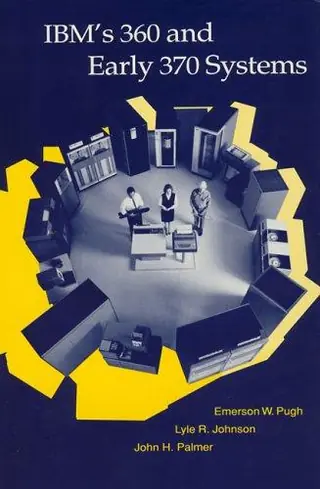
IBM's 360 and early 370 systems
by Emerson W. Pugh · first published 1991
67% recommend33% neutral
Why HN recommends it
Detailed account of how IBM's System/360 and early 370 machines were engineered, focusing on hardware and architecture, not business history. A solid companion to its predecessor for engineers and history readers.
Summarised by Claude from recommending comments
No new product offering has had greater impact on the computer industry than the IBM System/360. IBM's 360 and Early 370 Systems describes the creation of this remarkable system and the developments it spawned, including its successor, System/370. The authors tell how System/360's widely-copied architecture came into being and how IBM failed in an effort to replace it ten years later with a bold development effort called FS, the Future System. --from publisher description.
Affiliate links. As an Amazon Associate I earn from qualifying purchases.
Mentions per year
What Hacker News says
Related books
 2012–2024
From Airline Reservations to Sonic the Hedgehog
Martin Campbell-Kelly
Recommended by 2 · mentioned by 52 recommend · 5 mention2 recommend · 52 recommend
 2013–2024
Grace Hopper and the invention of the information age
Kurt W. Beyer
Recommended by 2 · mentioned by 52 recommend · 5 mention2 recommend · 52 recommend
 2009–2023
A history of modern computing
Paul E. Ceruzzi
Recommended by 8 · mentioned by 108 recommend · 10 mention8 recommend · 108 recommend
 2009–2025
Computing in the Middle Ages
Severo M. Ornstein
Recommended by 8 · mentioned by 108 recommend · 10 mention8 recommend · 108 recommend
 2008–2024
Crypto
Steven Levy
Recommended by 26 · mentioned by 3426 recommend · 34 mention26 recommend · 3426 recommend
How the Internet happened
Brian McCullough
Recommended by 7 · mentioned by 117 recommend · 11 mention7 recommend · 117 recommend
 2014–2026
The thrilling adventures of Lovelace and Babbage
Sydney Padua
Recommended by 14 · mentioned by 1514 recommend · 15 mention14 recommend · 1514 recommend
 2009–2026
A Quarter Century of UNIX
Peter H. Salus
Recommended by 7 · mentioned by 187 recommend · 18 mention7 recommend · 187 recommend
Two which I found very readable while also being very technical: "IBM's Early Computers" and "IBM's 360 and Early 370 Systems" by Emerson Pugh.
on “The Birth of Unix with Brian Kernighan” ↗IBM's Early Computers A Technical History by Charles J. Bashe, Emerson W. Pugh, John H. Palmer and Lyle R. Johnson IBM's 360 and Early 370 Systems by Emerson W. Pugh, Lyle R. Johnson and John H. Palmer Computer Engineering: A DEC View of Hardware Systems Design by C. Gordon Bell (Author), J. Craig Mudge John E. McNamara
on “The Soul of an Old Machine” ↗A few good ones that haven't been mentioned yet: * "IBM's 360 and Early 370 Systems " https://mitpress.mit.edu/books/ibms-360-and-early-370-system... * "Broad Band: The Untold Story of the Women Who Made the Internet" https://www.goodreads.com/book/show/35953464-broad-band * "Fire…
on “Ask HN: Computer Science/History Books?” ↗…depending on your area of interest, are: - R. Hodeson, Crystal Fire (on the invention of the transistor), http://amzn.to/1RictfF - T.R. Reid, The Chip (on the IC), http://amzn.to/1Hdbu8w - E.W. Pugh, IBM's 360 and Early 370 Systems, (on the evolution of computer architecture), http://amzn.to/1NKZcWQ Also, as others have mentioned, Soul of a New Machine is awesome. I feel like you may be asking about computer science, though, not…
on “Ask HN: How to learn about the history of computing?” ↗I wonder how they define "classics" - two of my cherished titles from MIT Press are "IBM's Early Computers" (1985) and "IBM's 360 and Early 370 Systems" (1991). They're examples of what I consider "The Perfect Computer Book". https://mitpress.mit.edu/books/ibms-early-computers https://mitpress.mit.edu/books/ibms-360-and-early-370-system...
on “Free Classic Books by MIT Press on Archive.org” ↗This, and "IBM's 360 and Early 370 Systems" are two of my favorite computer-related books. I wish other historical books were as thick and as thorough and well-written.
on “IBM's Early Computers” ↗The book "IBM's 360 and Early 370 systems" by IBM Press goes DEEP into the development of these systems, and is one of my very favorite technical books. I paid $50 for a used copy more than a decade ago and it's well worth it. (also: "IBM's…
on “Case Study: IBM's System/360-370 Architecture (1987) [pdf]” ↗Coincidentally, I finished reading "IBM's 360 and Early 370 Systems" earlier today. I highly recommend it and its predecessor, "IBM's Early Computers" from the MIT press. The business aspect is there, of course, but it's really about the development of the machines…
on “IBM System/360 Principles of Operation (1964) [pdf]” ↗IBM's Early Computers and IBM's 360 and Early 370 Systems. They are an incredible wealth of information for the research, design and implementations of early computers. Been aching to know about how the different transistors were developed, by whom and what…
on “Ask HN: Computer Science/History Books?” ↗Not GP, but 'IBM's 360 and Early 370 Systems', Pugh, Johnson, Palmer is solid.
on “Ask HN: Forensic analysis for 50 year-old tape?” ↗…especially heavy and thick if your program terminated abnormally with an ABEND type of error and a sysdump printed out. For references, see the books "Mainframes, Computing on Big Iron" by Patrick Stakem and "IBM's 360 and Early 370 Systems" by Emerson W. Pugh.
on “Ask HN: Stories from Users of Minicomputers and Mainframes” ↗…and IBM Annual Reports for 1965 and 1966. Wise (1966b) is a Fortune article titled "IBM's $5,000,000,000 gamble". I can't find the annual reports readily online. It looks like you want Appendix C of "IBM's 360 and Early 370 Systems" at https://books.google.com/books?id=MFGj_PT_clIC&pg=PA619&dq=I... , with financial an employee data for IBM from 1950 to 1977. In the early 1960s IBM had revenue of over $1.5 billion/year. Even then,…
on “The IBM System/360: the first modular, general-purpose computer” ↗IBM's 360 and Early 370 Systems is available on the internet archive. It's pretty pricey otherwise. https://archive.org/details/ibms360early370s0000pugh
on “The Birth of Unix with Brian Kernighan” ↗Speaking of Multics, I am reading "IBM's 360 and Early 370 Systems". In passing, the narrative mentions an early public rejection of S/360 by MIT and Bell Labs because it didn't have hardware-aided dynamic address translation used in time sharing. Instead, they went…
on “Unix: A History and a Memoir, by Brian Kernighan” ↗I had been reading about speeding up game programs by taking advantage of cache lines. Also, I've been reading "IBM's 360 and Early 370 Systems" and came upon the initial development of cache. You'd think that the initial cache would fetch and store a word, but it didn't. It grabbed a block of words. In other words, a cache line. In 1968.
on “IBM Adds POWER9 AIO, Pushes for an Open Memory-Agnostic Interface” ↗