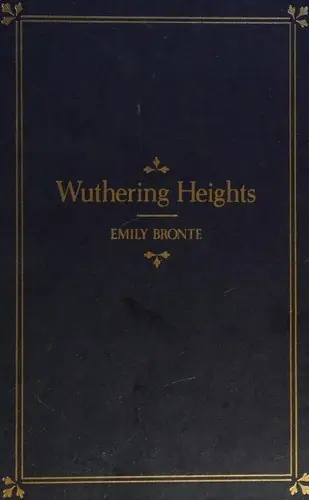
Wuthering Heights
by Emily Brontë · first published 1846
9% recommend61% neutral30% critical
Wuthering Heights is an 1847 novel by Emily Brontë, initially published under the pseudonym Ellis Bell. It concerns two families of the landed gentry living on the West Yorkshire moors, the Earnshaws and the Lintons, and their turbulent relationships with Earnshaw's adopted son, Heathcliff. The novel was influenced by Romanticism and Gothic fiction.
Affiliate links. As an Amazon Associate I earn from qualifying purchases.
Mentions per year
What Hacker News says
Related books
 2010–2024
Atonement
Ian McEwan
Recommended by 2 · mentioned by 62 recommend · 6 mention2 recommend · 62 recommend
 2010–2026
Little Women
Louisa May Alcott
Recommended by 4 · mentioned by 154 recommend · 15 mention4 recommend · 154 recommend
 2010–2024
The Secret Garden
Frances Hodgson Burnett
Recommended by 4 · mentioned by 84 recommend · 8 mention4 recommend · 84 recommend
 2010–2026
The Western canon
Harold Bloom
Recommended by 6 · mentioned by 146 recommend · 14 mention6 recommend · 146 recommend
 2010–2026
Great Expectations
Charles Dickens
Recommended by 5 · mentioned by 135 recommend · 13 mention5 recommend · 135 recommend
 2009–2026
The Count of Monte Cristo
Alexandre Dumas
Recommended by 128 · mentioned by 260128 recommend · 260 mention128 recommend · 260128 recommend
 2008–2026
Pride and Prejudice
Jane Austen
Recommended by 36 · mentioned by 11536 recommend · 115 mention36 recommend · 11536 recommend
 2009–2026
The Canterbury Tales
Geoffrey Chaucer, John E. Cunningham, Peter Ackroyd, Ted Stearn
Recommended by 15 · mentioned by 7115 recommend · 71 mention15 recommend · 7115 recommend
Between September and October I put down my usual collection of science fiction and cookbooks to read books from female authors. I strongly recommend each: 1. Pride and Prejudiced by Jane Austen 2. Wuthering Heights by Emily Bronte 3. The Handmaid's Tale by Margaret Atwood edit: line breaks
on “Ask HN: Books you read in 2018?” ↗…was it. Also, society has changed so much. I grew up in a time when there was no such thing as "children's books". My first reading was some pulp fiction, then some bestsellers, then Dracula. I got to Wuthering Heights when I was n. I found it gripping, but I understood almost nothing. Luckily - crazy luckily - I have a friend, a n-year-old girl, who also read Wuthering and introduced me to it. So I read it again.
on “Book people think they know why 9-year-olds stop reading for fun” ↗> "How a human being could have attempted such a book as [Emily Brontë’s Wuthering Heights] without committing suicide before he [sic] had finished a dozen chapters, is a mystery. It is a compound of vulgar depravity and unnatural horrors. …" Just from that excerpt I can't tell if that critic…
on “Why Great Critics Make Disastrous Judgments” ↗I have read a lot of classic books and several of them are quite dull. I have no idea why you would read both Wuthering Heights and The Count of Monte Cristo just because they are "classic". For people that really want to read through some these books, I actually recommend the abridged versions first. It is a lot easier to read…
on “See how many classic books you can read in 2023 with just 20 minutes a day” ↗…Picture of Dorian Gray" by Oscar Wilde "Frankenstein" by Mary Shelley "The Count of Monte Cristo" by Alexandre Dumas "Little Women" by Louisa May Alcott "Great Expectations" by Charles Dickens "Wuthering Heights" by Emily Brontë "The Call of the Wild" by Jack London "The Adventures of Tom Sawyer" by Mark Twain "The Hound of the Baskervilles" by Arthur Conan Doyle "Dracula" by Bram Stoker "The Legend…
…Indispensible Rules for Finding Even the Most Elusive Software and Hardware Problems" The rest (all first-time reads) - "Absolution" by Jeff Vandermeer (I enjoyed it but it was kind of unnecessary) - "Wuthering Heights" by Emily Bronte (I don't get the fascination with it) - "Strange Pictures" by Uketsu (odd) - "Starship Troopers" by Heinlein - "Rendezvous with Rama" by Arthur C. Clarke - "Ubik" by Philip K. Dick…
on “Ask HN: What did you read in 2025?” ↗Harper Lee (To Kill a Mockingbird) and Emily Brontë (Wuthering Heights) are two other important writers in this category.
on “I hated writing–until I learned there's a science to it(2024)” ↗…I’ll hurt you seriously! I’ll have you all modelled in wax and clay! and the first who passes the limits I fix shall—I’ll not say what he shall be done to—but, you’ll see! Go, I’m looking at you!” -- Wuthering Heights (1847), Chapter 2, Emily Brontë. I wonder what the frequency of AI common words like delve and other words/phrases are in Project Gutenberg, Wikipedia, and other collections.
on “Ahmad on X: "Anthropic's War on open source AI" / X” ↗7. Wuthering Heights – Emily Bronte
…completely endulge oneself in the language, what is? Of course, watching the Simpsons all day won't teach me some of the rarely used words. But there must be some stepping stones. I still haven't read Wuthering Heights because I don't want to have a dictionary lying around just to understand the story. And looking up something, reading on and forgetting it at the end of the day is quite common for me. Also I'm sure…
on “Estimate your English vocabulary size” ↗…not a good thing for a novel. Could you elaborate on this, especially with what basic facts are missing? My view on literature is optimistic about telling particular truths about society. For example, "Wuthering Heights" [0] looks like quite an honest view of society. Then again, this may be an exception more than the rule for that particular time period (I'm not personally sure, as I haven't read many books from that…
on “How did the Victorians become a reference point for joyless prudery?” ↗…books started to look interesting. Maybe it's because my hair decided that long wasn't what it wanted to be, in fact what it wanted was to not be. When people ask me if I've read Robinson Crusoe or Wuthering Heights or Great Expectations, I can look them in the eye and say yes, but that's only because back in the '80s, someone took the trouble to publish them in comic book form :D These days I read Pratchett.
on “Becoming "well read"” ↗…haven't read yet, and there are a lot of them. At first, I was hesitant to dive into classics, because I thought they were hard to read and highbrow. This has mostly not been the case (with the exception of Wuthering Heights, which I found impossible to get through). To wit, the best books I've read this year include: A Tale of Two Cities - Impossible to get through the first several chapters, but after that, you're off…
on “Ask HN: What good books have you read in 2016?” ↗…Even when someone says "I don't like author <X>.", if someone explains what they don't like, you can often find a different story that they like just fine. By contrast, forcing "Pride and Prejudice" or "Wuthering Heights" onto a ninth grade teenager who digs surreal humor is just going to make them want to give up on reading completely.
on “On pretending to have read books” ↗Yeah font size, but also just the work itself. If I'm reading epic fantasy I'll fly along. If I'm reading Wuthering Heights I'm crawling. I think it evens out.
on “Lex Fridman's Reading Plan in Numbers” ↗