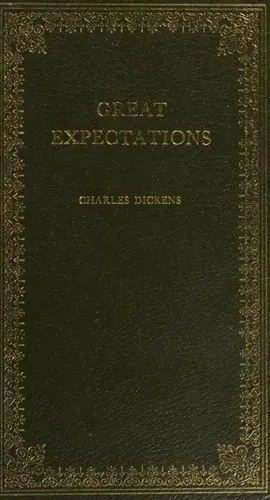
Great Expectations
by Charles Dickens · first published 1861
38% recommend62% neutral
Why HN recommends it
Offers a gripping storyline with a memorable twist and serves as an accessible entry point into classic English literature. Its phrasing and quips are memorable, and it suits students and those new to Dickens.
Summarised by Claude from recommending comments
Great Expectations is the thirteenth novel by Charles Dickens and his penultimate completed novel. It depicts the education of an orphan nicknamed Pip (the book is a bildungsroman; a coming-of-age story). It is Dickens' second novel, after David Copperfield, to be fully narrated in the first person. The novel was first published as a serial in Dickens's weekly periodical All the Year Round, from 1 December 1860 to August 1861. In October 1861, Chapman and Hall published the novel in three volumes. The novel is set in Kent and London in the early to mid-19th century and contains some of Dick
Affiliate links. As an Amazon Associate I earn from qualifying purchases.
Mentions per year
What Hacker News says
Related books
 2010–2024
Far from the Madding Crowd
Thomas Hardy
Recommended by 1 · mentioned by 41 recommend · 4 mention1 recommend · 41 recommend
 2010–2026
Anne of Green Gables
Lucy Maud Montgomery
Recommended by 4 · mentioned by 144 recommend · 14 mention4 recommend · 144 recommend
 2009–2025
Dracula
Bram Stoker
Recommended by 12 · mentioned by 3612 recommend · 36 mention12 recommend · 3612 recommend
 2009–2026
Madame Bovary
Gustave Flaubert
Recommended by 16 · mentioned by 3816 recommend · 38 mention16 recommend · 3816 recommend
 2010–2024
A Fine Balance
Rohinton Mistry
Recommended by 10 · mentioned by 1110 recommend · 11 mention10 recommend · 1110 recommend
 2016–2026
The Hound of the Baskervilles
Arthur Conan Doyle
Recommended by 5 · mentioned by 135 recommend · 13 mention5 recommend · 135 recommend
 2009–2026
Gone With the Wind
Margaret Mitchell
Recommended by 1 · mentioned by 171 recommend · 17 mention1 recommend · 171 recommend
 2010–2026
Little Women
Louisa May Alcott
Recommended by 4 · mentioned by 154 recommend · 15 mention4 recommend · 154 recommend
…enjoy reading him so much. Sure, he's turgid in places (the second chapter of the first volume of LOTR is easily the worst part of the whole book), but then so's a lot of Charles Dickens' work. I love Great expectations but still wince at the hackery of Hard Times...there's a reason nobody even tried to make a movie out of that one.
on “Is Tolkien Actually Any Good? (2003)” ↗Great Expectations (Charles Dickens). It grows on you after you've read through the first part.
on “Ask HN: What are some Good Books you have read in past one year or so..” ↗We had Charles Dickens's Great Expectations in school. I was mesmerised by the incredible storyline and the shocking twist at the end. It introduced me to western classic literature for the first time and I was really impressed. Then in college,…
on “Why Read the Classics? (1986)” ↗The War of The Worlds, H.G. Wells, 1898 Great Expectations, Charles Dickens, 1861 Zur Elektrodynamik bewegter Körper ("On the Electrodynamics of Moving Bodies"), A. Einstein, 1905
on “Ask HN: What are your favorite books or essays written at least 100 years ago?” ↗…and beautiful with lots of memorable phrases/quotes/quips etc. Every kid should be asked to read the complete canon and then discuss takeaways from them. 2) Charles Dickens - Started with Oliver Twist, Great Expectations These books (read the unabridged versions) were my introduction to the "Human Condition/Human Values" faced by people from different economic strata. His books span different genres but always end with…
on “Ask HN: What book had a big impact on you as a child or teenager?” ↗On the contrary, many books that now live in the literary canon as "classics" were barely appreciated or noticed in their own time. It is almost certain that even a commercial success like Great Expectations or The Adventures of Tom Sawyer enjoy more readers in the 21st Century than the 19th.
on “Choose your reading carefully” ↗…publishing and copyright enforcement was a bit of a free-for-all back then), and even the book-length versions of the novels had to be subsidized with advertising to offset the piracy losses. I have a copy of Great Expectations with advertisements for laundry soap and brass polish, which were aimed at the servants who were the target audience for the book.
on “Amazon leaks Kindle Unlimited” ↗…"Jane Eyre" by Charlotte Brontë "The Picture of Dorian Gray" by Oscar Wilde "Frankenstein" by Mary Shelley "The Count of Monte Cristo" by Alexandre Dumas "Little Women" by Louisa May Alcott "Great Expectations" by Charles Dickens "Wuthering Heights" by Emily Brontë "The Call of the Wild" by Jack London "The Adventures of Tom Sawyer" by Mark Twain "The Hound of the Baskervilles" by Arthur Conan Doyle…
Join for all of the reasons given and alluded to, but drop the 'Expectations' part. Or if you insist on having them, go read Charles Dickens 'Great Expectations' one more time (or for the first time) and then ponder...
on “Working for a Start-up: Expectations” ↗This has been done in newspapers and magazines since before tvs were accessible to the public. Charles Dickens's 'Great Expectations,' for example was published in serial form in his weekly newsletter.
on “Watch a series… would you read a series?” ↗"it's a good rule never to leave documentary evidence if you can help it, because you don't know when it may be put in." - from Great Expectations by Charles Dickens
on “German intelligence agency halts Internet monitoring for NSA” ↗…website called "Serial Literature" that allowed you to subscribe and read the book in a similar way, serialized, but in your email. I also added another famous work that was initially published serialized, Great Expectations by Charles Dickens. I later added about other 100 books to be read the same way (not all of them originally serialized). I never posted about it anywhere else (maybe flopped on Reddit, I don't remember),…
on “Show HN: (the return of) Read The Count of Monte Cristo and others in your email” ↗…website called "Serial Literature" that allowed you to subscribe and read the book in a similar way, serialized, but in your email. I also added another famous work that was initially published serialized, Great Expectations by Charles Dickens. I later added about other 100 books to be read the same way (not all of them originally serialized). I never posted about it anywhere else (maybe flopped on Reddit, I don't remember),…
on “Show HN: Public domain classics delivered as weekly email installments” ↗10. Great Expectations – Charles Dickens
…on the Web. He starts with a seed list of, say, five author-title pairs: Isaac Asimov, The Robots of Dawn David Brin, Startide Rising James Gleick, Chaos: Making a New Science Charles Dickens, Great Expectations William Shakespeare, The Comedy of Errors and just combing the web for patterns between the elements of each pair. Instead of pristine microformats and "proper" HTML, he takes what he gets: <LI><B>title</B>…
on “Don't Start Big, Start a Little Snowball” ↗