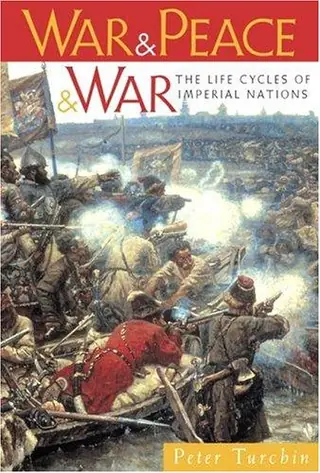
War and Peace and War
The Life Cycles of Imperial Nations
by Peter Turchin · first published 2005
63% recommend38% neutral
Why HN recommends it
Pop-science account of Turchin's cliodynamics work on why empires rise and fall, using historical data and theory on group cohesion and elite dynamics; suited to readers curious about history through a quantitative lens.
Summarised by Claude from recommending comments
Like Jared Diamond in Guns, Germs, and Steel, Peter Turchin in War and Peace and War uses his expertise in evolutionary biology to make a highly original argument about the rise and fall of empires. Turchin argues that the key to the formation of an empire is a society's capacity for collective action. He demonstrates that high levels of cooperation are found where people have to band together to fight off a common enemy, and that this kind of cooperation led to the formation of the Roman and Russian empires, and the United States. But as empires grow, the rich get richer and the poor get poo
Affiliate links. As an Amazon Associate I earn from qualifying purchases.
Mentions per year
What Hacker News says
Related books
 2010–2025
The structures of everyday life
Fernand Braudel
Recommended by 7 · mentioned by 97 recommend · 9 mention7 recommend · 97 recommend
 2010–2026
Albion's Seed
David Hackett Fischer
Recommended by 24 · mentioned by 3624 recommend · 36 mention24 recommend · 3624 recommend
 2008–2026
The fourth turning
William Strauss, Neil Howe
Recommended by 15 · mentioned by 3715 recommend · 37 mention15 recommend · 3715 recommend
 2007–2026
Guns, Germs, and Steel
Jared Diamond
Recommended by 214 · mentioned by 510214 recommend · 510 mention214 recommend · 510214 recommend
 2007–2026
A short history of nearly everything
Bill Bryson
Recommended by 102 · mentioned by 123102 recommend · 123 mention102 recommend · 123102 recommend
 2007–2026
Foundation
Isaac Asimov
Recommended by 143 · mentioned by 487143 recommend · 487 mention143 recommend · 487143 recommend
I'd refer you to Peter Turchin, War and Peace and War. He argues that it's not capitalism that leads to wealth concentration, it's peace, stability, and prosperity -- since we can see this problem worldwide, and very far back in history. Since peace breeds…
on “Trump’s F.C.C. Pick Quickly Targets Net Neutrality Rules” ↗I wouldn't bet on the US's longevity. Read Peter Turchin, War and Peace and War (discussed here a week or two ago), particularly noting his part about how multiple imperial peoples can't coexist in a single country... The Fourth Turning -- on the patterns that generations tend to…
on “Show HN: Mest – Place to talk with those you disagree with” ↗You might also be interested in Peter Turchin's War and Peace and War -- which depicts social cohesion as the measure of social health, and internal competition among like-minded members of a society as the beginning of the end. (This is confirmed repeatedly by history,…
on “Survival of the Friendliest” ↗…Group cohesion and dependency is so powerful that it's often the number one factor in determining which societies/countries/groups come out victorious with intergroup conflict. A great book called "War and Peace and War" by Peter Turchin is a fantastic book to read if this concept interests you. Another one, "Tribe" by Sebastion Junger also explores this topic.
on “Why We Dominate the Earth” ↗…the title of his book -- _Collapse: How Civilizations Choose to Fail or Succeed_ -- should have been something a lot less authoritative.) For what I think is actually the case, look up Peter Turchin's _War and Peace and War_, an "old-fashioned" -- or rather, newfangled -- work pointing to the importance of civilizational cohesion (Ibn Khaldun's asabiya, but not the normal Arabic definition of it) in the rise and fall of…
on “Want Passionate Kids? Leave 'em Alone” ↗Peter Turchin published a highly readable pop-science account of his work in a book called War and Peace and War. I read it a few months ago and gave a review. http://chester.id.au/2012/05/14/review-war-and-peace-and-war... What's left out of this link is that Turchin still hedges his findings heavily. He's not…
on “Human cycles: History as science” ↗…political thermodynamics that destroys all nations, no matter how great. Peter Turchin has developed an interesting family of theories about the rise and fall of great powers. He wrote a popular account, War and Peace and War, which I reviewed here: http://chester.id.au/2012/05/14/review-war-and-peace-and-war... As a footnote, I found why he used the term 'Asabiya'. It comes from an earlier historian, Ibn al-Khaldun.
on “Mission Creep: When Everything Is Terrorism” ↗Turchin, like I suspected. War and Peace and War is his first book on the subject, which is well worth reading. He's an ethnic Russian in the US, and focuses on US and Russian history; his model explains both countries very well, but he openly admits…
on “Computer Simulations Suggest War Drove the Rise of Civilisations (2013)” ↗…certainly not recent, and they're not just due to drugs. For Appalachia, read _Albion's Seed_ or at least Slate Star Codex's review ("the sensibility is positively Orcish"); for Sicily, read Peter Turchin's _War and Peace and War_ (watch for the section on "asabiyya black holes"), and probably _The Moral Basis of a Backwards Society_. Both of these societies have been absolutely awful for centuries.
on “Peak Millennial? Cities Can’t Assume a Continued Boost from the Young” ↗…you looking for world history? US history? Philosophy? History in tech? I can't say much about world history, but I've been reading some books to get a better understanding of American politics: - "War and Peace and War: The Rise and Fall of Empires": Interesting analysis on the rise and fall of conquering civilizations. Tons of parallels between dead empires and the US empire. - "The Death and Life of Great American…
on “The Griffin Warrior Tomb Upends What We Know About the Roots of Mycenae” ↗You might be interested in _War and Peace and War_, a theory of history focusing on social capital as a driving force, and in _The Fourth Turning_ -- which looks at changes over four-generation intervals, and which, written in 1997, made some surprisingly…
on “Ask HN: Interesting (Non software) books?” ↗In Peter Turchin's book War and Peace and War [1], the term "elite overproduction" does not refer to an overproduction of smart people, education, or college degrees. Instead, it refers to an overproduction of nobility, individuals who extract income…
on “Can too many brainy people be a dangerous thing?” ↗…of course the Vikings were interested in acquiring farming land and often settled and farmed in their places of conquest. A more apt comparison might be pastoralist raiders as mentioned in Turchin's War and Peace and War, whose nomadic lifestyle led naturally to the development of military skills that could be applied in raids on settled communities. Turchin wrote a lot about the Tatars and the Mongols could also be a…
on “Computer Simulations Suggest War Drove the Rise of Civilisations (2013)” ↗I've read the book about this: _War and Peace and War: The Rise and Fall of Empires_, by Peter Turchin. (http://www.amazon.com/War-Peace-Rise-Fall-Empires/dp/0452288... ) Turchin's model of asabiya is much more developed than the article's, but goes in…
on “Why Poor Countries Are Poor” ↗Turchin published a book about his theory of the rise of powerful civilisations, and his theory about their decline, called War and Peace and War. I reviewed it here: http://chester.id.au/2012/05/14/review-war-and-peace-and-war... This article covers the creation side. It's worth mentioning that in the book he requires these wars to be between…
on “Computer simulations suggest war drove the rise of civilizations” ↗