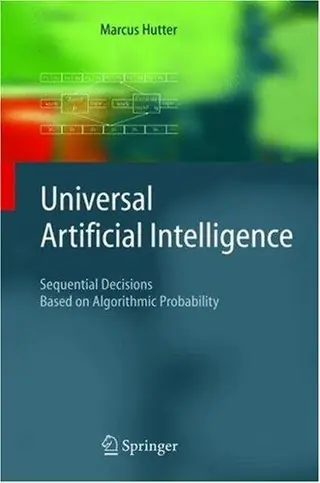
Universal Artificial Intelligence
by Marcus Hutter · first published 2004
38% recommend63% neutral
Decision Theory = Probability + Utility Theory + + Universal Induction = Ockham + Bayes + Turing = = A Unified View of Artificial Intelligence This book presents sequential decision theory from a novel algorithmic information theory perspective. While the former is suited for active agents in known environments, the latter is suited for passive prediction in unknown environments. The book introduces these two well-known but very different ideas and removes the limitations by unifying them to one parameter-free theory of an optimal reinforcement learning agent embedded in an arbitrary unknown e
Affiliate links. As an Amazon Associate I earn from qualifying purchases.
Mentions per year
What Hacker News says
Related books
 2013–2025
Artificial general intelligence
Ben Goertzel, Cassio Pennachin
Recommended by 1 · mentioned by 41 recommend · 4 mention1 recommend · 41 recommend
 2008–2026
The emotion machine
Marvin Minsky, Mercedes García Garmilla
Recommended by 16 · mentioned by 3116 recommend · 31 mention16 recommend · 3116 recommend
 2015–2024
The Master Algorithm
Pedro Domingos
Recommended by 23 · mentioned by 4023 recommend · 40 mention23 recommend · 4023 recommend
 2007–2026
The Singularity Is Near
Ray Kurzweil
Recommended by 30 · mentioned by 10330 recommend · 103 mention30 recommend · 10330 recommend
I highly recommend Markus Hutter's book: "Universal Artificial Intelligence: Sequential Decisions Based On Algorithmic Probability" (http://www.amazon.com/Universal-Artificial-Intelligence-Algo... ) Beware, you need some serious maths and a board to follow him. In the end the…
on “To create a super-intelligent machine, start with an equation” ↗…Cognition if you want to see doable exercises addressing real cognitive-science problems. If you want to see something crazy-awesome enough to deserve the term "artificial intelligence", try Hutter's Universal Artificial Intelligence.
on “Artificial Intelligence: Foundations of Computational Agents (2010)” ↗This discussion is not complete without a mention of Marcus Hutter’s seminal book[0] “Universal Artificial Intelligence: Sequential Decisions Based On Algorithmic Probability”. It provides many of the formalisms upon which metrics of intelligence are based. The gaps in current AI tech are pretty explainable in this context.…
on “What is intelligence? (2024)” ↗…Patternist Philosophy of Mind - Ben Goertzel 83. Engineering General Intelligence - Volume 2 - Ben Goertzel, Cassio Pennachin, & Nil Geisweiller 84. Computation and Cognition - Zenon W. Pylyshyn 85. Universal Artificial Intelligence - Marcus Hutter 86. The Cambridge Handbook of Computational Psychology - Ron Sun 87. Handbook of Neuroevolution Through Erlang - Gene I. Sher 88. Readings in Cognitive Science: A Perspective from Psychology…
on “Ask HN: What projects are you working on now?” ↗…the guys who are actually doing Real Research into this sort of thing are, IMHO, Juergen Schmidhuber and Marcus Hutter. They are getting formal results in what they call the "new formal science" of "Universal Artificial Intelligence", and their insights into UAI are then leading them back to insights into Narrow AI and Machine Learning. Notice how they keep producing publications in reputable journals, keep getting awards for their…
on “Why I am working on Artificial General Intelligence” ↗…https://www.amazon.com/Engineering-General-Intelligence-Part... https://www.amazon.com/Engineering-General-Intelligence-Part... https://www.amazon.com/Artificial-General-Intelligence-Cogni... https://www.amazon.com/Universal-Artificial-Intelligence-Alg... https://www.amazon.com/How-Create-Mind-Thought-Revealed/dp/0... https://www.amazon.com/Intelligence-Understanding-Creation-I... https://www.amazon.com/Society-Mind-Marvin-Minsky/dp/0671657...…
on “Ask HN: How close are we, really, to general AI?” ↗Shane Legg and Marcus Hutter of IDSIA did some recent work on a metric for machine intelligence. ( http://www.vetta.org/documents/ui_benelearn.pdf ) Marcus Hutter's PhD thesis produced a theory of "Universal Artificial Intelligence" called "AIXI" based on Solomonoff induction. Sadly, AIXI is incomputable, and the time and space bounded version "AIXItl" is still impractical. http://www.hutter1.net/ai/aixigentle.htm But you're right:…
on “Artificial General Intelligence: Now Is the Time ” ↗My disclaimer is: I am NOT an AI researcher. I don't have the mathematical background yet. As to Schmidhuber and Hutter, Google them. This is their book: http://www.amazon.com/Universal-Artificial-Intelligence-Algo... If you can't understand the math in that book, then you are basically not going to do better at the Formal UAI field than the crackpots have done for decades. I mean no disrespect, but nobody…
on “Why I am working on Artificial General Intelligence” ↗…This is not a paper on mathematical artificial intelligence, at last as I understand it, not in the way Goertzel or Hutter write about it. I was actually thinking this would be something like Hutter's universal artificial intelligence.
on “The Mathematics of Artificial Intelligence (2022)” ↗I don't know, but if they do, perhaps they converge to Marcus Hutter's "Universal Artificial Intelligence"[1]. [1]: http://hutter1.net/ai/uaibook.htm
on “Pattern Theory: The Mathematics of Perception (D. Mumford) (2002)” ↗…far as I can recall - always been even more loosely specified, and translates roughly to "an intelligence beyond any human intelligence". Another term you might hear, although not as frequently, is "Universal Artificial Intelligence". This comes mostly from the work of Marcus Hutter[1] and means something approximately like "an intelligence that can solve any problem that can, in principle, be solved". [1]: https://www.hutter1.net/ai/uaibook.htm
on “I doubt that anything resembling genuine AGI is within reach of current AI tools” ↗…always below human error rates, but this is still empirical because it works with the ill-defined definition of superintelligence that is "better than humans in all contexts". [1] Hutter, M. (2005). Universal artificial intelligence: Sequential decisions based on algorithmic probability. Springer Science & Business Media. [2] https://arxiv.org/abs/1912.10077 [3] https://openreview.net/pdf?id=Vib3KtwoWs [4] https://arxiv.org/abs/2006.14548…
on “The Problem with LLMs” ↗He has a book on "Universal Artificial Intelligence" , that defines what he considers AI and then solves it. The only catch is that it relies on Kolmogorov complexity, which is incomputable. The Kolmogorov complexity of a string is (loosely) the size…
on “Hutter Prize: Compress a 100MB file to less than the current record of 16 MB” ↗