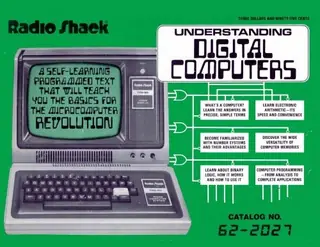
Understanding digital computers
by Forrest M. Mims · first published 1978
6mentions
3recommended by
4HN commenters
2010–2022first – last mentioned
75% recommend25% neutral
Affiliate links. As an Amazon Associate I earn from qualifying purchases.
Mentions per year
What Hacker News says
Related books
 2008–2026
The Elements of Computing Systems
Noam Nisan, Shimon Schocken
Recommended by 204 · mentioned by 268204 recommend · 268 mention204 recommend · 268204 recommend
 2008–2026
Code
Charles Petzold
Recommended by 243 · mentioned by 287243 recommend · 287 mention243 recommend · 287243 recommend
 2007–2026
The Soul of a New Machine
Tracy Kidder
Recommended by 260 · mentioned by 376260 recommend · 376 mention260 recommend · 376260 recommend
Another book in the same space is "Understanding Digital Computers, by Forrest Mims, originally sold by Radio Shack. It's dated, written in 1978, but the basics are still relevant, taking the reader from the definition of a bit, though binary numbers, Boolean logic…
on “Building a Modern Computer from First Principles” ↗…still possible; in fact it's easier now (using an FPGA and a hardware design language) than it was a few years ago (using 7400-series TTL chips and wire wrap). It's old, but I highly recommend the book Understanding Digital Computers by Forrest M. Mims (1987). It teaches the architecture of a four-bit computer completely and is sufficient to gain a foothold from which to read Hennessey and Patterson. From there, read Gordon Bell's…
on “Ask HN: Possible to know everything in a computer system, like in old days?” ↗Try this book: "Understanding Digital Computers : A Self-learning Programmed Text That Will Teach You the Basics for the Microcomputer Revolution" by Forrest M. Mims III. It's dated, but the core material is still relevant. Even the dated sections…
on “Ask HN: Best way to learn about computing history?” ↗A couple of really good books I'd recommend (for the intel 8086) would be the "The 8086 Project book" and the radio shack "Understanding Digital Computers". Those books are a great start to this kind of hobby.
on “A Homebrew 8-Bit Computer” ↗Also his book "Understanding Digital Computers" (1978). The details (magnetic core and bubble memory) are dated, but the fundamentals (logic, gates, ALU, ...) are still relevant and clearly explained at a level that a school child should be able…
on “Forrest Mims, Radio Shack, and the Notebooks That Launched a Thousand Careers” ↗…recalled an old series of magazine articles by Forrest Mims on building a very simple CPU from TTL parts, and suggested I read it. Over the next few weeks, I tracked down those articles, as well as Mims' "Understanding Digital Computers" and a textbook by Albert Paul Malvino, "Digital Computer Electronics." I read them all, and when I next had lunch with Ken at Vito's I reported back that it all seemed much clearer now - so much so…
on “MyCPU – Homebrew Computer from Discrete Logic Gates” ↗