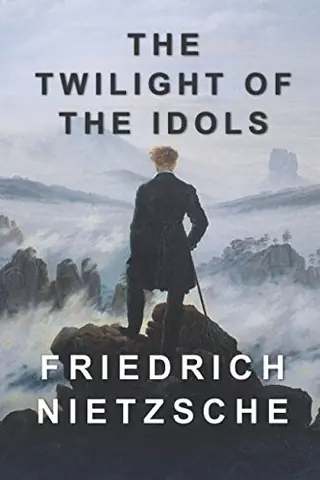
Twilight of the Idols
by Friedrich Nietzsche · first published 2017
30% recommend70% neutral
Why HN recommends it
A short, punchy entry point into Nietzsche's ideas on religion, morality and power. It serves as a first Nietzsche to read before Beyond Good and Evil, and it can shift how you see religion.
Summarised by Claude from recommending comments
Affiliate links. As an Amazon Associate I earn from qualifying purchases.
Mentions per year
What Hacker News says
Related books
 2009–2024
Ecce homo
Friedrich Nietzsche
Recommended by 4 · mentioned by 154 recommend · 15 mention4 recommend · 154 recommend
 2007–2026
The Dilbert Principle
Scott Adams
Recommended by 12 · mentioned by 3112 recommend · 31 mention12 recommend · 3112 recommend
Thus Spoke Zarathustra
Friedrich Nietzsche
Recommended by 31 · mentioned by 5831 recommend · 58 mention31 recommend · 5831 recommend
 2007–2026
Sophie's world
Jostein Gaarder
Recommended by 30 · mentioned by 4030 recommend · 40 mention30 recommend · 4030 recommend
 2007–2026
A genealogy of morals
Friedrich Nietzsche
Recommended by 17 · mentioned by 3817 recommend · 38 mention17 recommend · 3817 recommend
 2018–2026
Enlightenment now
Steven Pinker, Pablo Hermida Lazcano
Recommended by 51 · mentioned by 9751 recommend · 97 mention51 recommend · 9751 recommend
 2007–2026
The evolution of cooperation
Robert M. Axelrod
Recommended by 21 · mentioned by 3521 recommend · 35 mention21 recommend · 3521 recommend
 2007–2026
The Metamorphosis of Prime Intellect
Williams, Roger
Recommended by 40 · mentioned by 5740 recommend · 57 mention40 recommend · 5740 recommend
…book to the next and you're just trolling. If you don't, you're just wasting both our time when you should be reading. MIT OCW isn't a bad place to start. Nietzsche's various works (Beyond Good & Evil, Twilight of the Idols, Antichrist, etc) are also good.
on “The longest cell in the history of life” ↗Strange not to see Nietzsche here. Twilight of the Idols was his first book I read, then I ended up reading all the others without taking a break. Can't agree with everything he says, but it definitely resulted in making a 180 degree in my views on religion…
on “Ask HN: What books fundamentally changed the way you think about the world?” ↗…I Lay Dying & The Sound and the Fury Julian Jaynes' The Origin of Consciousness in the Breakdown of the Bicameral Mind Peter Medawar's The Art of the Soluable Designed by Peter Saville Nietzsche's Twilight of the Idols Bloom County Babylon
on “Ask YC: favorite books” ↗…Machiavelli himself was quite interested in the ancients, so this is not surprising. https://plato.stanford.edu/entries/machiavelli/#PoweVirtFort https://en.wikipedia.org/wiki/Virtù This excerpt from Twilight of the Idols (Nietzsche) is maybe the best brief description of the idea. Sorry for the length, the part about Machiavelli specifically is in the third paragraph. -- I am not indebted to the Greeks for anything…
on “What we get wrong about Machiavelli” ↗…what he puts forth but he is without a doubt one of the most dynamic and influential thinkers of the 19th century and still relevant to read even today. If you're interested in reading him, start with Twilight of the Idols and Beyond Good and Evil. If you like those two then you can delve into some of his other work such as the Antichrist, On the Geneaology of Morals, Human, All Too Human, and Thus Spoke Zarathustra
on “The Invigorating Strangeness of Friedrich Nietzsche” ↗>If you're interested in reading him, start with Twilight of the Idols and Beyond Good and Evil. If you like those two then you can delve into some of his other work such as the Antichrist, On the Geneaology of Morals, Human, All Too Human, and Thus Spoke Zarathustra What…
on “The Invigorating Strangeness of Friedrich Nietzsche” ↗Seriously, I like Steven Pinker, but I find this view naive. Here is a video: https://www.youtube.com/watch?v=ti9zdpLlXf0 called "How Hollywood Gets Nietzsche Wrong". I haven't read the source texts yet (Twilight of the Idols e.g.) but my understanding is that his main goal was to ask people to not-systematize and live the lives of others or wholly subscribe to someone else's philosophy but to live life as a self-creative…
on “Twenty Questions with Steven Pinker” ↗>"What doesn't kill you makes you stronger" is a well known saying. It's from Friedrich Nietzsche's "Twilight of the Idols": "What does not kill me, makes me stronger."
on “Person carrying bacteria resistant to antibiotics of last resort found in U.S.” ↗The phrase "what does not kill me makes me strong" comes from Nietzsche in the book "Twilight of the Idols". A book in which he criticizes christianity, going as far as comparing it to alcohol as the great narcotic of Europe. Nietzsche, IMO, was the sort that believed that suffering was sort of part of human…
on “The Transformative Power of Suffering” ↗…liberalism are examples. They are Christian heresies and cannot be comprehended apart from the Christian context within which they emerged. Nietzsche, who was an atheist, was smart enough to see this. The "Twilight of the Idols" is all about how silly this secular triumphalism, or even just contentment, is because it fails to see that the consequences of having "killed God" are not yet fully made manifest, but eventually will…
on “As religious faith has declined, ideological intensity has risen” ↗Hi everyone, I made an app that texts you one line from Nietzsche's "Twilight of the Idols" a day. I made it because I read the book, and thought that it would be cool to be able to really chew on what Nietzsche is saying line by line. Also, there's an integrated discussion subreddit that will…
on “Show HN: I built an app that texts you Nietzsche daily” ↗…willed, and the origin of every act had to be considered as lying within the consciousness (and thus the most fundamental psychological deception was made the principle of psychology itself). Source: Twilight of the Idols, Nietzsche
on “Nietzsche’s Eternal Return” ↗"A sedentary life is the real sin against the Holy Spirit. Only those thoughts that come by walking have any value." - Friedrich Nietzsche (Twilight of the Idols)
on “Don’t Underestimate the Power of a Walk” ↗“Only ideas won by walking have any value.” ― Friedrich Nietzsche, Twilight of the Idols
on “Walking increases spontaneous fluctuations in the brain” ↗He also said: "It is only ideas gained from walking that have any worth." - Nietzsche, Twilight of the Idols, 1889
on “The positive effect of walking on creative thinking (2014) [pdf]” ↗