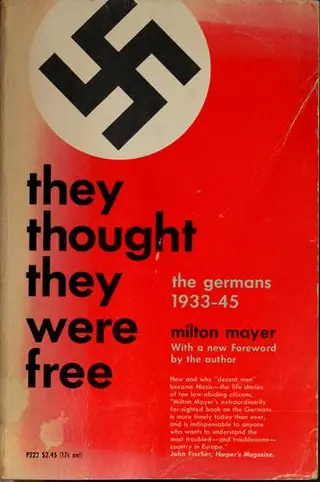
They thought they were free
by Milton Sanford Mayer · first published 1955
45% recommend55% neutral
Why HN recommends it
Interviews with ordinary Germans in a small town show how Nazism crept in and became normalized, and why decent people supported it. Recommended for anyone asking how ordinary societies slide into dictatorship.
Summarised by Claude from recommending comments
Affiliate links. As an Amazon Associate I earn from qualifying purchases.
Mentions per year
What Hacker News says
Related books
 2015–2025
Ordinary Men
Christopher R. Browning
Recommended by 19 · mentioned by 3119 recommend · 31 mention19 recommend · 3119 recommend
 2008–2026
Rules for radicals
Saul David Alinsky
Recommended by 14 · mentioned by 4614 recommend · 46 mention14 recommend · 4614 recommend
 2008–2026
Mein Kampf
Adolf Hitler
Recommended by 15 · mentioned by 53515 recommend · 535 mention15 recommend · 53515 recommend
Gulag Archipelago
Aleksandr Solzhenitsyn
Recommended by 77 · mentioned by 16977 recommend · 169 mention77 recommend · 16977 recommend
 2011–2026
The ones who walk away from Omelas
Ursula K. Le Guin
Recommended by 27 · mentioned by 9327 recommend · 93 mention27 recommend · 9327 recommend
 2008–2026
Manufacturing consent
Edward S. Herman, Noam Chomsky, John Pruden
Recommended by 179 · mentioned by 407179 recommend · 407 mention179 recommend · 407179 recommend
 2008–2026
On Liberty
John Stuart Mill
Recommended by 45 · mentioned by 9545 recommend · 95 mention45 recommend · 9545 recommend
Man's Search for Meaning
Viktor Emil Frankl
Recommended by 250 · mentioned by 325250 recommend · 325 mention250 recommend · 325250 recommend
…history to compare it to. Please heed the warning of somebody who does. These things sneak up on you and you won't be able to realize it until it's too late. This excellent excerpt from Milton Mayer's They Thought They Were Free talks about this phenomenom, I implore you to read it. [5] [0] https://en.wikipedia.org/wiki/Beer_Hall_Putsch [1] https://en.wikipedia.org/wiki/Cultural_Bolshevism [2] https://en.wikipedia.org/wiki/Big_lie [3]…
on “Nobel Peace laureates blast tech giants and warn against rising authoritarianism” ↗…reference librarian, but you might start with a few of the more reader-friendly popular accounts and see where your interests take you. Solzhenitsyn's The Gulag Archipelago is worthwhile; also Milton Mayer's They Thought They Were Free, and perhaps Ma Bo's Blood Red Sunset. The idea behind recommending these particular books is that they helped me move past the special pleading fallacy that is American exceptionalism ("It can't happen…
…the dog that is my life. If you have an insane and toxic system, then it's better to start getting radical. Ah, but now -- how to get radical? There we all explode. update, with recommended reading: They Thought They Were Free: The Germans, 1933-45, Milton Mayer We either do or don't have people successfully playing at money/power/mind-game for the stakes of controlling the planet from the top down. Either way, I am afraid.…
on “How Black People Are Being Shut Out of America's Weed Boom” ↗I highly recommend the excellent “They Thought They Were Free” For perspective on what it feels like to become a nazi. https://www.amazon.com/They-Thought-Were-Free-Germans/dp/022...
on “Who Goes Nazi? (1941)” ↗>Similarly I would be interested in how the public opinion of Hitler changed. I read "They Thought They Were Free" by Milton Mayer to get a glimpse of an answer to this question for myself. Highly recommended.
on “WikiLeaks 9/11 Files” ↗…doesn't end with casting a ballot, especially in trying times like these. Nobody is going to come and save us; if we don't stand up, nobody will. I can wholeheartedly recommend the book "The Germans: They thought they were free" by Milton Mayer[1]. It very thoroughly describes how a society ends up asking how the holocaust could possibly have happened while nobody did anything about it while it did. [1]: https://press.uchicago.edu/Misc/Chicago/511928.html
on “Discord's face scanning age checks 'start of a bigger shift'” ↗Salami slicing is the first page of the present day authoritarian play book. Here's an excerpt from They Thought They Were Free, a book about the mindset of ordinary Germans experiencing the rise of the Nazi Government: Each act, each occasion, is worse than the last, but only a little worse. You wait for the next and the next.…
on “FBI arrests judge accused of helping man evade immigration authorities” ↗…holocaust could have happened. If you ever asked yourself "how could something so evil have happened" you should definitely watch it: https://www.youtube.com/watch?v=BsKrWLf7Kg4 Likewise it is worth reading They Thought They Were Free. It describes the mental states of denial and inevitability, the rationalization of inaction, and of realizing it's "too late." If you want the quick read you can start at "Each act, each occasion, is…
Another opportunity to recommend "They Thought They Were Free: The Germans 1933-45" by Milton Mayer. The audiobook is great too. A critical but empathetic look at how fascism rises and spreads through, and alongside, ordinary people in ordinary society. Excellent…
on “Ten Signs of Fascism. America has all of them” ↗Because I think you need to have more empathy for why people align themselves with causes you disagree with. If you have the time, I suggest reading "They Thought they Were Free," by Milton Meyer. It's a well-known book that tries to answer why generally "good" people joined or supported the Nazi party in pre-WWII Germany. It's been about a decade since I last read it, but I…
on “One Google Staffer Fired, Two Others Put on Leave Amid Tensions” ↗I understand your skepticism. But, understand that, even if the USA was a fascist state, you wouldn't notice a thing. Check out this excerpt from They Thought They Were Free. This should be required reading for every citizen of a democracy. http://www.press.uchicago.edu/Misc/Chicago/511928.html That said, I think we impoverish our understanding when we label everything…
on “The town is no longer friendly for business” ↗…major parties at the time) spend their squabbling with the Socialdemocrats instead of focusing their attention on the "real enemy". If you're actually interested in this topic, you should read the book "They thought they were Free". It chronicles how normal people fell to support the fascists - the Nazi party.
Read They Thought They Were Free. People who vote for dictators _rarely_ view themselves as enablers of the bad things that come afterwards, even though they are an essential part of the process. Supporters choose to ignore the bad stuff.…
on “Trump wins presidency for second time” ↗Based on some interesting quotes, They Thought They Were Free: The Germans, 1933-45 by Milton Meyer. An excerpt: https://press.uchicago.edu/Misc/Chicago/511928.htm > "The dictatorship, and the whole process of its coming into being, was above all diverting. It…
on “Ask HN: Good articles or books to understand the current zeitgeist?” ↗I can recommend “They Thought They Were Free”. The book is imperfect, but it hit home to me the horrific truth on National Socialism: that the people who did it were regular people, not the monsters of myth.
on “Charlie Brown and Franz Stigler incident (1943)” ↗