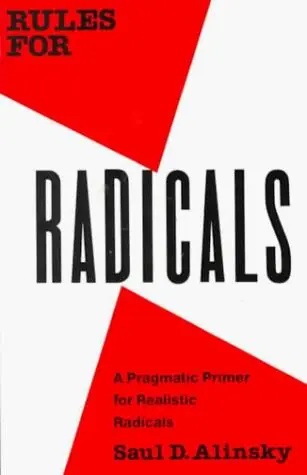
Rules for radicals
a practical primer for realistic radicals
by Saul David Alinsky · first published 1971
30% recommend67% neutral2% critical
Why HN recommends it
Practical primer on community organizing and activist tactics, written by a Chicago organizer in 1971; useful for anyone wanting to understand how grassroots movements gain leverage and persuade.
Summarised by Claude from recommending comments
Rules for Radicals: A Pragmatic Primer for Realistic Radicals is the late work of community organizer Saul D. Alinsky, and his last book, published in 1971 shortly before his death. His goal for the Rules for Radicals was to create a guide for future community organizers to use in uniting low-income communities, or “Have-Nots”, in order to empower them to gain social, political, and economic equality by challenging the current agencies that promoted their inequality.[1] Within it, Alinsky compiled the lessons he had learned throughout his personal experiences of community organizing spanning f
Affiliate links. As an Amazon Associate I earn from qualifying purchases.
Mentions per year
What Hacker News says
Related books
 2014–2026
The story of B
Daniel Quinn
Recommended by 7 · mentioned by 87 recommend · 8 mention7 recommend · 87 recommend
 2008–2022
Thinking Strategically
Avinash K. Dixit, Barry J. Nalebuff
Recommended by 9 · mentioned by 119 recommend · 11 mention9 recommend · 119 recommend
 2011–2026
Physics for Entertainment
Yakov Perelman
Recommended by 11 · mentioned by 1311 recommend · 13 mention11 recommend · 1311 recommend
 2010–2025
More money than God
Sebastian Mallaby
Recommended by 6 · mentioned by 76 recommend · 7 mention6 recommend · 76 recommend
 2009–2026
Consilience
Edward Osborne Wilson
Recommended by 9 · mentioned by 129 recommend · 12 mention9 recommend · 129 recommend
 2009–2026
Thus spake Zarathustra
Friedrich Nietzsche
Recommended by 7 · mentioned by 207 recommend · 20 mention7 recommend · 207 recommend
 2010–2026
Post office
Charles Bukowski
Recommended by 13 · mentioned by 2113 recommend · 21 mention13 recommend · 2113 recommend
 2008–2024
Structures, or, Why things don't fall down
James Edward Gordon
Recommended by 15 · mentioned by 2115 recommend · 21 mention15 recommend · 2115 recommend
…release. You want the use of force by the police to be both disproportionate and highly visible. There are a whole series of elaborate rules to make the state's use of force work for you. Saul Alinsky's Rules for Radicals is the traditional primer in this sort of thing, but it's always interesting to hear the stories of those that lived that type of life.
on “Tiny Inconspicuous Handcuff Key” ↗…left activism in general, which has been lacking in the tactics and strategy department. That's not Chomsky's fault, but agitation without organization leads to futility and demoralization. Alinsky's Rules for Radicals remains a standard primer of activist organizing methods but at times it seems to have been almost forgotten about by people on the left. I only heard about it because people in the Tea Party took up…
on “U.S. Stood by as Indonesia Killed a Half-Million People, Papers Show” ↗There is a whole entire book about this concept, and it was written in 1971, so you won't have to endure Ron Paul to learn the ideas in it. It's "Rules for Radicals" by Saul Alinsky. Alinsky is a famous leftist, but he was also a South Side community organizer in Chicago, 15 years before Obama was. The book is unabashedly leftist in ways that are almost quaint,…
on “Three ways you can develop a Ron Paul-type movement in your own company” ↗Galeano's Memory Of Fire books, also Saul Alinsky's _Rules For Radicals_ (one of the best marketing books ever written).
on “Ask HN: What books fundamentally changed the way you think about the world?” ↗>Rules For Radicals by Saul Alinsky I'm halfway through the prologue and I have to say, this is very insightful and relevant to today for having been written in 1971. Thanks for bringing it to my attention.
on “Inciting violence vs freedom of speech” ↗I recently read "Rules for Radicals" by Saul Alinksy, it's a book on how to go about politically organize communities. It's sort of like the underdog's machivellian Prince. I recommend it. The story behind how I came across it is also…
on “Ask HN: What are your favorite books?” ↗…Nature Of Mass Movements by Eric Hoffer I think this book remains the most useful and concise guide to understanding mass movements and fanaticism I've ever read. It pairs nicely with Saul Alinsky's Rules for Radicals. Hoffer's book is more expository and cautionary where Alinsky's book is more enthusiastic and encouraging, while both books have a healthy dose of cynicism about mass movements themselves. ----- [1]:…
on “Ask HN: What are the best unknown books you have read?” ↗"The Body Electric" & "Cross Currents" by Dr. Robert O. Becker got me into health effects of wireless radiation exposures. "The undercover economist" by Tim Harford got me interested in economics. "Rules for Radicals" by Saul Alinsky on community organizing.
on “Ask HN: What books got you curious and inspired about fields other than CS?” ↗We're under no moral obligation to play by their rules. Read Rules for Radicals.
on “Newpipe.net removed from Google search results due to DMCA take down request” ↗"Rules for Radicals" by Saul D. Alinsky. On how to organize revolutions and how to be careful about what you wish for.
on “What's the most radical book you've read?” ↗…socialism" - the government ended up owning the steel, coal, and railroad industries, all of which were in trouble. That was not a people's movement. For the organizer's point of view, see Saul Alinsky's "Rules for Radicals".[1] Alinsky is all about how to organize and win, working from the bottom. Alinsky was a labor organizer. His approach is independent of political position. Orwell offers cautionary views, but he's…
on “Orwell: The Rewrite” ↗As actual books, Alinsky's Rules for Radicals, which a BBS friend of mine gave me when he squatted for a few days in my parent's garage, and Eduardo Galleano's Memory of Fire trilogy, a narrative literary history of Latin America, which the Jesuits…
on “Ask HN: What book had a big impact on you as a child or teenager?” ↗You might enjoy reading Rules for Radicals if you haven't already. If your riot can provoke a worse response from the authority, it can help your cause. The reaction is the action. It may be that this protest in Serbia got a bit rowdy and riotous…
on “Military grade sonic weapon is used against protesters in Serbia” ↗Rules for Radicals is one of my favorite books and I don't think this an accurate summary of what Alinsky says, at all. It's a short book, you can get it for free online, people should just read it.
on “Military grade sonic weapon is used against protesters in Serbia” ↗With the rise in interest in political activism, it's worth reading Saul Alinksy's Rules for Radicals. All sides are moving towards utilization of the tactics and ethics contained therein, and it's helpful to understand how community organizing works in the age of mass media.
on “Change.org Raises $30M Led by Reid Hoffman; Sam Altman and Bill Gates Invest Too” ↗