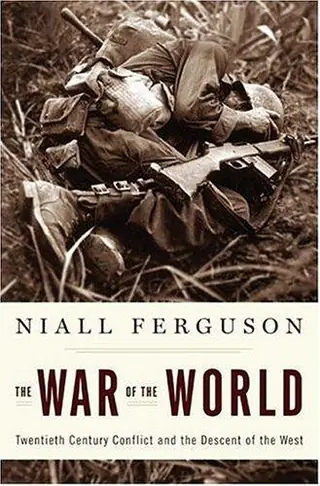
The War of the World
by Niall Ferguson · first published 2006
8mentions
1recommended by
4HN commenters
2010–2019first – last mentioned
25% recommend75% neutral
Historian Fergusson provides a revolutionary reinterpretation of the modern era that resolves its central paradox: why unprecedented progress coincided with unprecedented violence, and why the seeming triumph of the West bore the seeds of its undoing. From the conflicts that presaged the First World War to the aftershocks of the Cold War, the twentieth century was by far the bloodiest in all of human history. How can we explain the astonishing scale and intensity of its violence when, thanks to the advances of science and economics, most people were better off than ever before? Wherever one lo
Affiliate links. As an Amazon Associate I earn from qualifying purchases.
…after World War I disrupted incumbent powers and wealth. World Wars I and II really need to be considered as a unit. War continued into the '20s in Eastern Europe and then resumes in 1936 in Spain. See "War of the World" by Niall Ferguson. Socialism was not that strong before WW I destroyed the power structures of the German, Russian, Austro-Hungarian, and Ottoman Empires. The resumption of war in World War II destroyed…
on “Economists Are Rethinking the Numbers on Inequality” ↗I have recently read Niall Ferguson’s “War of the World", which gives a new history of the 20th century. One that was one long 100-year war spanning from set up for WWI which led to WWII which led to Cold War. He argues that the same types of thinking and…
on “Ask HN: Is World War III imminent?” ↗That observation of how peaceful and interdependent the world looked at the dawn of the 20th century is also how Niall Ferguson's book The War of the World starts. It really is quite sobering to appreciate how people back then really believed that mutual dependence and globalization would make large-scale warfare impossible.
on “The Fifty is awake again” ↗Niall Ferguson's The War of the World: History's Age of Hatred, which looks at the 20th century, starts by pointing out how comfortable and settled everything looked at the start of the 20th century and as Keynes put it that this state appeared…
on “The Thucydides Trap: Are the U.S. And China Headed for War?” ↗I remember that from the start of Niall Ferguson's The War of the World - in 1913 the world looked quite a bit like it does today (at least from a "globalization" perspective).
on “The 2 Simple Reasons the Soviet Union Was Doomed to Fail” ↗I don't think there is any immediate prospect of war. However, I can't help recalling the start of Nial Ferguson's "The War of the World": "The world at the beginning of the 20th century seemed for most of its inhabitants stable and relatively benign. Globalizing, booming economies married to technological breakthroughs seemed to promise…
on “Germany, Not Greece, Should Exit the Euro” ↗…inhabitants stable and relatively benign. Globalizing, booming economies married to technological breakthroughs seemed to promise a better world for most people." From the description of Niall Ferguson's The War of the World.
on “The violence paradox: Is violence actually declining?” ↗…memes really are dangerous? If you increase the velocity of transmission, then even in a free system there are some dangerously infectious falsehoods that it might be in the public good to slow. Think War of the World on Facebook.
on “Facebook admits it must do more to stop the spread of misinformation” ↗