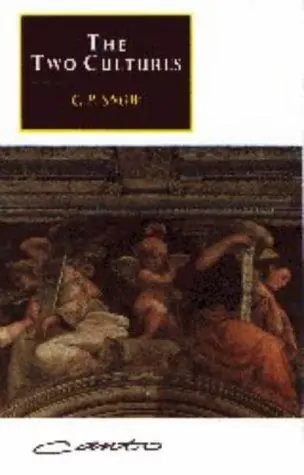
The two cultures
an expanded version of the Two cultures and the scientific revolution
by C. P. Snow · first published 1964
17% recommend83% neutral
Why HN recommends it
A short, influential lecture arguing that the division between the sciences and the humanities is an artificial cultural divide. It is a quick read that frames debates about science and the liberal arts.
Summarised by Claude from recommending comments
The Two Cultures is the first part of an influential 1959 Rede Lecture by British scientist and novelist C. P. Snow. Its thesis was that "the intellectual life of the whole of western society" was split into the titular two cultures — namely the sciences and the humanities — and that this was a major hindrance to solving the world's problems. The talk was delivered 7 May 1959 in the Senate House, Cambridge, and subsequently published as The Two Cultures and the Scientific Revolution. The lecture and book expanded upon an article by Snow published in the New Statesman of 6 October 1956,
Affiliate links. As an Amazon Associate I earn from qualifying purchases.
For more information on this see C.P. Snow's over half-century-old lecture, "The Two Cultures." Within it he posits a great rift between the humanities and the sciences. The lecture is very much relevant to this discussion. As a side note, Edge.org posits itself as an abridging third culture in…
on “Geek anti-intellectualism: replies” ↗The Two Cultures and the Scientific Revolution by C.P. Snow (1959). An important shot over the bow.
on “Was Paul Feyerabend Really Science's "Worst Enemy"? (2016)” ↗…a "humanist spiritual belief" and a "reductionist one". That's a smouldering flame war that started half a millennium back between Copernicus, Galileo and the church. May I suggest a cool read is "The Two Cultures." by C. P. Snow [1]. Snow thinks, as I do, that this artificial split holds humanity back. Albert Einstein is also a great study to get into this groove. If I am objecting to anything (not sure if I…
on “Relationships are coevolutionary loops (2023)” ↗…thing is pseudo-science and even worse - a false dichotomy. It's much more about cultural snobbery and cultural tribalism around which pursuits are regarded as "more worthy". Look up C.P. Snow's "The Two Cultures" - it was incredibly influential at the time but also described a prejudice we still labour under. It's pervasive in the English speaking world. I suspect less so in the non-anglosphere West and possibly…
on “Pixel 10 Phones” ↗I've always considered that Tim Jennison quote to be a reference to C.P. Snow's "The Two Cultures" lecture. Steve Jobs' ambition for Apple to be "where the Liberal Arts and Technology meet" also seemed similarly influenced. If you haven't read Snow's lecture, it's well worth the quick read.
on “What an unprocessed photo looks like” ↗…sciences, modern technologies, and the ways of business.[a] Perhaps the smart kids don't want to study with these ignorant individuals? [a] As C. P. Snow wrote about these people in 1959 in his famous Two Cultures lecture: "A good many times I have been present at gatherings of people who, by the standards of the traditional culture, are thought highly educated and who have with considerable gusto been expressing…
on “Mea culpa: there is a crisis in the humanities” ↗…maybe about HN. I didn't see mention of the Weinberg articles. Really, the several categories of books, fiction, non-fiction, humanism, literature, etc. aside, the more clear dichotomy is C. P. Snow's Two Cultures -- just two. There HN is firmly in one of these two and the NYR, the other.
on “The Books We Talk About (and Those We Don’t)” ↗…they’re supposed to regulate. But neither does anyone else. Siva Vaidhyanathan [1], the author of this Wired article, seems to be a fine representative of the humanities half of what C.P. Snow called The Two Cultures [2]. The ability to craft sentences is an admirable skill, one I wish I had, but innumeracy and the inability to grasp causation seems to be a badge of honor among the non-STEM elite. The question is…
on “There’s no such thing as a tech expert anymore” ↗The lack of self-awareness of the author is rather amusing. He seems to be striving to be a poster boy for the willful ignorance C.P. Snow bemoaned in The Two Cultures.
on “Observations on tragedy in a digital age” ↗It will probably end up like C. P. Snow's The Two Cultures and for many never the twain shall meet. This shouldn't be surprising really given the diversity of people, views, etc. As for myself, I use both regularly but for serious work the PC/large screen predominates.…
on “The FBI now recommends using an ad blocker when searching the web” ↗Goes back a long way, c.f. C. P. Snow and the Two Cultures book or article in the 50s. Before that Charles Babbage had something to say about the state and teaching of mathematics in British universities. My personal view is that there has to be a wider discussion…
on “Rishi Sunak sets up review to tackle 'anti-maths mindset'” ↗I derive these comments from the introduction by Stefan Collini (a lit professor) in the Cambridge UP edition of "The Two Cultures". (https://www.amazon.com/Two-Cultures-Canto-Classics/dp/110760...) Snow had a PhD in chemistry, but dropped out of science early on to write popular novels and to become a very successful bureaucrat.…
on “The Two Cultures” ↗…understanding of fiction, I have to conclude, with this force feeding and blocking, some of my best years for learning were seriously wasted. Thus, I'm torqued. I have to be reminded of C. P. Snow, The Two Cultures and find, (with irony) with that favorite word of the literary set, irony, a post in the culture of engineering, math, and science by the culture of fictional novels, belle lettre, literary art, etc.
on “The Books We Talk About (and Those We Don’t)” ↗…far as I can tell, Priddy isn't saying anything the deconstructivists haven't already; and by that I mean the same hollow self-justifying outcries that have dominated the humanistic part of C.P. Snow's Two Cultures since, well, since Wordsworth. If Priddy and his ilk could ever dream up an alternative which would "put science in its place," I'd be happy to hear it, but so far, science makes progress regardless of…
on “Science and the Demise of Philosophy” ↗Not sure if you're kidding, but Eton is one of the finest schools in the UK, probably the world, so it's a bit much to be quite so disparaging. Also I'm guessing you've never heard of CP Snow: 'The Two Cultures is the first part of an influential 1959 Rede Lecture by British scientist and novelist C. P. Snow. Its thesis was that "the intellectual life of the whole of western society" was split into two cultures…
on ““I thought I'd share this Boris Johnson story with you”” ↗