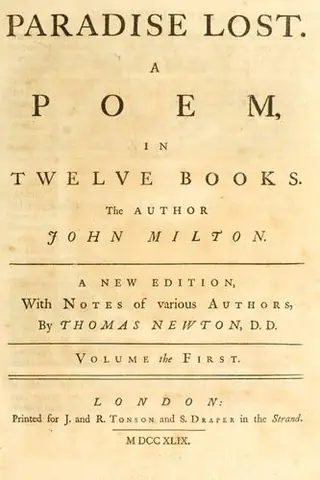
Paradise Lost
by John Milton · first published 1667
23% recommend74% neutral3% critical
Why HN recommends it
Epic poem praised for vivid imagery, powerful verse and a charismatic Satan, with big ideas about free will. Rewards slow rereading, reading aloud, and companions like annotated editions or Yale lectures.
Summarised by Claude from recommending comments
John Milton's Paradise Lost is one of the greatest epic poems in the English language. It tells the story of the Fall of Man, a tale of immense drama and excitement, of rebellion and treachery, of innocence pitted against corruption, in which God and Satan fight a bitter battle for control of mankind's destiny. The struggle rages across three worlds - heaven, hell, and earth - as Satan and his band of rebel angels plot their revenge against God. At the center of the conflict are Adam and Eve, who are motivated by all too human temptations but whose ultimate downfall is unyielding love. Mark
Affiliate links. As an Amazon Associate I earn from qualifying purchases.
Mentions per year
What Hacker News says
Related books
 2020–2026
Samson Agonistes
John Milton
Recommended by 1 · mentioned by 31 recommend · 3 mention1 recommend · 31 recommend
 2020–2025
The forgotten books of Eden
Rutherford Hayes Platt, Paul Laune
0 recommend · 3 mentioned0 recommend · 3 mention0 recommend · 30 recommend
Sir Gawain And the Green Knight
Pearl Poet
Recommended by 3 · mentioned by 123 recommend · 12 mention3 recommend · 123 recommend
Divine comedy
Dante.
Recommended by 16 · mentioned by 6416 recommend · 64 mention16 recommend · 6416 recommend
 2008–2026
A Midsummer Night's Dream
William Shakespeare
Recommended by 5 · mentioned by 185 recommend · 18 mention5 recommend · 185 recommend
Love Song of J. Alfred Prufrock
T. S. Eliot
Recommended by 2 · mentioned by 72 recommend · 7 mention2 recommend · 72 recommend
 2009–2026
The Odyssey.
HOMER.
Recommended by 14 · mentioned by 2614 recommend · 26 mention14 recommend · 2614 recommend
 2008–2026
Pride and Prejudice
Jane Austen
Recommended by 36 · mentioned by 11536 recommend · 115 mention36 recommend · 11536 recommend
…almost completely clear of any modern poetry or academic analysis of it. It's mostly boring rubbish. Also note longer form poems that tell stories are a good way to enjoy it. John Milton's masterpiece, Paradise Lost, for example.[3] [1] https://www.thomasgray.org/cgi-bin/display.cgi?text=elcc [2] https://en.wikipedia.org/wiki/The_Ode_Less_Travelled [3] http://www.gutenberg.org/files/20/20-h/20-h.htm
on “On getting poetry” ↗…and Representation. Surprisingly readable and insightful, even if you don't buy his metaphysics. Einstein had Schopenhauer's portrait on his wall and considered him a genius. * Poetry John Milton - Paradise Lost Powerful and beautiful writing. * Fiction Rabelais - Gargantua and Pantagruel. Funny and a real feast of words (the translation is a work of art in itself) Thomas Mann - The Magic Mountain. Haunting…
on “Ask HN: Which books you have read till now that were worth investing time in?” ↗What about Paradise Lost by Milton? The Aeneid by Virgil? Candide? Anna Karenina? War & Peace? And I prefer the Count of Monte Cristo over the Three Musketeers. The entire Divine Comedies, not just the Inferno. Also liked to…
on “Becoming "well read"” ↗…magistrates" or something like that, which I read as "Please don't kill me, see? I'm on your side" - existing as an intellectual during times of revolution can be a tricky thing. I personally think "Paradise lost" is a better introduction to Milton, but the point remains.
on “The real roots of early city states may rip up the textbooks” ↗Milton's Paradise Lost changed centuries of how poetry is considered and continues to strongly influence modern literature today. It's one of the great pieces of work in the English language and themes introduced in this work…
on “Paradise Lost is one of the most important poems” ↗…translations of the Buddhist writings in volume 45. One volume a week of this material is steep. A lot of this has its own pace and forcing your way through it faster loses the reason to bother. Milton's Paradise Lost, for example, is an awesome poem, but it implies a cadence, and it's a much slower cadence than modern readers are used to for nontechnical prose.
on “Ask HN: Books you plan to read in 2020?” ↗But Milton, you forgot Milton. I'm reading Paradise Lost. Maybe it is one of those things you're supposed to read, but it's genuinely really good. Like, "to be weak is miserable doing or suffering: but of this be sure, to do aught good never will be our task,…
on “The Way I Work: Jason Fried of 37Signals” ↗John Milton is on that list. Newton was exceptionally important, but our world would be poorer without Paradise Lost. I'm glad Milton spent his time as he did.
on “The Risk of Discovery” ↗…Milton on the political outs. Many others who had supported the Revolution were executed when the new king came into power, but somehow Milton survived on the margins. The Hackett Classics edition of Paradise Lost does a good job explaining all of this in the introduction as well as the footnotes: https://www.amazon.com/Paradise-Lost-Hackett-Classics-Milton... Paradise Lost is one of the most beautiful poems in…
on “The Sound and the Story: Exploring the World of Paradise Lost” ↗There are parts of Paradise Lost that read like science fiction, like Satan's ascent through Hell (as yet uninhabited, because no one yet has sinned!), and through a Ptolmaic (which, yes, was an intentional anachronism) cosmos to sneak…
on “Paradise Lost (1667)” ↗…(including, probably, Milton and Dante) would say that it's because humans have no experience with absolute Good, so it's impossible to imaginatively "get". That's as may be, but I still encourage you to give "Paradise Lost* a try: Milton's use of the English language is unmatched by anyone, ever.
on “Paradise Lost (1667)” ↗After reading the complete Shakespeare, it is a natural continuation to go on to read the complete Milton. Outside the core of Paradise Lost/Regained, Samson Agonistes is another gem, and Lycidas is of course a classic poem. The way Milton uses English the language exalts it into the profundity of Latin. One feels Milton's words are of sanctified…
on “Paradise Lost (1667)” ↗…idea how life could have emerged on Earth without external help. It's a long way from amino acids to life -- like the distance between the squiggles that make up the letters of the alphabet and Milton's Paradise Lost. I mean, why not just declare Carbon, Hydrogen, and Oxygen to be "precursors for life" and then declare "the ingredients were already there!" For those who are genuinely interested, check out the book…
on “All of the bases in DNA and RNA have now been found in meteorites” ↗…continuing anyway. Just read the play, see what you pick up, then read it again. Treat it like poetry and don't worry too much about understanding every word; see if you can get the feel. I found that Milton's Paradise Lost took me 3 or 4 false starts over a decade before I managed to get into the flow enough to read the whole thing. There's still probably a lot I missed, but it was thoroughly enjoyable. Sometimes it's…
on “Making Elizabethan plays understandable and fun to read” ↗…Making of Star Trek II: The Wrath of Khan a few years ago, I embarked on a Wrath of Khan–themed read of books that either influenced the filmmakers or were referenced in the movie: The Prisoner of Zenda, Paradise Lost, A Tale of Two Cities, and the entire Horatio Hornblower series. Very enjoyable! I still have one left: Moby Dick.
on “The Essential Question: "What should I read next?"” ↗