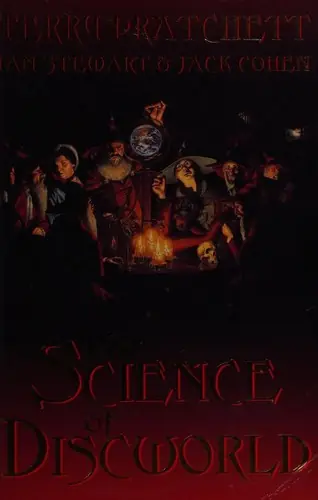
The Science of Discworld
by Terry Pratchett, Ian Stewart, Jack Cohen · first published 1999
41% recommend53% neutral6% critical
Why HN recommends it
Accessible popular science that blends real scientific ideas with story and humour. It prompts questions about why the world works the way it does and suits fans of Pratchett curious about science.
Summarised by Claude from recommending comments
Contains a story by Terry Pratchett, around which Stewart and Cohen write about the Discworld.
Affiliate links. As an Amazon Associate I earn from qualifying purchases.
Mentions per year
What Hacker News says
Related books
 2015–2026
Raising Steam
Terry Pratchett
Recommended by 4 · mentioned by 174 recommend · 17 mention4 recommend · 174 recommend
 2009–2026
The Light Fantastic
Terry Pratchett
Recommended by 5 · mentioned by 145 recommend · 14 mention5 recommend · 145 recommend
 2009–2026
Equal Rites
Terry Pratchett, Nurit Sharʻabi
Recommended by 12 · mentioned by 2812 recommend · 28 mention12 recommend · 2812 recommend
 2012–2026
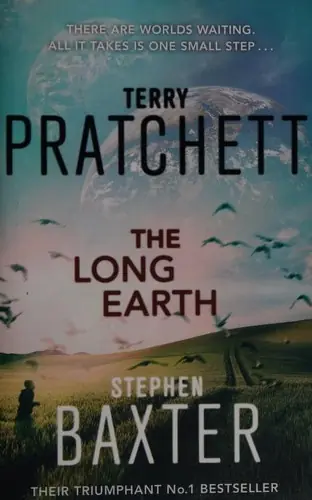
The long earth
Terry Pratchett, Stephen Baxter
Recommended by 10 · mentioned by 2410 recommend · 24 mention10 recommend · 2410 recommend
 2009–2026
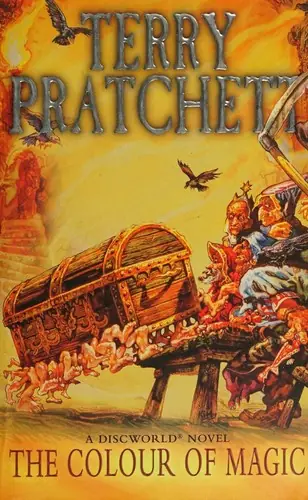
The Colour of Magic
Terry Pratchett
Recommended by 9 · mentioned by 389 recommend · 38 mention9 recommend · 389 recommend
 2015–2026
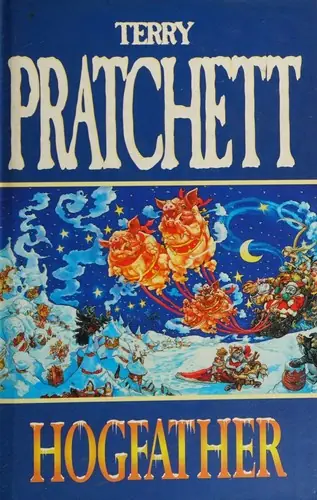
Hogfather
Terry Pratchett
Recommended by 13 · mentioned by 2913 recommend · 29 mention13 recommend · 2913 recommend
 2010–2026
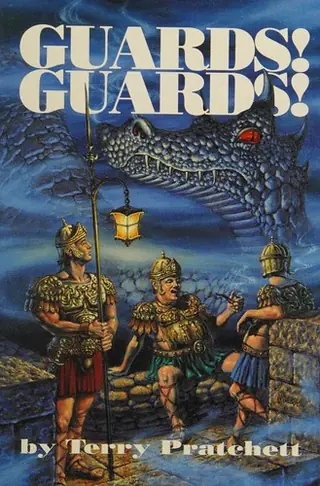
Guards! Guards!
Terry Pratchett
Recommended by 33 · mentioned by 5533 recommend · 55 mention33 recommend · 5533 recommend
 2008–2026
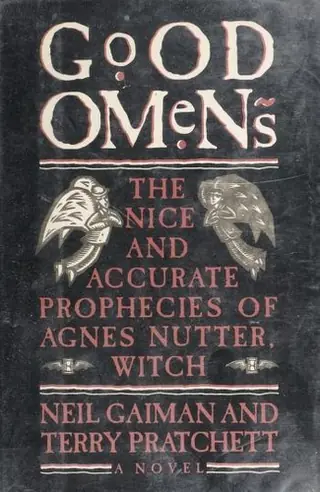
Good Omens
Terry Pratchett, Neil Gaiman
Recommended by 32 · mentioned by 8232 recommend · 82 mention32 recommend · 8232 recommend
…not sure that's the case. I think there's been some times (like maybe pre-Devonian), where the Earth was pretty much Waterworld. There was a series of books that Terry Pratchett co-authored, called The Science of Discworld, where a bunch of wizards were creating a planet, and it went through a bunch of phases, punctuated by E.L.E. asteriod impacts. I think it was a fanciful chronicle of early Earth. Interesting books.
on “Field geology at Mars' equator points to ancient megaflood” ↗…recognise and pronounce the subtle double and triple entendres (e.g. of the Nac Mac Feegles) - which suggests they and the editors don't fully appreciate the humour Pratchett intended. Don't miss the "The Science of Discworld" series (book I (1999), II:The Globe (2002), III:Darwin's Watch (2005), IV:Judgement Day (2013)) where the chapters alternate between stories of the Wizzards (voiced by Stephen Cohen) of Unseen University…
on “Discworld on Page and Screen, Part 1: Serious Comedy” ↗If he likes the Terry Pratchett books then the 3 "Science of Discworld" books are surprisingly good (in both science and story) when I was half expecting something along the lines of a cut-away diagrams of space ships that you might find in a Science of Star Wars book from…
on “Ask HN: Great books for teenager age 15” ↗I am reading "The Science of Discworld" and I like it a lot. It is accessible, engaging, and makes you really think and question why things are the way they are. http://www.amazon.co.uk/The-Science-Discworld-Terry-Pratchet... "Pratchett…
on “Steven Weinberg: Science books for the general reader” ↗Do a thing: read the Science of Discworld books. I posit that Terry Pratchett also has a lot to say about narrative causality as it applies to IRL.
on “Narrative Collapse” ↗I learned about this from the "Science of Discworld" books, I believe the first one, which I cannot recommend enough if you like Sir Terry.
on “Natural nuclear fission reactor” ↗The Science of Discworld series of books are surprisingly good for things that sound, on first hearing of them them, like a quick cash in. Both the science writing and the Discworld content is pretty great and well integrated…
on “Ask HN: What's the best book you've read so far in 2024?” ↗I remember this paper being discussed in the novel "Science of Discworld" -- a super interesting book involving collaboration between a fiction author and some real world scientists -- where the fictional characters in the novel discover our universe and its rules ... I always…
on “AI-designed chips are so weird that 'humans cannot understand them'” ↗…most significant contribution that our large brain made to our approach to the universe was to endow us with the power of story. We are Pan narrans, the storytelling ape." -- Ian Stewart and Jack Cohen, Science of Discworld II
on “Why Telling a Story is the Most Powerful Way to Activate Our Brains” ↗…('wise man'). In any case it's an arrogant and bigheaded thing to say, wisdom being one of our least evident features. In reality, we are Pan narrans, the storytelling chimpanzee." - Terry Pratchett, The Science of Discworld II: The Globe
on “Researchers reach human parity in conversational speech recognition” ↗I was introduced to Langton's ant by the Science of Discworld books, which used it as an example of emergent phenomena.
on “Langton’s ant” ↗I have everything he wrote (which includes a number of non-Discworld books, like Johnny and the Bomb, and The Bromeliad Trilogy). I didn't especially like the Science of Discworld books that much, but he didn't really write them. One character that showed up in every one of his Discworld books -to a point- was Death. After Sir Terry got his diagnosis, I noticed that Death stopped…
on “I Miss Terry Pratchett” ↗Terry Pratchett, The Science of Discworld: > As humans, we have invented lots of useful kinds of lie. As well as lies-to-children ('as much as they can understand') there are lies-to-bosses ('as much as they need to know') lies-to-patients ('they…
on “No country for mediocre mathematicians” ↗> "science-education-ism". My phrase - I don't know of a real one... anyone? Ever since I first read it in "The Science of Discworld" I've called that "Lies-to-children" (https://en.wikipedia.org/wiki/Lie-to-children): A lie-to-children (plural lies-to-children) is a simplified explanation of technical or complex subjects as a teaching…
on “An animal that doesn't breathe oxygen” ↗I've just realised that this is somewhat the inverse of the Science of Discworld books. Those books are split into alternative chapters of popular science, and Discworld stories about the characters reacting to our science from their point of view as characters in a fantasty novel.…
on “Harry Potter and the Methods of Rationality just got several fascinating updates” ↗