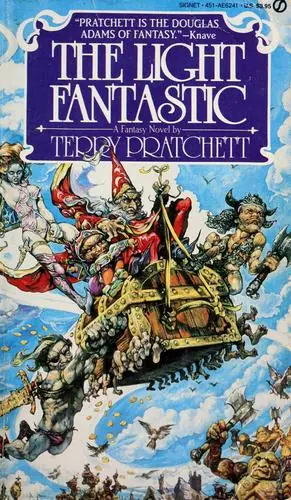
The Light Fantastic
by Terry Pratchett · first published 1986
36% recommend50% neutral14% critical
Why HN recommends it
A lighthearted, very funny fantasy that works well for unwinding after long technical days. It is a fun, quick read with cool ideas and good humor, and a good entry point for those new to Discworld.
Common criticism: Several find the early Discworld books weaker than later ones, and it is less deep than later work.
Summarised by Claude from recommending comments
From the back cover: In The Light Fantastic only one individual can save the world from a disastrous collision. Unfortunately, the hero happens to be the singularly inept wizard Rincewind, who was last seen falling off the edge of the world....
Affiliate links. As an Amazon Associate I earn from qualifying purchases.
Mentions per year
What Hacker News says
Related books
 2009–2026
The Colour of Magic
Terry Pratchett
Recommended by 9 · mentioned by 389 recommend · 38 mention9 recommend · 389 recommend
 2009–2026
Equal Rites
Terry Pratchett, Nurit Sharʻabi
Recommended by 12 · mentioned by 2812 recommend · 28 mention12 recommend · 2812 recommend
 2010–2026
Guards! Guards!
Terry Pratchett
Recommended by 33 · mentioned by 5533 recommend · 55 mention33 recommend · 5533 recommend
 2008–2026
Monstrous Regiment
Terry Pratchett
Recommended by 9 · mentioned by 179 recommend · 17 mention9 recommend · 179 recommend
 2015–2026
Raising Steam
Terry Pratchett
Recommended by 4 · mentioned by 174 recommend · 17 mention4 recommend · 174 recommend
 2014–2025
The Wee Free Men
Terry Pratchett, Paul Kidby
Recommended by 4 · mentioned by 84 recommend · 8 mention4 recommend · 84 recommend
 2014–2026
Small Gods
Terry Pratchett, Ray Friesen
Recommended by 47 · mentioned by 7147 recommend · 71 mention47 recommend · 7147 recommend
 2010–2024
Nation
Terry Pratchett, Stephen Briggs
Recommended by 6 · mentioned by 76 recommend · 7 mention6 recommend · 76 recommend
Discworld! I just finished the second one, The Light Fantastic, and loved it. Terry Pratchett is a brilliant and very funny author. I find after long days of technical thinking I really enjoy a lighthearted funny piece of fiction to help me unwind and get to sleep.…
on “Ask HN: What are you reading right now?” ↗"The Light Fantastic" was my first introduction to Terry Pratchett back around 1989 or so. I was definitely hooked. To me, the first two books are lot more like Douglas Adams' books: vehicles for cool ideas and good humor,…
on “Sir Terry Pratchett has died” ↗…interact with it might not be particularly distinguishable from how we interact with it when it's just a chunk of rock. A good parallel to think of here is probably Discworld, I might suggest reading The Light Fantastic if you never had to get a bit of a sense of how we might interact with celestially sized lifeforms and just how one-sided that relationship could potentially be.
on “Why do we assume extraterrestrials might want to visit us?” ↗…across the street helping themselves to musical instruments, can you believe that?” “Yeah,” said Rincewind, picking up a knife and testing its blade thoughtfully. “Luters, I expect.” Excerpt From The Light Fantastic Great author.
on “Sam Vimes 'Boots' Theory of Socio-Economic Unfairness” ↗So many good memories... reading the Light Fantastic for first time, getting Eric in that big format with many illustrations, the witches, Vimes and the guards during my uni years, Mort, Maurice, and so on and so on... and then... the profound melancholy…
on “I Miss Terry Pratchett” ↗…say they are nice. However if you put them in order, it seems forced to put a story together. I had similar thoughts after reading Pratchett's The Colour of Magic. Though after I started reading The Light Fantastic it fell into place. I would say that those two books should be inseparable. Whatever happens in the first does not make sense until the second book. Now I can say that I enjoyed it more then Mort and…
on “How I Consume Books” ↗He definitely grew significantly as a writer over time, and I would agree that some of his early work isn't particularly strong (The Light Fantastic, for example, is relatively bog-standard comic fantasy without any of the depth his later work showed). If you start reading at the very beginning of the Discworld, you're slogging through the weaker…
on “Sam Vimes 'Boots' Theory of Socio-Economic Unfairness” ↗…bit of a shame. But it did hook me and made me want to read all of the others. I think by the time of Pyramids TP was really getting in to his stride, so when I went back to The Colour of Magic and The Light Fantastic and found them less polished I wasn't put off as I knew there was better to come.
on “Sir Terry Pratchett has died” ↗…even his worst is like Tom Holt on top form. I'd read them in order, personally. Though that might just be because that's been my experience of them. As others have said, the style changes after The Light Fantastic, but the first two books do a lot of scene setting and character building that feed into the later works. edit - Troll Bridge was published in the anthology 'After the King: Stories In Honor of J.R.R.…
on “Sir Terry Pratchett has died” ↗The main reason for that recommendation is that The Colour of Magic and The Light Fantastic, though fun books and enjoyable fantasy parodies in themselves, are really not representative of what the later Discworld books were to become. When Terry wrote Equal Rites and Mort, he really set out…
on “Sir Terry Pratchett has died” ↗…nearly everything Guards! Guards! did... but did it better. Honestly, his books are just amazing though, quite worth a read.... possibly skipping to start at Equal Rites since The Colour of Magic and The Light Fantastic were less polished than his later works - but do check out the Tim Curry having movie covering those first two books... maybe bring a power point presentation or two along to appease any power hungry…
on “WeWork and Counterfeit Capitalism” ↗…of view characters who change and grow across the 50 or so novels, yet each novel is a complete story in its own right (well, with the only exception of the very first two, The Colour of Magic and The Light Fantastic).
on “Entitlement issues (2009)” ↗The main problem with Rincewind is that the entry point for his story is The Color of Magic+The Light Fantastic, which as the first two Discworld novels are much weaker than later books in the series. Guards Guards is just a much better first book to read, that or Equal Rites is more representative of the quality…
on “Discworld on Page and Screen, Part 1: Serious Comedy” ↗If you don't feel like reading The Colour of Magic & The Light Fantastic (the sequel that completes the story) then look for the DVD of The Colour of Magic (it originally ran as a double-bill made-for-tv movie, the first was CoM and the second part was LF). There's also the…
on “Terry Prachett: Why Gandalf Never Married (1985)” ↗I honestly wouldn't recommend it as a first book - and I appreciate the TV mini-series that collapsed Colour of Magic and A Light Fantastic into a single coherent story. Also, it had Tim Curry. But the discworld doesn't actually need all that much introduction - each book is pretty self-sufficient but learning more about the characters…
on “Discworld on Page and Screen, Part 1: Serious Comedy” ↗