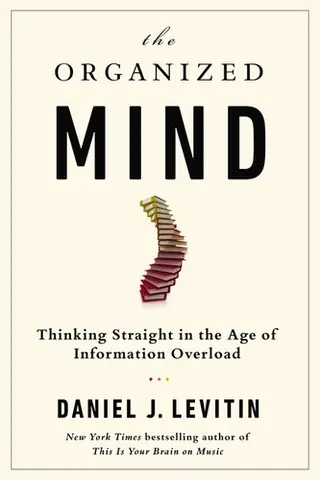
The Organized Mind
by Daniel J. Levitin · first published 2014
75% recommend25% neutral
Why HN recommends it
Explains how the brain handles attention, memory, and task switching, with practical strategies for managing information overload; useful to anyone wanting to change how they organize their time and notes.
Summarised by Claude from recommending comments
The information age is drowning us with an unprecedented deluge of data. At the same time, we’re expected to make more—and faster—decisions about our lives than ever before. No wonder, then, that the average American reports frequently losing car keys or reading glasses, missing appointments, and feeling worn out by the effort required just to keep up. But somehow some people become quite accomplished at managing information flow. In The Organized Mind, Daniel J. Levitin, PhD, uses the latest brain science to demonstrate how those people excel—and how readers can use their methods to regain
Affiliate links. As an Amazon Associate I earn from qualifying purchases.
Mentions per year
What Hacker News says
Related books
Thinking Fast and Slow by Daniel Kahneman
Gloria J. Russell
Recommended by 99 · mentioned by 14799 recommend · 147 mention99 recommend · 14799 recommend
 2012–2026
The Power of Habit
Charles Duhigg
Recommended by 127 · mentioned by 191127 recommend · 191 mention127 recommend · 191127 recommend
 2007–2026
The Wealth of Nations
Adam Smith
Recommended by 92 · mentioned by 40592 recommend · 405 mention92 recommend · 40592 recommend
My Name Is Red - Orhan Pamuk (I read it 2nd time) The Organized Mind - Daniel Levitin (Recommended) The Prophet - Kahlil Gibran (Recommended if you like the style) The Power of Habit (Not recommend it)
on “Ask HN: Books you read in 2018?” ↗…I thought about tail probabilities and risk taking + bar bell strategies in general 2. Thinking Fast and Slow - made me think about all of the biases that my mind has that I dont even realize 3. The organized mind - This book gave me a lot of ideas about how I can change my life to live with less distractions and maybe do thinks more efficently 4. The Vital Question - Made me realize how lucky we as humans and…
on “Ask HN: What books changed the way you think about almost everything?” ↗Nassim Taleb's books (Black swan, Antifragile, Fooled by Randomnesss) Thinking Fast and Slow The Organized Mind The Vital Question by Nick Lane. The Beginning of Infinity by David Deutsch
on “Ask HN: Mind bending books to read and never be the same as before?” ↗…brain sharp: 1. "Moonwalking with Einstein" by Joshua Foer - This book is about the science of memory and how to improve your memory through techniques like memory palaces and mnemonic devices. 2. "The Organized Mind" by Daniel Levitin - This book is about how to manage information overload and stay organized in the digital age. It covers topics like time management, decision making, and multitasking. 3. "Thinking,…
on “Ask HN: What Books helped you sharpen your brains?” ↗Antifragile by Taleb The Black Swan by Taleb Thinking Fast & Slow by Kahneman Guns, Germs, and Steel by Diamond The World According To Monsanto by Robin The Organized Mind by Levitin The Vital Question by Lane Life Ascending by Lane Chasing the Scream by Hari Anything By Gladwell.
on “Ask HN: What book have you given as a gift?” ↗A few off the top of my head: A book I often recommend is "The Organized Mind", by Dan Levitin. He focuses heavily on the prefrontal cortex – executive function, etc. But the takeaway for me was his analysis of how much it 'costs' the brain to context switch. "Flow" by Mihaly…
on “Self-Interruption and Distraction” ↗- Orhan Pamuk - My Name is Red (Nobel Prize Winner, 2006) - Daniel J. Levitin - Organized Mind - Shunryu Suzuki - Zen Mind, Beginner's Mind
on “Ask HN: Best books you read in the past decade?” ↗The Rise and Fall of American Growth Sapiens The Universe in a Single Atom Reality is not what it seems The Organized Mind The Power of Habit Zen Mind Beginners Mind Restoration Agriculture A Random Walk on Wall Street The Life Changing Magic of Tidying-up
on “Ask HN: Best books you read in the past decade?” ↗An interesting read on the subject, although not exclusively focused on multi-tasking, mostly US-centric and at times a bit wordy, is "The Organized Mind" (https://amzn.com/0147516315) by Daniel J Levin, a professor in Psychology. Among other things, he explains why multitasking seems rewarding: it "creates a dopamine-addiction feedback loop, effectively…
on “The Diminishing Returns of Multitasking” ↗…deck will usually not just tell me the information, but what book it came from, and often which page. I'm pretty diligent about careful note collation. I've definitely gotten better since I read "The Organized Mind", a book which was so enlightening for my persona that I built more than 1000 cards to remember as many of its concepts as I could. Regardless, I'm reading my previous comment and should admit that I'm…
on “Time is the only real currency we have” ↗This article, like other things I've read in books like "The Organized Mind", or the class "Learning How to Learn" is that learning for adults is usually difficult not because of reduced learning capacity, but instead individual behaviors, emotional regulation, and culture. Dr.…
on “When do we become unable to learn a language like a native speaker? (2018)” ↗If you want to get deep on this subject, I highly recommend "The Organized Mind" and "The Power of Habit". The Organized Mind really breaks down the cost of "task switching" and explores the brain's strengths, quirks, and weaknesses, and how strategies of highly effective people…
on “Deep Work: A welcome kick in the butt” ↗I have the same system going, and i started it right after reading The Organized Mind also. What a great book! - that never really gets hyped up.
on “Time is the only real currency we have” ↗I recently read "The Organized Mind". I didn't expect it to be a book on ethics, but it certainly did impact me that way, and caused me to alter an enormous number of faulty mental behaviors, and allowed me to see abuse in language. >…
on “Twitter hides Donald Trump tweet for “glorifying violence”” ↗…humans are doing. Readings from chatGPT: "Unconscious Decisions" by Nicole Branan "Thinking, Fast and Slow" by Daniel Kahneman "Blink: The Power of Thinking Without Thinking" by Malcolm Gladwell "The Organized Mind" by Daniel J. Levitin and the TLDR: "TL;DR AI today is more like the human unconscious mind: fast, data-driven, automatic, and opaque even to itself. But it doesn't reflect consciousness in the way…
on “Research Reveals How AI "Thinks" (It Doesn't)” ↗