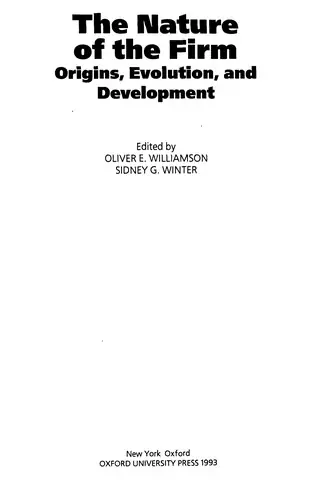
The nature of the firm
by Ronald Coase · first published 1991
37% recommend61% neutral1% critical
Why HN recommends it
Short, lucid 1937 paper explaining why firms exist: they cut the transaction costs of using markets, and stop growing when internal coordination costs more. Suits readers thinking about company size or remote work.
Summarised by Claude from recommending comments
"R.H. Coase in his 1991 Nobel Prize Lecture--included in this paperback edition--held that the importance of his 1937 article, "The Nature of the Firm," was "the explicit introduction of transaction costs into economic analysis," and described the future challenge to social scientists as the relentless "study of the world of positive transaction costs." This book develops that central emphasis and unifying theme from the Coasian research agenda. Book jacket."--BOOK JACKET.
Affiliate links. As an Amazon Associate I earn from qualifying purchases.
Mentions per year
What Hacker News says
Related books
Problem of Social Cost
R. H. Coase
Recommended by 7 · mentioned by 97 recommend · 9 mention7 recommend · 97 recommend
 2019–2026
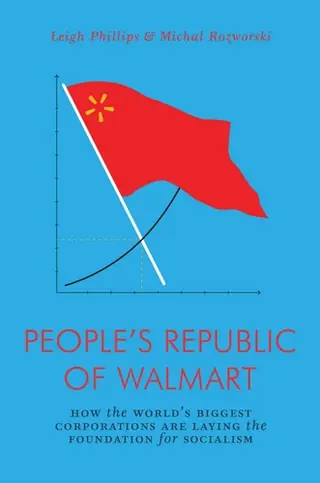
The People's Republic of Walmart
Leigh Phillips
Recommended by 12 · mentioned by 2312 recommend · 23 mention12 recommend · 2312 recommend
 2014–2026
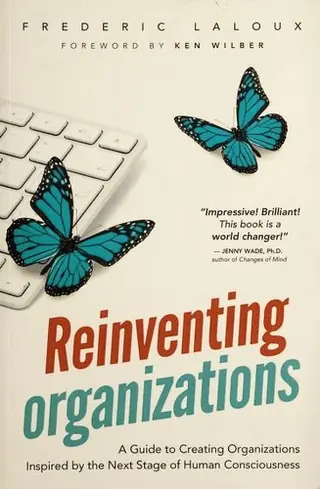
Reinventing Organizations
Frederic Laloux
Recommended by 26 · mentioned by 3826 recommend · 38 mention26 recommend · 3826 recommend
 2016–2026
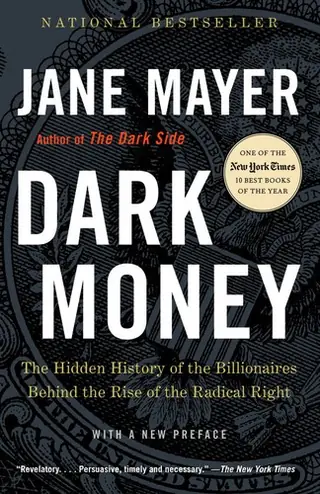
Dark Money
Jane Mayer
Recommended by 21 · mentioned by 3321 recommend · 33 mention21 recommend · 3321 recommend
 2011–2026
The Master Switch
Tim Wu
Recommended by 63 · mentioned by 9063 recommend · 90 mention63 recommend · 9063 recommend
 2011–2026
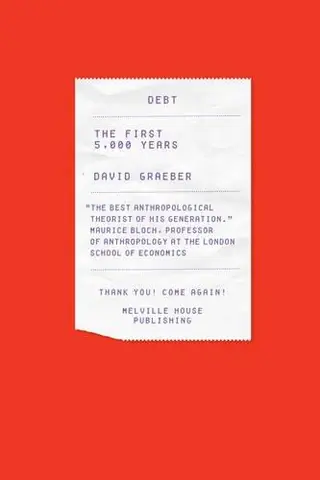
Debt
David Graeber
Recommended by 182 · mentioned by 303182 recommend · 303 mention182 recommend · 303182 recommend
Harry Potter
J. K. Rowling
Recommended by 55 · mentioned by 25555 recommend · 255 mention55 recommend · 25555 recommend
 2007–2026
Rainbows End
Vernor Vinge
Recommended by 112 · mentioned by 238112 recommend · 238 mention112 recommend · 238112 recommend
You might like Ronald Coase's "The Nature of the Firm". https://en.wikipedia.org/wiki/Theory_of_the_firm A business is a socialist command economy embedded in a market economy, which has odd boundary effects at the interfaces.
on “I took a job at Amazon, only to leave after 10 months” ↗reminds me of this classic Ronald Coase - The Nature Of The Firm, 20 pages http://onlinelibrary.wiley.com/doi/10.1111/j.1468-0335.1937.... summary http://en.wikipedia.org/wiki/The_Nature_of_the_Firm btw. great design!
on “Show HN: A place to buy and sell services directly from each other” ↗…can reduce transaction costs and replace firms with markets made up of smaller firms. A really interesting and accessible (but usually misinterpreted via soundbite) famous work in economics is ' The Nature of the Firm' by Ronald Coase. I think this is the best framework for understanding the key dynamic here. Whether employees or independent "contractors" make economic sense is most influenced by transaction costs.…
on “Uber Rush” ↗Oh I really would have liked to have talked to Coase, on your reference I tracked down his paper on the nature of the firm [1] and thought it was excellent. His point is a bit more nuanced than why firms exist but more why is it that markets can self organize and firms do not. The interesting thing is that historically it…
on “In the Future, Employees Won’t Exist” ↗Go read Ronald Coase's "The nature of the firm". And if your work _can_ be structured to minimize the transaction costs, you might as well go to a low-wage country rather than mess with a remote, medium-wage team. I worked with one company that had…
on “Ask HN: Pros and cons of working at a startup in 2018?” ↗…end in people naturally organizing in competent hierarchies, producing the dreaded institutions and middlemen that cryptocurrency tries to do away with. Read for this very question Coase's essay, The Nature of the Firm.
on “Full Ethereum blockchain now available as a BigQuery public dataset” ↗Coase's book The Nature of the Firm, which I read for some reason for pleasure while I was in grad school for a completely unrelated subject, stands out to me as one of the most elegant, lucidly-thought and well-presented books I've ever…
on “Economist's Theories Led to Carbon Trading – Ronald Coase Died Monday at Age 102” ↗Thanks for pointing this out. There are many strong opinions on this subject guided by little more than naïve intuition. Having an opinion on the nature of the firm without reading Coase is like having an opinion on externalities without reading Coase [1]. [1]: http://www.jstor.org/discover/10.2307/724810?uid=3739560&uid...
on “Firm Inefficiency” ↗There is an economics article I’ve brought up several times on HN. It has a lot of non obvious deep implications: “The Nature of the Firm' (1937), By Ronal Coase” It tries to answer the question of why companies exist rather than bilaterally trade of goods and services between individuals in a market. IE, if centralised economies are so…
on “Hard-won lessons about money and investing” ↗Coase won the Economics Nobel for his analysis of why and how firms organize. The Nature of the Firm[0] is still worth reading. The answer basically boils down to "transaction costs" and how they affect economic activity at different scales. [0] http://www3.nccu.edu.tw/~jsfeng/CPEC11.pdf
on “Valve Economist Yanis Varoufakis Appointed Finance Minister of Greece” ↗Do you think tax returns and complying with other bureaucracy is fun? There are myriad reasons why people form firms and a body of literature around it. Start with Coase's Nature of the firm : http://en.wikipedia.org/wiki/The_Nature_of_the_Firm
on “I quit the tech industry” ↗Read Ronald Coase's Nature of the Firm: http://www3.nccu.edu.tw/~jsfeng/CPEC11.pdf It isn't really that firms are communist internally, but that firms exist to reduce transactions costs. Such as contracting for every thing every day (i.e.…
on “Nest’s time at Alphabet” ↗This reminds me to re-read Coase's "The Nature of the Firm." 80 years old and still brilliant.
on “The Pop-Up Employer: Build a Team, Do the Job, Say Goodbye” ↗His original papers are as accessible as popular press. The big ones are “Nature of the Firm” and “The Problem of Social Cost.” For the 2nd one, Coase complained it is used to reach the opposite conclusion than he intended.^ http://onlinelibrary.wiley.com/doi/10.1111/j.1468-0335.1937.... http://home.cerge-ei.cz/ortmann/UpcesCourse/Coase%20-%20The%...…
on “The gig economy of the 18th Century” ↗"The Nature of the Firm" by Ronald Coase. He called it transaction costs. I ran across this while trying to grok one firm I worked at that managed thru over-governance, funding models, etc to maximize internal transaction…
on “Google AMP – A 70% drop in our conversion rate” ↗