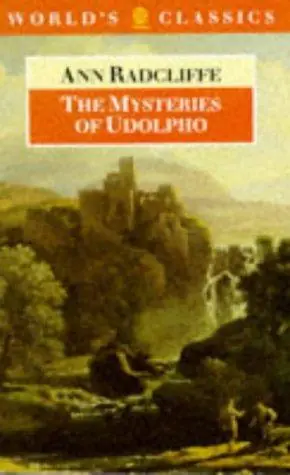
The Mysteries of Udolpho
by Ann Radcliffe · first published 1794
4mentions
0recommended by
4HN commenters
2021–2025first – last mentioned
100% neutral
The Mysteries of Udolpho (1794) is the archetypal Gothic novel. A young woman, Emily St. Aubert, suffers the death of her father, followed by worsening physical and psychological death, mirrored in a landscape of crumbling castles and emotive Alps.
Affiliate links. As an Amazon Associate I earn from qualifying purchases.
…"Ligeia" in 1838. By then, the Gothic genre was well under way, with Horace Walpole having published the classic The Castle of Otranto in 1764. Ann Radclife (the mother of the Gothic) had published The Mysteries of Udolpho in 1794 and it was already parodied by Jane Austen's Northanger Abbey in 1817, long before Poe even started writing any of his Gothic fiction. Science fiction has a very long history, and depending on…
on “Is Poe the most influential American writer? A new book offers evidence” ↗…Gutenberg first ruined a perfectly good wine press by spilling ink all over it. Nothing at all from the 18th century. Bypassing the 1700s titles that include Daniel Defoe, Robinson Crusoe; Ann Radcliffe, The Mysteries of Udolpho. Of course, the most obvious but expected bias is the inclusion of nearly no one outside of Western writers, writing in English. The exceptions are only in translation. Surely somewhere between the time…
on “Apex Books of Goodreads” ↗Thank you for the feedback. If anyone is wondering, the reason that Robinson Crusoe and The Mysteries of Udolpho are not "apex books" is that they are both dominated by the Iliad. * The Iliad by Homer (-700) — 432,847 ratings — 3.90 average * Robinson Crusoe by Daniel Defoe (1719) — 297,130 ratings — 3.68 average…
on “Apex Books of Goodreads” ↗In Northanger Abbey we get an explicit reference to one of those books, The Mysteries of Udolpho by Ann Radcliffe, which started the entire Gothic novel craze. Comparing the two is quite informative: Where Radcliffe describes the basic character traits over a page or two, followed by another page…
on “Jane Austen's Boldest Novel Is Also Her Least Understood” ↗