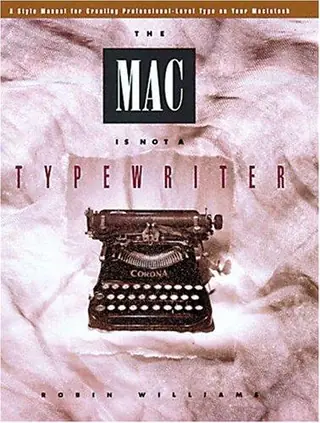
The Mac is not a typewriter
a style manual for creating professional-level type on your Macintosh
by Robin Williams · first published 1989
65% recommend29% neutral6% critical
Why HN recommends it
A short, example-driven primer on basic typography for computer writers, covering punctuation, spacing, quotes, and dashes. It is useful for non-designers and remains relevant to web type.
Summarised by Claude from recommending comments
Affiliate links. As an Amazon Associate I earn from qualifying purchases.
Mentions per year
What Hacker News says
Related books
 2013–2023
The PC is not a typewriter
Robin Williams
Recommended by 2 · mentioned by 42 recommend · 4 mention2 recommend · 42 recommend
 2008–2025
Programmers at work
Susan M. Lammers
Recommended by 19 · mentioned by 3619 recommend · 36 mention19 recommend · 3619 recommend
Practical Typography
Matthew Butterick
Recommended by 98 · mentioned by 11398 recommend · 113 mention98 recommend · 11398 recommend
 2008–2025
Time Management for System Administrators
Thomas Limoncelli
Recommended by 19 · mentioned by 2719 recommend · 27 mention19 recommend · 2719 recommend
 2007–2023
The Non-Designer's Design Book
Robin Williams
Recommended by 75 · mentioned by 8375 recommend · 83 mention75 recommend · 8375 recommend
 2011–2026
Ghost in the wires
Kevin D. Mitnick
Recommended by 63 · mentioned by 8663 recommend · 86 mention63 recommend · 8663 recommend
 2010–2026
The Chicago manual of style
University of Chicago Press Editorial Staff
Recommended by 19 · mentioned by 11219 recommend · 112 mention19 recommend · 11219 recommend
 2007–2026
The Elements of Style
William Strunk, Jr., E. B. White
Recommended by 131 · mentioned by 231131 recommend · 231 mention131 recommend · 231131 recommend
…tools to work with, like @font-face and lettering.js, but basic punctuation and formatting don’t get enough love. It’s an oldie, but I think everyone working with web type should read Robin Williams’ The Mac is not a typewriter [0]. It’s just as relevant to modern web type as it was to early desktop publishing. [0] http://www.amazon.com/Mac-not-typewriter-Robin-Williams/dp/0...
on “I wanna work at Instagram” ↗The book “the Mac is not a typewriter” (https://www.amazon.com/Mac-Not-Typewriter-2nd/dp/0201782634) may help get them some idea about style. It is 15 years old, targets print, and is aimed at Mac users, but that doesn’t matter that much.…
on “Five minute guide to better typography” ↗Oldies but goodies - The Mac is not a typewriter and Beyond the Mac is not a typewriter by Robyn Williams. It's not Mac-specific, and both have a lot of examples of how you can improve design. Fairly eye-opening if you're not used to having a design…
on “How can a programmer learn to design websites that don’t suck” ↗…pioneers. Interesting to see how they think and what they have in common. Time Management for System Administrators by Thomas Limoncelli. Short, easy read with lots of practical advice for all of us. The Mac is Not a Typewriter by Robin Williams. Very slim. Learn the difference between hyphens, en-dashes, and em-dashes. If you do product design you might enjoy a slow musing read through Apple's original Human Interface Guidelines.…
on “Ask HN: Good business or technology book recommendations?” ↗The Elements of Style by William Strunk and E. B. White The Language Instinct by Steven Pinker The Problem of Pain by C. S. Lewis The Mac Is Not a Typewriter by Robin Williams Getting Real by 37 Signals
on “Ask HN: What are your favorite non-fiction books of all time?” ↗…someone with whom I was having a regular discussion. OTOH, I used to overuse em dashes because the Mac made proper typesetting possible. It used to be the sign that someone had read the very useful The Mac is not a Typewriter by Robin Williams.
on “Dead Internet Theory” ↗All it takes to get accused of being AI nowadays is to remember and use (1) what you were taught about composition in your high school English class, and (2) what you learned from "The Mac is Not a Typewriter" [1]. [1] https://www.amazon.com/dp/0201782634
on “How to stop Claude from saying load-bearing” ↗…lots of famous computer pioneers. Very interesting to think about the remarks that appear again and again. Smart and Gets Things Done by Joel Spolsky will make you feel good about yourself. :-) The Mac is Not a Typewriter by Robin Williams is a nice bite-sized lesson on type. The original Human Interface Guidelines by Apple is a pretty interesting look back into what motivated them in those days, especially if you do…
on “Ask HN: What are some good, lightweight reads on computing?” ↗I was taught about the diaeresis way back in the 1970s in high school English. But I didn’t embrace it until the late 80s when I started writing with a Macintosh, and read “The Mac is Not a Typewriter,” a great little book. I've always liked typography and graphic design, and I enjoy anachronisms like ligatures, alternate letterforms, drop capitals, visual justification, latin phrases, and so on ad…
on “How Qualcomm shook down the cell phone industry for almost 20 years” ↗Anyone who read "The Mac is not a typewriter" — a fantastic book of the early computer age — likely uses em dashes.
on “ChatGPT Pro” ↗I learned em-dash from The Mac Is Not A Typewriter. From now on I'll keep the -- plain ASCII to hopefully avoid the backlash.
on “The consumption of AI-generated content at scale” ↗Include the Gen Xers who read The Mac Is Not A Typewriter in the 90s or were merely into fonts. Heck, anyone used to a word processor that automatically changes dash dash into em-dash. There’s a lot of us that knew how to use em-dash.
on “Why Vampires Live Forever” ↗If you read The Mac is Not a Typewriter in 1992—thus burning Option-Shift-hyphen into your typing patterns for life, along with a dogmatic love for serif body fonts—you're the real victim here.
on “It's Not Just X. It's Y” ↗…of writing in something like Readers Digest from the 1950s, and judge whether the conversational tone is worth emulating. Regardless, most opinions are probably influenced either by such books as The Mac is not a Typewriter or alternately by a high school typing class that was based on a curriculum for professional secretaries. There were still high schools into the 1990s that taught students about carbon paper. Even if…
on “Why two spaces after a period isn’t wrong – lies typographers tell about history” ↗...but Robin Williams told me the Mac is not a typewriter, and I assume that generalizes to Windows and Linux systems, so it is not clear to me why I would care what Mavis Beacon says.