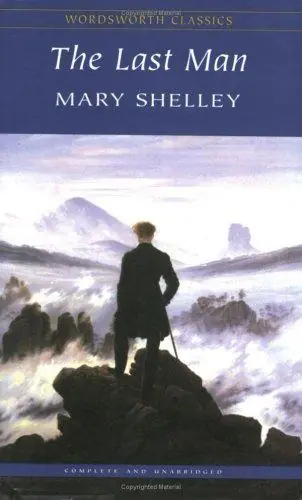
The Last Man
by Mary Shelley · first published 1826
67% recommend33% neutral
Mary Shelley, the author of [Frankenstein][1], wrote the apocalyptic novel The Last Man in 1826. Its first person narrative tells the story of our world standing at the end of the twenty-first century and - after the devastating effects of a plague - at the end of humanity. In the book Shelley writes of weaving this story from a discovery of prophetic writings uncovered in a cave near Naples. The Last Man was made into a 2008 film. [1]: http://openlibrary.org/works/OL450125W/Frankenstein
Affiliate links. As an Amazon Associate I earn from qualifying purchases.
Mentions per year
What Hacker News says
Related books
 2009–2026
Frankenstein
Mary Shelley, Bernie Wrightson, Stephen King
Recommended by 15 · mentioned by 5915 recommend · 59 mention15 recommend · 5915 recommend
 2007–2026
Stranger in a Strange Land
Robert A. Heinlein
Recommended by 97 · mentioned by 27797 recommend · 277 mention97 recommend · 27797 recommend
 2007–2026
Foundation
Isaac Asimov
Recommended by 143 · mentioned by 487143 recommend · 487 mention143 recommend · 487143 recommend
…neck. 4. It is also unclear how the monster was animated. There is no lightning rod and no "it's alive" moment. Frankenstein is at or near the top of many best of all time book lists. Shelly's The Last Man is also one of my favorites.
on “Review of annotated editions of Frankenstein” ↗I tend to rate Mary Shelley as the earliest sci-fi author. Not just for 'Frankenstein', but also for 'The Last Man'. I would strongly recommend tackling Issac Asimov's 'Foundation' series as one of the all time classics. Another pretty early one to take a look at is 'We' by Yevgeny Zamyatin. It was the first book…
on “Beginnings of Science Fiction” ↗…alternatives to them might be considered? Soft science fiction mixes rigorous speculation with other priorities but still takes it seriously. For example, long-range balloon travel in Mary Shelley's The Last Man is an atrophic and naive earnest extrapolation of the bleeding edge technology of the time that is clearly meant to establish that the tragic story is a vision of a far future (which, despite this little…
on “Science Fiction vs. Science Fantasy” ↗