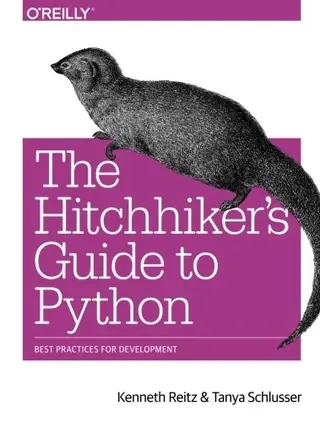
The Hitchhiker’s Guide To Python
Best Practices for Development
by Kenneth Reitz, Tanya Schlusser · first published 2016
93% recommend4% neutral4% critical
Why HN recommends it
Practical tour of the Python toolchain and best practices: virtual environments, project structure, PEP8 style, packaging, and web, database and CLI areas. Suits beginners and non-Python specialists setting up.
Summarised by Claude from recommending comments
Affiliate links. As an Amazon Associate I earn from qualifying purchases.
Mentions per year
What Hacker News says
Related books
Python Distilled
David M. Beazley
Recommended by 9 · mentioned by 109 recommend · 10 mention9 recommend · 109 recommend
 2012–2026
Effective Python
Brett Slatkin
Recommended by 22 · mentioned by 3322 recommend · 33 mention22 recommend · 3322 recommend
 2008–2024
Python Cookbook
Alex Martelli, David Ascher, David M. Beazley, Brian K. Jones
Recommended by 17 · mentioned by 3217 recommend · 32 mention17 recommend · 3217 recommend
 2015–2026
Automate the Boring Stuff with Python
Al Sweigart
Recommended by 75 · mentioned by 8175 recommend · 81 mention75 recommend · 8175 recommend
 2010–2026
Learn Python the Hard Way
Zed Shaw
Recommended by 246 · mentioned by 395246 recommend · 395 mention246 recommend · 395246 recommend
 2015–2026
Fluent Python
Luciano Ramalho
Recommended by 67 · mentioned by 8967 recommend · 89 mention67 recommend · 8967 recommend
 2008–2026
Dive into Python
Mark Pilgrim
Recommended by 94 · mentioned by 16194 recommend · 161 mention94 recommend · 16194 recommend
 2007–2026
Refactoring
Martin Fowler
Recommended by 94 · mentioned by 14594 recommend · 145 mention94 recommend · 14594 recommend
Jumping on the Kenneth Reitz train, you might check out The Hitchhiker's Guide to Python: http://docs.python-guide.org/en/latest/ He recommends the following Python projects for reading: * Howdoi (https://github.com/gleitz/howdoi) * Flask (https://github.com/mitsuhiko/flask) * Werkzeug (https://github.com/mitsuhiko/werkzeug) * Requests (https://github.com/kennethreitz/requests) * Tablib (htt
on “Ask HN: Good Python codebases to read?” ↗I suggest that you open up the doc source on github so that you can attract contributions from people while still maintaining editorial control. A good example is: python-guide.org -- http://docs.python-guide.org/en/latest/index.html
on “PHP: The Right Way” ↗Thanks everyone, the comments are much appreciated. Here's a list of books and other media resources recommended so far in the thread: Robert C. Martin, Clean code: https://www.amazon.com/Clean-Code-Handbook-Software-Craftsma... Vaughn Vernon, various: https://vaughnvernon.co/?page_id=168 Steve McConnell, Code Complete: https://www.amazon.com/Code-Complete-Practical-Handbook-Cons... 2 Clean c
on “Ask HN: How to transition from academic programming to software engineering?” ↗Have you tried 'The Hitchhiker's Guide to Python'? It strives to be exactly this -- a guide on installation, configuration, and usage of the Python runtime and development toolchain. http://docs.python-guide.org/en/latest/
on “At full speed with Python: a book for self-learners” ↗I have made the jump from writing academic code to working on a product where actual software engineering was encouraged. Although I did jump back to academia pretty quickly. Hitchhiker's Guide to Python is a very good book (freely available online, or get a copy from O'Reilly); some of it may be obvious but some might not be. It is true IMO that making your code testable will also make it better designed.…
on “Ask HN: How to transition from academic programming to software engineering?” ↗Has your current Python development setup failed you yet? Are Python versions preventing you from producing useful software? Are you looking to explore and experiment with setups, or is shipping useful software what counts? "The Hitchhiker’s Guide to Python"[^1] does a tour of the tools that would be very useful. Virtual environments, testing, frameworks, etc. [^1]: https://docs.python-guide.org
on “Ask HN: Simple but modern Python dev set-up?” ↗I'm not a python developer by trade, but here are some of the resources I have found helpful. The links below are in the order I would read them if I was starting again. Hitchhiker's Guide to Python - https://docs.python-guide.org/ * Setting up virtual environments * Structuring projects * Code style (PEP8) * Popular libraries for various use cases (i.e. Django/Flask for web applications) se
on “WTF Python: Exploring and understanding Python through surprising snippets” ↗There's the Hitchhiker's Guide to Python which has a lot of advice and covers best practices and/or projects over a number of big areas like web frameworks, databases, command line tools, etc.: https://docs.python-guide.org/
on “Python built-ins worth learning (2019)” ↗Requests: HTTP for Humans Lovely code and good documentation https://github.com/kennethreitz/requests Also checkout the Hitchhiker's Guide to Python http://docs.python-guide.org/en/latest/index.html
on “Where is excellent Python code?” ↗I like http://docs.python-guide.org/en/latest enough to point it out specifically (it's linked far down the page). Combined with PEP8, it's a fantastic stylistic resource.
on “Getting started with Python: Tips, Tools and Resources” ↗Kenneth Reitz's python-guide definitely is a great resource for project structures, workflows etc. http://docs.python-guide.org/en/latest/
on “Ask HN: Intermediate Python learning resources?” ↗I've found "The Hitchhiker’s Guide to Python" quite helpful: http://docs.python-guide.org/en/latest And if you're a Windows user wanting to use Python modules that are partly implemented in C, I recommend downloading them in binary form: http://www.lfd.uci.edu/~gohlke/pythonlibs
on “Ask HN: Python resources?” ↗If you are planning to enter Django world, it's always good to know Python well. The Hitchhiker’s Guide to Python![1] explains a number of Python related things which beginners(in my experience and opinion) generally either tend to overlook. You do not need to read it all at once. Chapters can almost be read independently and in no particular order. Secondly, go through Python Ecosystem - An Int
on “How to Tango with Django: A Python Django Tutorial” ↗Why not add these to the Python Guide [1]? When I'm learning/reading about something, I like big, comprehensive resources, especially if they cover the same topic, instead of hunting for small websites like this... [1]: http://docs.python-guide.org
on “Easy-Python: Libraries and Resources” ↗I'm relatively new to Python so I don't have anything that I've closely studied...mostly things I've bookmarked that have been submitted to HN. The attractiveness of Python to me is the huge scientific programming community behind it, plus its human-friendly syntax...if R was more readable by me, I'd prefer to work with just one language. So in terms of Python resources: - The classic NLTK book:
on “Introduction to Data Analysis in R” ↗