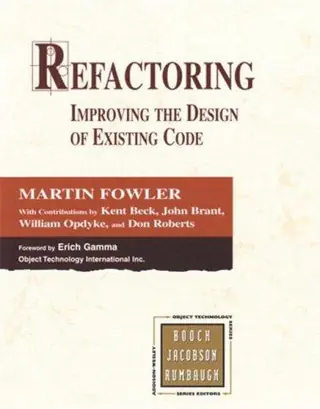
Refactoring
by Martin Fowler · first published 1999
65% recommend33% neutral2% critical
Why HN recommends it
Walks through concrete code examples being broken into smaller, reusable parts, teaching repeatable techniques for improving existing code and showing what good OO code looks like. Suits working developers.
Summarised by Claude from recommending comments
As the application of object technology--particularly the Java programming language--has become commonplace, a new problem has emerged to confront the software development community. Significant numbers of poorly designed programs have been created by less-experienced developers, resulting in applications that are inefficient and hard to maintain and extend. Increasingly, software system professionals are discovering just how difficult it is to work with these inherited, non-optimal applications. For several years, expert-level object programmers have employed a growing collection of technique
Affiliate links. As an Amazon Associate I earn from qualifying purchases.
Mentions per year
What Hacker News says
Related books
 2008–2026
Clean Code
Robert C. Martin
Recommended by 298 · mentioned by 739298 recommend · 739 mention298 recommend · 739298 recommend
 2007–2026
Code Complete
Steve McConnell
Recommended by 393 · mentioned by 669393 recommend · 669 mention393 recommend · 669393 recommend
 2007–2026
The Pragmatic Programmer
Andy Hunt, Dave Thomas
Recommended by 353 · mentioned by 589353 recommend · 589 mention353 recommend · 589353 recommend
 2009–2026
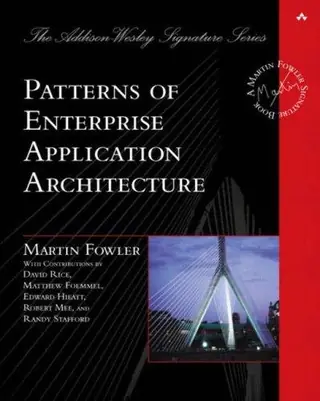
Patterns of Enterprise Application Architecture
Martin Fowler
Recommended by 34 · mentioned by 7634 recommend · 76 mention34 recommend · 7634 recommend
 2008–2026
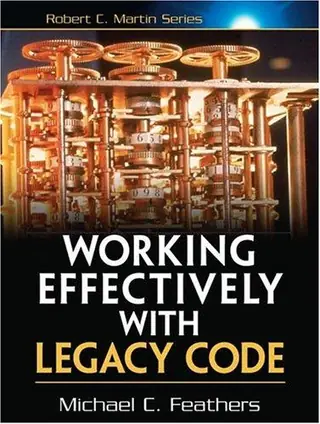
Working effectively with legacy code
Michael C. Feathers
Recommended by 186 · mentioned by 234186 recommend · 234 mention186 recommend · 234186 recommend
 2010–2023
Abstraction and specification in program development
Barbara Liskov
Recommended by 4 · mentioned by 54 recommend · 5 mention4 recommend · 54 recommend
 2010–2025
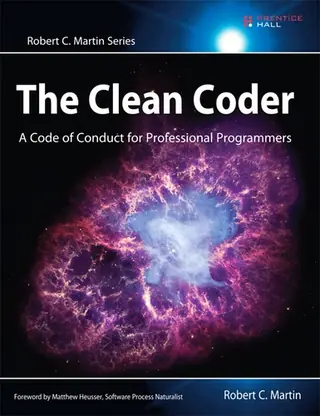
The clean coder
Robert C. Martin
Recommended by 53 · mentioned by 8553 recommend · 85 mention53 recommend · 8553 recommend
 2020–2021
A geometric approach to differential forms
David Bachman
Recommended by 1 · mentioned by 21 recommend · 2 mention1 recommend · 21 recommend
There's always the classics: https://www.amazon.com/Design-Patterns-Elements-Reusable-Obj... https://www.amazon.com/Refactoring-Improving-Design-Existing... EDIT: And it appears the website is a direct rip-off of these books.
on “Design Patterns and Refactoring” ↗Also, check out this refactoring book: http://www.amazon.com/Refactoring-Improving-Design-Existing-...
on “How does one learn about the latest advances in Computer Science (not fads) to apply and improve your work? ” ↗I cannot stress this enough: learn refactoring, http://www.amazon.com/Refactoring-Improving-Design-Existing-... You will simultaneously learn: - terminology and models relevant to software design and construction at every level - principles of…
on “Ask HN: When does programming start to make sense?” ↗…what object oriented programming means, then I'd recommend reading the Gang of Four book on Design Patterns (http://www.amazon.com/Design-Patterns-Elements-Reusable-Obje...) and Martin Fowler's book on Refactoring (http://www.amazon.com/Refactoring-Improving-Design-Existing-...). Those will give you a pretty good basis in software design and maintenance. In terms of recommended reading for learning a language,…
I think the best introduction to object oriented design is shown in the first chapter of Martin Fowler's book "Refactoring". He gives the example of a DVD rental shop that has to calculate the rental fee based on the type of DVD: - A New Release is $3 per day - A Children's DVD is $1.50 for three days, then $1.50 per day…
on “Goodbye, shitty "Car extends Vehicle" object-orientation tutorial” ↗Consider buying these books: http://www.amazon.com/Refactoring-Improving-Design-Existing-... http://www.amazon.com/Design-Patterns-Object-Oriented-Addiso...
on “Ask YC: What is "quality" code?” ↗Some books to read: http://www.amazon.com/Algorithm-Design-Jon-Kleinberg/dp/0321... http://www.amazon.com/Design-Patterns-Object-Oriented-Addiso... http://www.amazon.com/Refactoring-Improving-Existing-Addison... http://www.artima.com/shop/forsale
on “Ask YC: Study theory, or keep coding?” ↗Read Refactoring. http://www.amazon.com/Refactoring-Improving-Design-Existing-... In my view it is the single most important programming book in existence. Yes, other books will teach you other, incredibly important…
on “Books every self-taught computer scientist should read” ↗Refactoring: http://www.amazon.com/Refactoring-Improving-Design-Existing-... Read it. Learn it. Love it. Make it a habit that is so ingrained you do it automatically. Extract method: do it reflexively.
on “Tell, don't ask” ↗You'll want these: http://www.amazon.com/Working-Effectively-Legacy-Robert-Mart... http://www.amazon.com/Refactoring-Improving-Design-Existing-... http://www.bevmo.com/Shop/ProductDetail.aspx?ProductID=1282
on “I've inherited 200K lines of spaghetti code—what now?” ↗As the link by lttlrck also advocates: throwing shit out can easily be a mistake. More usually, http://www.amazon.com/Working-Effectively-Legacy-Michael-Fea... + http://www.amazon.com/Refactoring-Improving-Design-Existing-... can get you further, faster. Stuff keeps working while you incrementally improve it.
on “Top Surprises When Starting Out as a Software Developer” ↗"Refactoring: Improving the Design of Existing Code" http://www.amazon.com/Refactoring-Improving-Design-Existing-...
on “Ask HN: What's the best technical eBook you have read?” ↗I disagree with the premise that organizing code is not a recognized or appreciated skill among developers. At least not since this was published: http://www.amazon.com/Refactoring-Improving-Design-Existing-... Martin Fowler really struck a chord all the developers trying to do the right thing by cleaning up badly structured code, by giving the practice a name and explaining why…
on “Organizing complexity is the most important skill in software development” ↗…https://www.amazon.com/Clean-Code-Handbook-Software-Craftsma... https://www.amazon.com/Clean-Architecture-Craftsmans-Softwar... https://www.amazon.com/Patterns-Enterprise-Application-Archi... https://www.amazon.com/Refactoring-Improving-Existing-Addiso... https://www.amazon.com/Code-Complete-Practical-Handbook-Cons... https://www.amazon.com/Pragmatic-Programmer-Journeyman-Maste... https://www.amazon.com/Mythical-Man-Month-Software-Engineeri...…
on “Microsoft changed how it interviews software developers” ↗Refactoring by Martin Fowler is a great one https://www.amazon.com/Refactoring-Improving-Existing-Addiso... Design Patterns is also very well known https://www.amazon.com/Design-Patterns-Elements-Reusable-Obj...
on “Ask HN: How to learn best practices when you have no one to teach you?” ↗