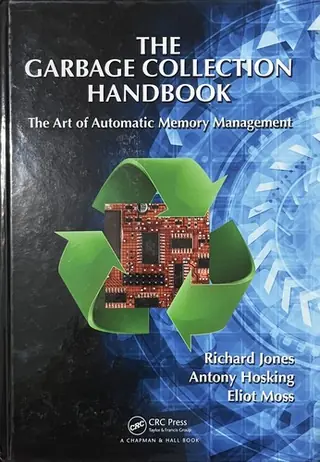
The garbage collection handbook
by Jones, Richard · first published 2012
68% recommend32% neutral
Why HN recommends it
Comprehensive, well-written reference on automatic memory management, covering tracing, reference counting, parallel and real-time collectors. Suits those building or studying GCs who want more depth than a single paper.
Summarised by Claude from recommending comments
Affiliate links. As an Amazon Associate I earn from qualifying purchases.
Mentions per year
What Hacker News says
Related books
 2009–2023
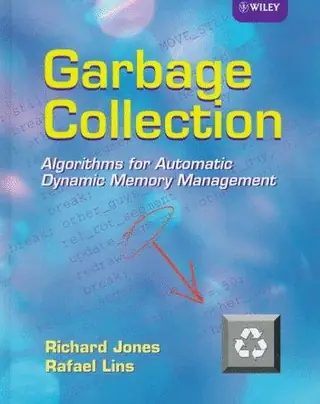
Garbage collection
Jones, Richard
Recommended by 6 · mentioned by 86 recommend · 8 mention6 recommend · 86 recommend
 2012–2026
The art of unit testing
Roy Osherove
Recommended by 12 · mentioned by 1712 recommend · 17 mention12 recommend · 1712 recommend
Art of Programming - Volume 3 - Answers to Exercises
Donald Knuth
Recommended by 6 · mentioned by 246 recommend · 24 mention6 recommend · 246 recommend
 2008–2025
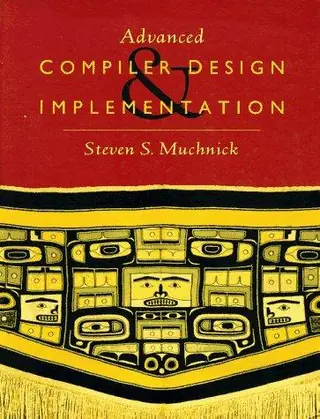
Advanced compiler design and implementation
Steven S. Muchnick
Recommended by 13 · mentioned by 2213 recommend · 22 mention13 recommend · 2213 recommend
 2010–2025
Language Implementation Patterns
Terence Parr
Recommended by 18 · mentioned by 2718 recommend · 27 mention18 recommend · 2718 recommend
The effective engineer
Edmond Lau
Recommended by 19 · mentioned by 2519 recommend · 25 mention19 recommend · 2519 recommend
 2007–2026
Engineering a compiler
Keith D. Cooper
Recommended by 39 · mentioned by 7139 recommend · 71 mention39 recommend · 7139 recommend
 2008–2026
Enterprise integration patterns
Gregor Hohpe, Bobby Woolf
Recommended by 23 · mentioned by 3223 recommend · 32 mention23 recommend · 3223 recommend
…You could write a decent GC with just the info in that paper. It doesn't cover parallel or real-time garbage collection (which both get far more complicated); for those, you want Jones et. al's _The Garbage Collection Handbook_ (http://www.amazon.com/The-Garbage-Collection-Handbook-Manage...) and plenty of time to explore its bibliography. (His older book is also good, but doesn't cover those topics.)
on “Rare Are GC Talks” ↗The bibliography stops in 2002. Here's a 2011 book that's sort of an advanced, vs. updated version of it's 1996 predecessor: http://www.amazon.com/The-Garbage-Collection-Handbook-Manage... It covers the recent state of the art up to it's publication (e.g. Azul's Pauseless but not C4).
on “The Memory Management Reference” ↗A few ones: "Algorithms and Data Structures" from Niklaus Wirth. "Introduction to Algorithms, 3rd Edition" from Thomas H. Cormen, Charles E. Leiserson, Ronald L. Rivest, Clifford Stein. "The Garbage Collection Handbook: The Art of Automatic Memory Management" from Richard Jones and Antony Hosking "Code Complete" from Steve McConnell "From Mathematics to Generic Programming" from Alexander Stepanov and Daniel Rose
on “Ask HN: What language-agnostic programming books should I read?” ↗…just the live stuff. Mark-compact for sure only touches live data which makes it efficient for functional langs (for some definition of 'efficient', I have questions). I'd recommend reading a book ('The Garbage Collection Handbook: The Art of Automatic Memory Management' 2nd edition, Richard Jones et al) before abusing GC. I actually agree with some of what you're saying but you need to say why. > It wastes time, it wastes space,…
on “For Better Computing, Liberate CPUs from Garbage Collection” ↗I would recommend the following: https://github.com/edubart/nelua-lang/wiki/Useful-Links-for-Research The Garbage Collection Handbook: The Art of Automatic Memory Management [1] [1] https://www.amazon.com/dp/0367659247
on “Ask HN: Best Books on the JVM?” ↗…decades of mostly imperative programming. Other books on lambda calculus, type theory, OCaml, Haskell, etc. preceded this in my reading list, but this book clinched my love of functional programming. The Garbage Collection Handbook by Richard Jones, Antony Hosking, and Eliot Moss provides broad, yet sufficiently detailed, coverage of automatic memory management that most techniques can be understood and implemented without digging…
on “Ask HN: Which books have made you a better thinker and problem solver?” ↗The Garbage Collection Handbook [http://gchandbook.org/] has a good overview of the advantages and disadvantages of reference counting as garbage collection. In summary, Advantages: A. Objects are collected immediately when they become garbage. B. Programming language runtime support is simpler. C. Memory can be reclaimed easily in programs with distributed heaps. Disadvantages: A. Natural
on “Swift 3.0 Unsafe World” ↗…keeping garbage around for longer, which means using a lot of memory. This ... is not at all how garbage collectors work, especially where real time is concerned. Not even remotely. I recommend "The Garbage Collection Handbook" (the 2011 edition) for a better overview. And ultra-low pause times are generally more of an opt-in feature, because they're rarely needed. [1] E.g. Herb Sutter's talk at C++Con 2016: https://www.youtube.com/watch?v=JfmTagWcqoE&t=16m23s
on “Concurrency in Swift: One possible approach” ↗It depends on your allocator - ptmalloc, the default linux allocator - is open source, and there's plenty of very robust open allocators (jemalloc, mimalloc, tcmalloc, etc). Understanding how your allocator works can be very important in certain contexts. On windows I'd expect the default allocator to be a black box, but I might be wrong. For garbage collection I strongly recommend this book (on
on “Before the iPhone, I worked on a few games for what were called "feature phones"” ↗"Garbage Collection" by Jones & Lins was, in my opinion, an excellent book back in the day: http://tinyurl.com/8lrveqm I noticed that Jones has a new book (The Garbage Collection Handbook) out now, which presumably is even better: http://tinyurl.com/8nl6con
on “Demystifying Garbage Collectors” ↗For those interested in additional technical details of high-performance garbage collection, the book cited (The Garbage Collection Handbook: The Art of Automatic Memory Management) is a fantastic reference. It's one of the best-written technical books I own, and distills much of the modern literature. If you need to do GC performance tuning…
on “Go 1.4+ Garbage Collection Plan and Roadmap” ↗For those lacking CS background, reference counting is an GC algorithm. The 5th chapter from "The Garbage Collection Handbook", http://gchandbook.org/, one of the most renowned books in the field, there are of course other equally renowned sources I can refer to.
on “Lazarus – A Delphi-compatible cross-platform IDE” ↗Yes, the main book which is recommended for the course is "The Garbage Collection Handbook". In addition one can read the "Garbage Collection: Algorithms for Automatic Dynamic Memory Management", but this one is specific to C++.
on ““Essentials of Garbage Collectors” full course is now available” ↗"It depends." There is no such thing as a singular "GC", tradeoffs are everywhere, and there are more relevant metrics than just average collection time. I recommend this paper from 1992 for an introduction of what types of GC techniques exist https://www.cs.rice.edu/~javaplt/411/15-spring/Readings/wils... It's good basic knowledge. If you get through that you might want to peruse more modern te
on “ZGC – What's new in JDK 16” ↗Unreal then, https://docs.unrealengine.com/4.26/en-US/ProgrammingAndScrip... Or you prefer anything written in DirectX or Metal? Chapter 5 from The Garbage Collection Handbook. https://gchandbook.org/contents.html
on “Driving with D” ↗