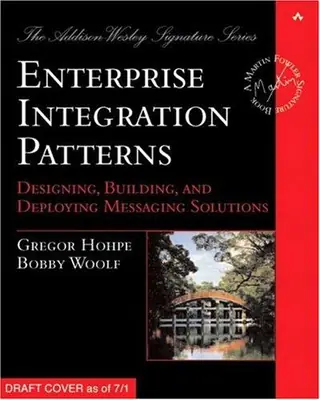
Enterprise integration patterns
by Gregor Hohpe, Bobby Woolf · first published 2003
72% recommend28% neutral
Why HN recommends it
Pattern catalog for messaging-based integration, covering channels, routers, publish/subscribe and dead letter handling. Useful for architects and engineers new to distributed systems.
Summarised by Claude from recommending comments
Affiliate links. As an Amazon Associate I earn from qualifying purchases.
Mentions per year
What Hacker News says
Related books
 2014–2026
Pattern-oriented software architecture
Frank Buschmann
Recommended by 6 · mentioned by 86 recommend · 8 mention6 recommend · 86 recommend
 2009–2026
Patterns of Enterprise Application Architecture
Martin Fowler
Recommended by 34 · mentioned by 7634 recommend · 76 mention34 recommend · 7634 recommend
 2007–2026
Domain-Driven Design
Eric Evans
Recommended by 104 · mentioned by 191104 recommend · 191 mention104 recommend · 191104 recommend
The effective engineer
Edmond Lau
Recommended by 19 · mentioned by 2519 recommend · 25 mention19 recommend · 2519 recommend
 2008–2025
Head First design patterns
Eric Freeman, Elisabeth Freeman, Kathy Sierra, Bert Bates
Recommended by 65 · mentioned by 10065 recommend · 100 mention65 recommend · 10065 recommend
 2012–2026
The art of unit testing
Roy Osherove
Recommended by 12 · mentioned by 1712 recommend · 17 mention12 recommend · 1712 recommend
 2009–2025
Dynamics of software development
McCarthy, Jim
Recommended by 10 · mentioned by 1610 recommend · 16 mention10 recommend · 1610 recommend
 2013–2024
Naked Statistics
Charles J. Wheelan
Recommended by 7 · mentioned by 157 recommend · 15 mention7 recommend · 157 recommend
…This isn't about programming. It's about architecture, in the build-a-building sense. It studies what happens to buildings over the course of their lives, as opposed to just when they're first built. Enterprise Integration Patterns, by Gregor Hohpe and Bobby Woolf. Learn how to use message queues and service busses correctly. Honestly, just read the first couple of chapters (65 pages or so), and the rest is reference, to look up…
on “Ask HN: What language-agnostic programming books should I read?” ↗Enterprise Patterns is a classic, that alone redeems the man's non-hackish career. P.S. I also enjoyed Enterprise Integration Patterns by Hohpe and Woolf.
on “Unit testing in Coders at Work” ↗…selections on the first page of the SO thread. I didn't drill down any further, but there was some good stuff there. Of the ones I didn't see, I'd throw out: The World Is Flat - Thomas L. Friedman Enterprise Integration Patterns - Gregor Hohpe & Bobby Woolf Thinking in C++ - Bruce Eckel
on “What is the single most influential book every programmer should read?” ↗Enterprise Integration Patterns: http://www.amazon.com/Enterprise-Integration-Patterns-Design... http://www.eaipatterns.com/ Covers stuff like: RPC, messages, channels, etc.
on “Ask HN: Books on network programming patterns?” ↗…Evan's "Domain-driven design", or Martin Fowler's "Patterns of Enterprise applicaton architecture". As for some specific styles, try typesafe's manifesto and description of reactive applications, Hohpe's "Enterprise Integration patterns" for pipes-and-filter architectures, and anything by Stefan Tilkov (https://www.innoq.com/blog/st/) for REST.
on “Ask HN: What is the best resource to learn about software architecture?” ↗Your #2 is drastic. Your #1, reasonable, and Martin Fowler is your friend [1][2]. [1]: http://www.martinfowler.com/articles/enterprisePatterns.html [2]: http://www.amazon.co.uk/Enterprise-Integration-Patterns/dp/8... [edit: beefed up]
on “Ask HN: I have a mental block designing software. Time to quit?” ↗…info there. I'm not aware of any textbooks on ES per se but there are a few good books on areas that overlap. [2] [3] [4] [1] https://groups.google.com/forum/#!forum/dddcqrs [2] https://www.amazon.com/Enterprise-Integration-Patterns-Desig... [3] https://www.amazon.com/Implementing-Domain-Driven-Design-Vau... [4] https://www.amazon.com/Domain-Driven-Design-Tackling-Complex...
on “Why Are People into Event Sourcing?” ↗…reference, but they're good for lending out to people, especially junior devs). Reference: - Effective Java (good for learning the mindset of developing backward-compatible APIs in any language) - Enterprise Integration Patterns (I work on an enterprise APIs team) - Designing Data-Intensive Applications - Camel in Action Good for lending out: - The Phoenix Project - Making Work Visible - Effective DevOps - The Pragmatic…
on “Ask HN: What books do you keep on your desk?” ↗If you're going to dive into CQRS/ES, I'd recommend: * Enterprise Integration Patterns (basically an entire book about messaging architectures) [1] * Vaughn Vernon's books and online writing [2], * Domain Driven Design by Eric Evans [3], * and most of what Greg Young, Udi Dahan, and that…
on “Kafka, GDPR and Event Sourcing” ↗…There are other, much more common patterns such as send/receive and publish/subscribe. Exploring these patterns opens up whole new approaches to software design. I wholeheartedly recommend the book [Enterprise Integration Patterns](https://www.enterpriseintegrationpatterns.com/) by Gregor Hohpe and Bobby Woolf. It's quite old now but is still the best and most complete introduction to asynchronous design. An alternative perspective…
on “Microservices Circuit-Breaker Pattern Implementation: Istio vs. Hystrix” ↗Not an article, but a book: "Enterprise Integration Patterns: Designing, Building, and Deploying Messaging Solution" by Hohpe and Woolf (You don't need to read all the patterns in detail; reading the overview will be enough to get you a pretty good idea. You only…
on “Software Architecture Guide” ↗…books I really like are The Design of Everyday Things by Don Norman, it is a good read and lets you talk to a lot of UX'ers as I have found more than a few that have used this book for their thesis. Enterprise Integration Patterns by Gregor Hohpe and Bobby Woolf, which is old but in world of streaming procesing a lot of the patterns can be reused. The Site Reliability Engineering books or their free counter parts found on https://landing.google.com/sre/books/…
on “Ask HN: What is the best money you have spent on professional development?” ↗…to buy some proper books to get familiar with well written design patterns. Classics are "Design Patterns" from the Gang of Four (GoF), "Pattern-Oriented Software Architecture" by Buschmann et al. or "Enterprise Integration Patterns" by Hophe and Woolf which patterns are partly available on the website https://www.enterpriseintegrationpatterns.com/. The first two books I consider almost a must read. Actually it's not about reading…
on “Ask HN: Best way to learn design patterns?” ↗Patterns of Enterprise Application Architecture, Martin Fowler, and Enterprise Integration Patterns, Gregor Hohpe. both predate microservices, and both are still very useful today.
on “Ask HN: What are good books on SW architecture that don't sell microservices?” ↗If you're also interested in Software Architecture (at least the high-level), then I can also recommend https://architectelevator.com/book/ by Gregor Hohpe (who also wrote another long-time classic: Enterprise Integration Patterns). Another one I found very helpful is Designing Data-Intensive Applications by Martin Kleppmann.
on “Ask HN: What books should I read to improve as a software engineer?” ↗