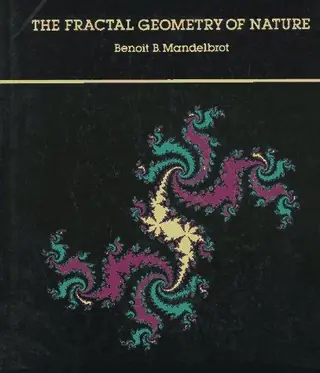
The fractal geometry of nature
by Benoît B. Mandelbrot, Josep Maria Llosa · first published 1982
16mentions
8recommended by
15HN commenters
2012–2025first – last mentioned
53% recommend47% neutral
Why HN recommends it
An accessible, image-rich tour of fractal ideas in nature, written for non-mathematicians. Readers value its colour plates and broad ideas on self-similar shapes, suiting curious readers and those exploring complexity.
Summarised by Claude from recommending comments
Affiliate links. As an Amazon Associate I earn from qualifying purchases.
Perhaps 'intriguing' is the better term. I'd implore everyone to spend a few rainy weekends trudging through Mandelbrot's 'The Fractal Geometry of Nature'[1] and Wolfram's 'A New Kind of Science'[2]. Both are rather terse, but I found both added a whole new depth of analogy in the way I see the Universe(s). It's easy to be dismissive of Stephen Wolfram…
on “The game of life emulated in the game of life” ↗…can easily find them, often along with reviews that help to decide which one is the right choice. For papers and journals I find this significantly harder. As an example, I recently read Mandelbrot's "Fractal Geometry of Nature" and really enjoyed it. I am sure there are many groups researching the mathematical properties of structures found in (living) nature (think patterns in fungi growth, selfoptimization of bone structure…
on “Ask HN: How do you find interesting research papers to read as a hobby?” ↗you might be interested in "the fractal geometry of nature" by benoit mandelbrot.
on “Google Earth Fractals” ↗You should read Mandelbrot’s book “the fractal geometry of nature.” He talks quite a bit about ideas like this. It’s written with the intention that non mathematicians can read and understand the ideas too which is kind of neat.
on “Fractional Brownian Motion for Terrain Generation” ↗causality, by judea pearl a pattern language, by christopher alexander maps of meaning, by jordan peterson on intelligence, by jeff hawkins the fractal geometry of nature, by benoit mandelbrot ^^^ a crash course in cognitive architecture for AI folks
on “What's your favorite technical book to read during this time of home quarantine?” ↗I also had to convince my parents to buy me books about fractals. My prized possession as a 15 year old was a copy of Mandelbrot's "Fractal Geometry of Nature". A lot of it went over my head but it had some gorgeous colour plates and interesting sections. I still have it at home some 35 years later. That also inspired me to write IFS code for ferns, Sierpinski…
on “Show HN: Beyond Z²+C, Plot Any Fractal” ↗If this stuff interests you there is a nice book called the fractal geometry of nature that has some interesting techniques. http://www.amazon.com/Science-Fractal-Images-Heinz-Otto-Peit...
on “Terrain Generation with Midpoint Displacement” ↗I will try getting through Goodfellows ‚Deep Learning‘ book, the maths for ML book: https://mml-book.github.io/ and the classic ‚The Fractal Geometry of Nature‘. I’m also listening to various audiobooks, but these are much easier to get through in bulk than books I’ve actually got to sit down and read for like the above.
on “Ask HN: Books you plan to read in 2020?” ↗Hello Jordan, have you read that book and would you recommend it over "The Fractal Geometry of Nature by Benoit Mandelbrot (1982) [1]? I'm asking because I bought the latter and would like to know if this book provides more recent information on the topic. Thank you. -- [1] http://www.amazon.com/Fractal-Geometry-Nature-Benoit-Mandelb...
on “The Algorithmic Beauty of Plants (1990)” ↗…really fascinating for anyone who is interested in the relationships between mechanistic generation and biological/natural artifacts. For me, this book fits in the same family as Benoit Mandelbrot's "The Fractal Geometry of Nature", and Ulf Grenander's work on stochastic models for the generation of shapes like hands. And see also, cellular automata.
on “Evolving Lindenmayer Systems” ↗…stop thinking about the crazy new ideas this injected into me and suspect that I'm probably becoming a numberphile. Interestingly, I was just reading the Book (hardcover) with the recursive Title: "The Fractal Geometry of Nature" by Benoit Mandelbrot. And this brings an entirely new meaning into my world view after combining the ideas behind this and http://en.wikipedia.org/wiki/Multifractal_analysis#technique...
on “The Sierpinski triangle page to end most Sierpinski triangle pages” ↗Midpoint displacement is mentioned in The Science of Fractal Images (and the Beauty of Fractal Images), and also in Mandelbrot's book Fractal Geometry of Nature. From a phone, sorry about upside down: http://m.imgur.com/JGCpnIu A snippet from "Science of Fractal Images"
on “2D Terrain generation using midpoint displacement” ↗There was even a whole pop-sci book -- Hubbard's "The World According to Wavelets" (1996) that was a bit like Mandelbrot's "The Fractal Geometry of Nature" in that it predicted an amazing future for the technique and claimed that science would be revolutionized by it. But it is nice to see that wavelets, like fractals, do have their uses even if the revolution…
on “Wavelets (1994) [pdf]” ↗…Langton's Ant (1986) https://en.wikipedia.org/wiki/Langton%27s_ant Avida (1993) https://en.wikipedia.org/wiki/Avida Tierra (early 1990s) https://en.wikipedia.org/wiki/Tierra_(computer_simulation) Fractal Geometry of Nature (1982) https://en.wikipedia.org/wiki/The_Fractal_Geometry_of_Nature I dunno, some of these seem to be doing it much earlier than 2002.
on “A New Kind of Science: A 15-Year View” ↗…regularly put discarded books in a cart in front of the library with a money box, so you could just take a book and put one or two euros in the box. Among other things I got a copy of Benoit Mandelbrots "The fractal geometry of nature" which I still treasure to this day.
on “Discarded delights: The joy of ex-library books (2021)” ↗